
Penny Dreadfuls, 1867 · page 206 of 300
Roving Jack, The Pirate Hunter — page 206: what you’re looking at
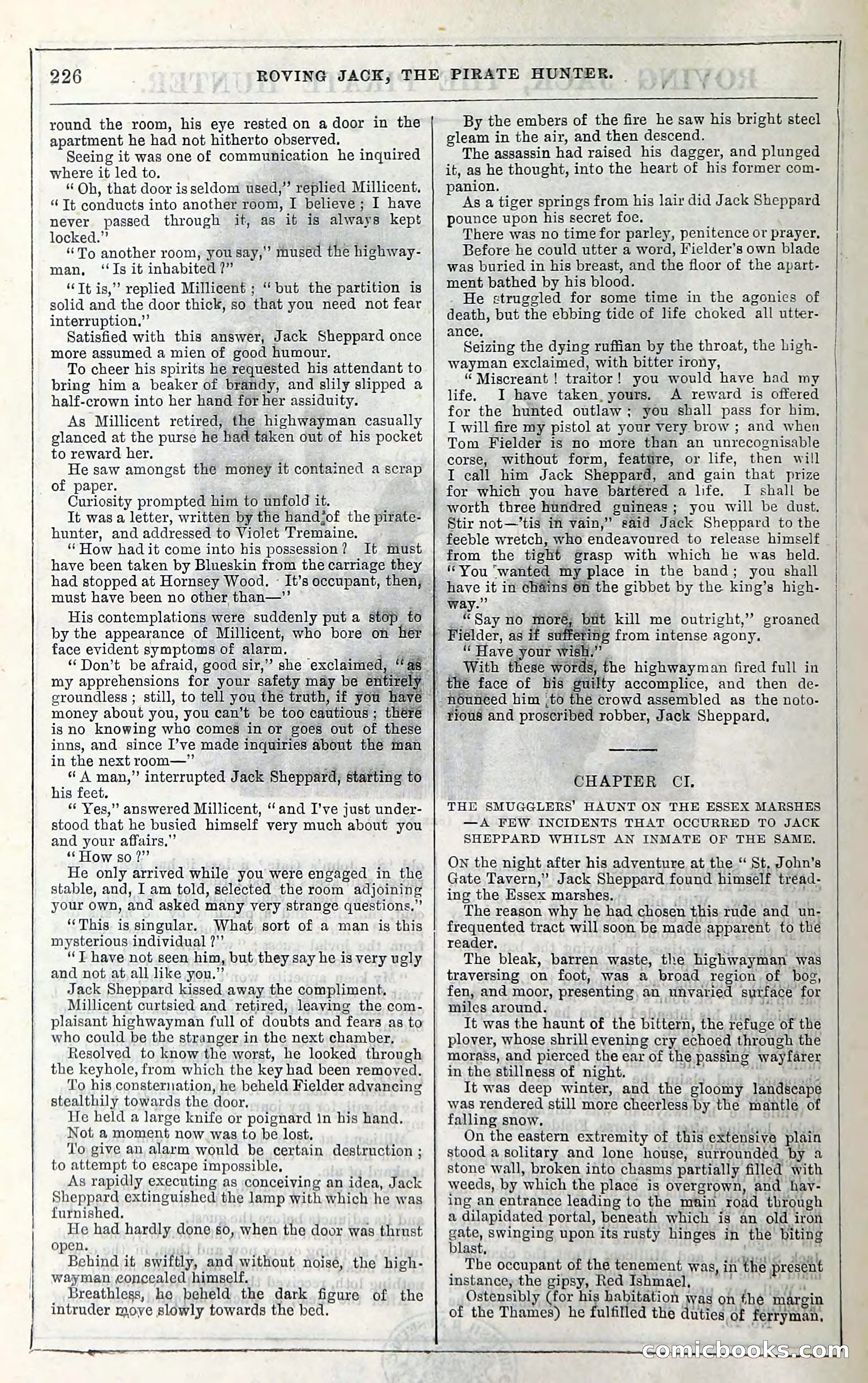
A restored page from Penny Dreadfuls, 1867. Page through the whole issue in the reader above.
📄 Transcribed text from this page (OCR, searchable)
Machine-transcribed from the original scan — historical spelling and the odd misread are preserved.
226 ROVING JACK, THE PIRATE HUNTER. 7 , Se SS ee round the room, his eye rested on a door in the apartment he had not hitherto observed. ; Seeing it was one of communication he inquired where it led to. “Oh, that door isseldom used,” replied Millicent. “Tt conducts into another room, I believe; I have never passed through it, as it is always kept locked.” is ‘To another room, you say,” mused the highway- man, ‘Is it inhabited ?” “Tt is,” replied Millicent ; ‘‘ but the partition is solid and the door thick, so that you need not fear interruption.” Satisfied with this answer, Jack Sheppard once more assumed a mien of good humour. To cheer his spirits he requested his attendant to bring him a beaker of brandy, and slily slipped a half-crown into her hand for her assiduity. As Millicent retired, the highwayman casually glanced at the purse he had taken out of his pocket to reward her, He saw amongst the money it contained a scrap of paper. Curiosity prompted him to unfold it. It was a letter, written by the handjof the pirate- hunter, and addressed to Violet Tremaine. “How had it come into his possession? It must have been taken by Blueskin from the carriage they had stopped at Hornsey Wood. - It’s occupant, then, must have been no other than—”’ His contemplations were suddenly put a stop to by the appearance of Millicent, who bore on her face evident symptoms of alarm. “Don’t be afraid, good sir,” she exclaimed, “as | my apprehensions for your safety may be entirely croundless ; still, to tell you the truth, if you have | money about you, you can’t be too cautious; there isno knowing who comes in or goes out of these inns, and since I’ve made inquiries about the man in the next rrom—”’ Be “ A man,” interrupted Jack Sheppard, starting to his feet. ‘“‘ Yes,” answered Millicent, “and I’ve just under- stood that he busied himself very much about you and your affairs,” “‘ How so ?”’ He only arrived while you were engaged in the stable, and, I am told, selected the room adjoining your own, and asked many very strange questions,” “This is singular. What sort of a man is this mysterious individual ?”’ ‘‘T have not seen him, but they say he is very ugly and not at all like you.” Jack Sheppard kissed away the compliment, Millicent curtsied and retired; leaving the com- plaisant highwayman full of doubts and fears as to who could be the stranger in the next chamber, Resolved to know the worst, he looked through the keyhole, from which the key had been removed. To his consternation, he beheld Fielder advancing stealthily towards the door. He held a large knife or poignard 1n his hand. Not 4 moment now was to be lost. ‘l'o give an alarm would be certain destruction ; to attempt to escape impossible, As rapidly executing as conceiving an idea, Jack Sheppard extinguished the lamp with which he was furnished. He had hardly done,so, when the door was thrust open. ' Behind it swiftly, and without noise, the high- wayman concealed himself. Breathless, he beheld the dark figure of the intruder move slowly towards the bed. By the embers of the fire he saw his bright steel gleam in the air, and then descend. The assassin had raised his dagger, and plunged it, as he thought, into the heart of his former com- panion. As a tiger springs from his lair did Jack Sheppard pounce upon his secret foe. There was no time for parley, penitence or prayer, Before he could utter a word, Fielder’s own blade was buried in his breast, and the floor of the apart- ment bathed by his blood. . He struggled for some time in the agonies of death, but the ebbing tide of life choked all utter- ance. Seizing the dying ruffian by the throat, the high- wayman exclaimed, with bitter irony, “ Miscreant ! traitor! you would have had my life. I have taken, yours. A reward is offered for the hunted outlaw; you shall pass for him, I will fire my pistol at your very brow ; and when Tom Fielder is no more than an unrecognisable corse, without form, feattre, or life, then will I call him Jack Sheppard, and gain that prize for which you have bartered a life. I shall be worth three hundred guineas; you will be dust. Stir not—’tis in vain,” said Jack Sheppard to the feeble wretch, who endeavoured to release himself from the tight grasp with which he was held. ‘You ‘wanted my place in the band; you shall have it in chains 6n the gibbet by the king’s high- way.” _ “Say no moré, but kill me outright,’ groaned Fielder, as if suffering from intense agony. “ Have your wish,” With these words, the highwayman fired full in the face of his guilty accomplice, and then de- nounced him {to the crowd assembled as the noto- tious and proscribed robber, Jack Sheppard, CHAPTER CI. THE SMUGGLERS’ HAUNT ON THE ESSEX MARSHES —A FEW INCIDENTS THAT OCCURRED TO JACK SHEPPARD WHILST AN INMATE OF THE SAME. ON the night after his adventure at the ‘‘ St, John’s Gate Tavern,” Jack Sheppard found himself tread- ing the Essex marshes. ie. The reason why he had chosen this rude and un- frequented tract will soon be made apparent to the reader, ‘oe The bleak, barren waste, the highwayman was traversing on foot, was a broad region of bos, fen, and moor, presenting, an uhvaried surface for miles around. Le STA It was the haunt of the bittern, the refuge of the plover, whose shrill evening cry echoed through the morass, and pierced the ear of the passing wayfarer in the stillness of night. pay Peet... It was deep winter, and the gloomy landscape was rendered still more cheerless by the mantle of falling snow. SON On the eastern extremity of this extensive plain stood a solitary and lone house, surrounded by a stone wall, broken into chasms partially filled with weeds, by which the place is overgrown, and hav- ing an entrance leading to the main road through a dilapidated portal, beneath which is an old iron gate, swinging upon its rusty hinges in the’ biting ast, | | taal The occupant of the tenement was, in the present instance, the gipsy, Red Ishmael, § © ||” Ostensibly (for his habitation was on the margin of the Thames) he fulfilled the duties of ferryman,