
Penny Dreadfuls, 1867 · page 163 of 300
Roving Jack, The Pirate Hunter — page 163: what you’re looking at
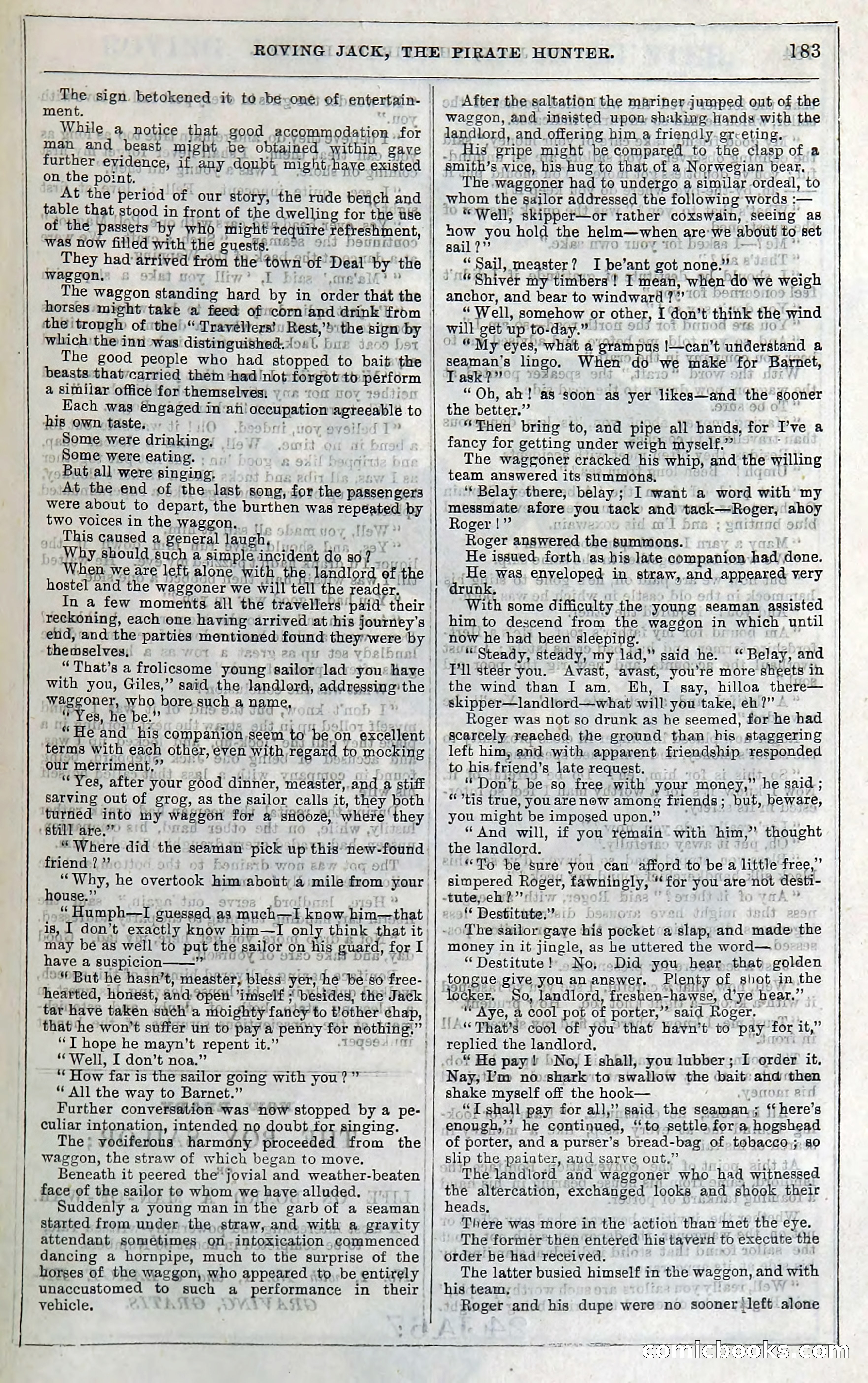
A restored page from Penny Dreadfuls, 1867. Page through the whole issue in the reader above.
📄 Transcribed text from this page (OCR, searchable)
Machine-transcribed from the original scan — historical spelling and the odd misread are preserved.
—_- rd ROVING JACK, THE! PIRATE, HUNTER. The: sign. betokened-it to -bé-one; of entertain- _ ment. re While. 4, notice that..good accommodation for man and beast might be obtained within, gave further evidence, if any doubt might.t aye existed on the point. Aig a Nieto Phe At the period of our’ story, the rude betich and table that, stood in front of the dwelling for the use of the was now filled with the guests.°°" They had arrived from the téwnof D ee ng TEE LT bi ' passers by who’ NSsCHMwso9 waggon. ef ba Stew 5 reel The waggon standing hard by in order that the horses might’ take a the trough of ‘the! Travélers? : Rest,’» the sigm by which'the inn was distinguished.toel fur ie09 bet The good people who had stopped to bait the beasts thatcarried them ‘had !not forgot to pérform a similar office for themselves; »«* tom vo y 290 h1¢ _Hach was engaged in aii! occupation agreeable to Ris onmotasteny: JF 1410 bsohat woy evelfod T» Some were drinking; Some were eating. ¥: But'all were slinging; ce edi ner | At, the end of the-last, song, for the passengers rr. ry tle were about to depart, the burthen was repeated by two voices in the WASZODe tho fm cy _ This caused a general laugh,, Why should such a simple incident do. sof : When we are left, alone with the landlord of the hostel and the waggoner we will tell the reader. ‘ \ “rer In a few moments all thé travellers paid’ their ‘Teckoning, eachione having arrived at this journey's end, and the parties mentioned found theywere by themselves, Bs Nea qy Joa yoslbaa! “ That’s a frolicsome young sailor lad you have. with you, Giles,” said. the landlord, addressing the | waggoner, who boresuch aname, _ . F DUMERCE SOND GC. ne ey ae ERD: ee, _ “He and his companion seem to be.on excellent RW se ADS SPr jn ma JO Pil bis iJ } terms with each other, even with regard to mocking our merriment,” , Kar. se crn AS ant ~ “Yes, after your good dinner, measter, and a stiff sarving out of grog, as the sailor calls it, they both turned into my Waggon for a° sidozé; Where ‘they ‘KilPteio acd furso asdto oft no .olidw yl | 5 “Where did the seaman pick up this new-found friend?” OCTSD wow ef “Why, he overtook him about a mile from) your house,”’ : : _ Humph-—I guessed as much—I know, him—that Js, I don’t exactly know him—I only think that it, may be as well’ to put the sailor on his guard, for I have g-suspicion——=—="—— ee ee | SP Bat he hasn’t; meastery bless: yer; he We so free- heatted, honest, and open imself + besides) the Jatk tar have takén such’ a moighty fancy to #other chap, that ‘he won’t suffer un to pay a penny for nothing.” ‘“‘T hope he mayn’t repent it.” ASCs “Well, I don’t noa.”’ ‘“ How far is the sailor going with you?” “ All the way to Barnet.” Further conversation “was now stopped by a pe- culiar intonation, intende no doubt for singing. The* yo¢iferous harmony proceeded from the’ waggon, the straw of which began to move. Beneath it peered the*jovial and weather-beaten face of the sailor to whom we have alluded. Suddenly a young man in the garb of a seaman’ started from under the, straw, and with a gravity attendant sometimes on,.intoxication .cammenced dancing a hornpipe, much to the surprise of the horses of the waggon, who appeared «to. be entirely unaccustomed to such a performance in their vehicle. mw SVAV AAD 5 ! ss) 6 might tequire'réfreshment, eal ‘by the feed of tcorn'iand drink from © — CS eS 183 After the saltation the mariner jumped ont; of the waggon, and. insisted upon shaking. hands with the landlord, and offering him_a friendly. grceting. _ dis gripe might be compared to the clasp ofa smith’s vice, his hug to that of a Norwegian bear. _ The waggoner had to undergo a similar ordeal, to whom the sailor addressed the following words :— ’ “ Well} skipper—or rather coxswain, seeing as now you hold the helm—when are we about to set sail?” ae 0 IWOY 10r Does t—! _ “Sail, measter? I be’ant got none.”’* ~~ “ Shiver my timbers! 1 mean, won do we weigh anchor, and bear to windward ??) 0) °°" 7 9&9 99 “ Well, somehow or other, { don’t’ think the’ wind Will géup to-day." 104 983 tot Datod st Jo / “My eyés, what agrampus !|—can’t understand a seaman’s lingo. When 'do''we make’ for’ Barnet, Task p07 1928: ala Bs “Oh, ab! as‘soon as the better.” “'*'Then’ bring to, and pipe all hands, for I’ve a fancy for getting under weigh myself.” The waggoner cracked his whip, and the willing team answered its summons, | apd ‘Belay there, belay; I owant a word with my messmate’ afore you' tack and tack—Roger, ‘ahoy Roger |” ie) id oT bre ; ynttond osid Roger answered the summons. : yas * He issued, forth as his late companion had done. __ He was. enveloped in straw, and appeared very ‘drunk, | ! ) With some difficulty the young seaman assisted him to descend from the waggon in which until now he had been sleeping. ~~ : “Steady, steady, my lad,” said he. “Belay, and I'll steer ‘you. Avast, avast, you’re more sheets in the wind than I am. Eh, I say, hilloa there— skipper—landlord—what will you take, eh?” Roger was not so drunk as he seemed, for he had scarcely reached, the ground’ than his staggering left him, and.with apparent friendship. responded to his friend’s late request. | _* Don’t beso yer likes—and the’ sooner free with your money,” he said ; “tis true, you are now among friends; but, beware, you might be imposed upon,” — “And will, if you remain with him,” thought the landlord. eye. wer ) “To: be Sure’ you can afford to be a little free,” simpered Roger, fawningly, “for you are not desti- -tutepelyh?’ oi wolf bisa os rch»? f° Destitute:” > OT | . The sailorigaye his pocket a slap, and made the money in it jingle, as he uttered the word—' “ Destitute! .No, .Did you, hear that golden tongue give you an.answer. Plenty of shot in the cker, So, landlord, freshen-hawse, d’ye bear.” ..,.. Aye, 4 cool pot of porter,” said Roger. — “That's cool of you'that havn't’ to’ pay replied the landlord, : of He pay f )No, E shall, you lubber ;I°order it, Nay, 'P’'m no) shark\to swallow the bait: and then shake myself off the hook— amon arn + -“I.shall pay for all,’? said, the seaman; {{ here’s enough,’ he continued, “‘to settle, fora, hogshead of porter, and a purser’s bread-bag, of..tobacco,;. 80 for it,” | slip the painter, and sarve out,” ~The landlord and waggoner who had witnessed the altercation, exchanged looks and shook their heads, ee a There was more in the action than met the eye. The former then entered his taveri to execute the order be had received. Te ve The latter busied himself in the waggon, and with his team, Roger and his dupe were no sooner }left alone Y,