
Penny Dreadfuls, 1867 · page 12 of 300
Roving Jack, The Pirate Hunter — page 12: what you’re looking at
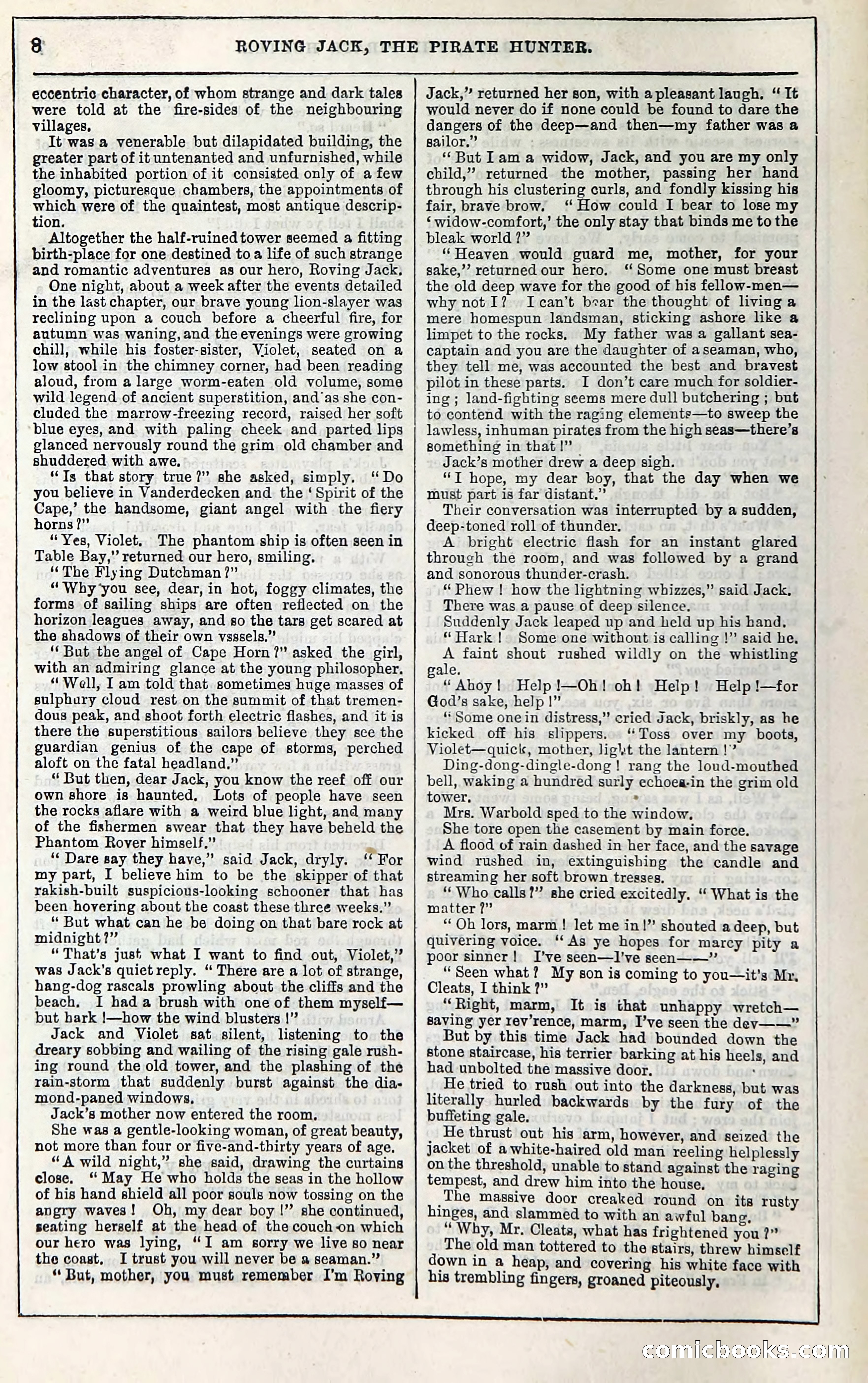
A restored page from Penny Dreadfuls, 1867. Page through the whole issue in the reader above.
📄 Transcribed text from this page (OCR, searchable)
Machine-transcribed from the original scan — historical spelling and the odd misread are preserved.
8 ROVING JACK, THE PIRATE HUNTER. eccentric character, of whom strange and dark tales were told at the fire-sides of the neighbouring villages, It was a venerable but dilapidated building, the greater part of it untenanted and unfurnished, while the inhabited portion of it consisted only of a few gloomy, picturesque chambers, the appointments of which were of the quaintest, most antique descrip- tion. Altogether the half-ruined tower seemed a fitting birth-place for one destined to a life of such strange and romantic adventures as our hero, Roving Jack, One night, about a week after the events detailed in the last chapter, our brave young lion-slayer was reclining upon a couch before a cheerful fire, for autumn was waning, and the evenings were growing chill, while his foster-sister, Violet, seated on a low stool in the chimney corner, had been reading aloud, from a large worm-eaten old volume, some wild legend of ancient superstition, and’as she con- cluded the marrow-freezing record, raised her soft blue eyes, and with paling cheek and parted lips glanced nervously round the grim old chamber and shuddered with awe, “Ts that story true?’ she asked, simply. ‘Do you believe in Vanderdecken and the ‘Spirit of the Cape,’ the handsome, giant angel with the fiery horns?” “Yes, Violet. The phantom ship is often seen in Table Bay,” returned our hero, smiling, ‘The Flying Dutchman?” “Why ‘you see, dear, in hot, foggy climates, the forms of sailing ships are often reflected on the horizon leagues away, and so the tars get scared at the shadows of their own vsssels,”’ ‘‘ But the angel of Cape Horn?” asked the girl, with an admiring glance at the young philosopher, “ Well, I am told that sometimes huge masses of sulphury cloud rest on the summit of that tremen- dous peak, and shoot forth electric flashes, and it is there the superstitious sailors believe they sce the guardian genius of the cape of storms, perched aloft on the fatal headland.” “ But then, dear Jack, you know the reef off our own shore is haunted, Lots of people have seen the rocks aflare with a weird blue light, and many of the fishermen swear that they have beheld the Phantom Rover himself,” ‘‘ Dare say they have,” said Jack, dryly. For my part, I believe him to be the skipper of that rakish-built suspicious-looking schooner that has been hovering about the coast these three weeks.” “But what can he be doing on that bare rock at midnight?” “That’s just what I want to find out, Violet,” was Jack's quietreply. “ There are a lot of strange, hang-dog rascals prowling about the cliffs and the beach, I hada brush with one of them myself— but hark !—how the wind blusters |” Jack and Violet sat silent, listening to the dreary sobbing and wailing of the rising gale rush- ing round the old tower, and the plashing of the rain-storm that suddenly burst against the dia- mond-paned windows, Jack’s mother now entered the room, She was a gentle-looking woman, of great beauty, not more than four or five-and-thirty years of age. “A wild night,” she said, drawing the curtains close. “ May He who holds the seas in the hollow of his hand shield all poor souls now tossing on the angry waves! Oh, my dear boy |” she continued, seating herself at the head of the couchon which our hero was lying, “I am sorry we live so near the coast, I trust you will never be a seaman.” “ But, mother, you must remember I’m Roving LL Ce, Jack,” returned her son, with a pleasant laugh. “ It would never do if none could be found to dare the dangers of the deep—and then—my father was a sailor.” ‘But Lam a widow, Jack, and you are my only child,” returned the mother, passing her hand through his clustering curls, and fondly kissing his fair, brave brow. ‘ How could I bear to lose my ‘widow-comfort,’ the only stay that binds me tothe bleak world ?” ‘Heaven would guard me, mother, for your sake,’’ returned our hero. ‘‘ Some one must breast the old deep wave for the good of his fellow-men— why not I? Ican’t bear the thought of living a mere homespun landsman, sticking ashore like a limpet to the rocks, My father was a gallant sea- captain and you are the daughter of aseaman, who, they tell me, was accounted the best and bravest pilot in these parts. I don’t care much for soldier- ing; land-fighting seems mere dull butchering ; but to contend with the raging elements—to sweep the lawless, inhuman pirates from the high seas—there’s something in that!” Jack’s mother drew a deep sigh. “T hope, my dear boy, that the day when we must part is far distant.” Their conversation was interrupted by a sudden, deep-toned roll of thunder. A bright electric flash for an instant glared through the room, and was followed by a grand and sonorous thunder-crash. * Phew ! how the lightning whizzes,” said Jack, There was a pause of deep silence. Suddenly Jack leaped up and held up his hand, “Hark! Some one withont is calling !” said he, A faint shout rushed wildly on the whistling gale. “ Ahoy! Help!—Oh! oh! Help! Help !—for God’s sake, help |” “Some one in distress,” cried Jack, briskly, as he kicked off his slippers. ‘Toss over my boots, Violet—quick, mother, ligt the lantern !” Ding-dong-dingle-dong! rang the loud-mouthed bell, waking a hundred surly echoea-in the grim old tower, ° Mrs. Warbold sped to the window. She tore open the casement by main force. A flood of rain dashed in her face, and the savage wind rushed in, extinguishing the candle and streaming her soft brown tresses. “Who calls?” she cried excitedly. “ What is the matter ?” ‘Oh lors, marm ! let me in!” shouted adeep, but quivering voice. ‘‘As ye hopes for marcy pity a poor sinner! I’ve seen—l’ve seen——” “Seen what? My son is coming to you—it’s Mx, Cleats, I think ?” “Right, marm, It is that unhappy wretch— faving yer rev’rence, marm, I’ve seen the dey——” But by this time Jack had bounded down the stone staircase, his terrier barking at his heels, and had unbolted the massive door. _ He tried to rush out into the darkness, but was literally hurled backwards by the fury of the buffeting gale. _ He thrust out his arm, however, and seized the jacket of a white-haired old man reeling helplessly on the threshold, unable to stand against the raging tempest, and drew him into the house, | The massive door creaked round on its rusty hinges, and slammed to with an awful bang, ‘Why, Mr. Cleats, what has frightened you?” The old man tottered to the stairs, threw himself down in a heap, and covering his white face with his trembling fingers, groaned piteously, Eomichooksrco