
Penny Dreadfuls, 1866 · page 98 of 276
Ivan the Terrible; or, Dark Deeds of Night — page 98: what you’re looking at
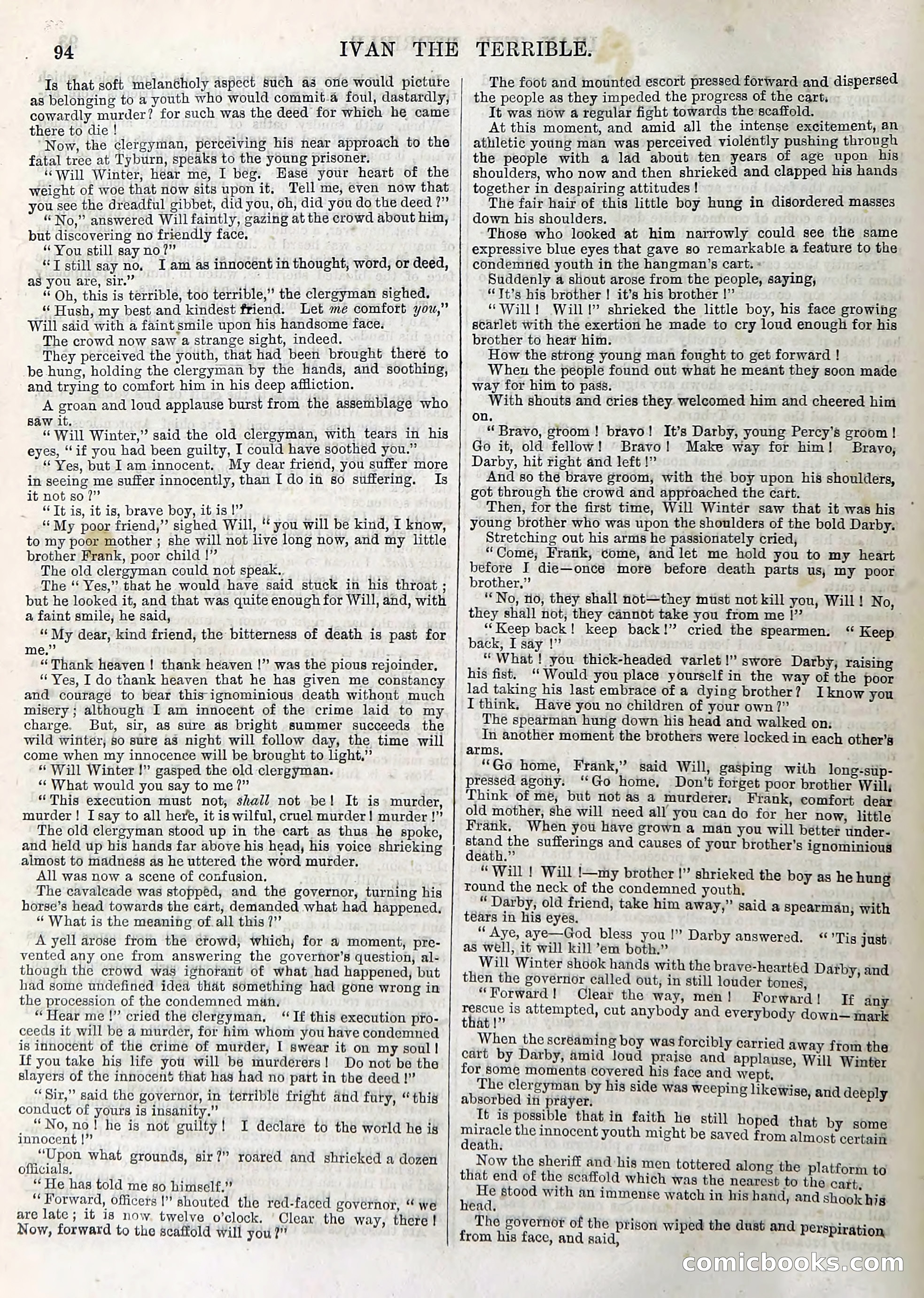
A restored page from Penny Dreadfuls, 1866. Page through the whole issue in the reader above.
📄 Transcribed text from this page (OCR, searchable)
Machine-transcribed from the original scan — historical spelling and the odd misread are preserved.
94 IVAN THE Is that soft melancholy aspect Such as one would picture as belonging to a youth who would commit-a foul, dastardly, cowardly murder? for such was the deed for which he came there to die ! ae Now, the clergyman, perceiving his near approach to the fatal tree at Tyburn, speaks to the young prisoner. ‘‘ Will Winter, hear me, I beg. Hasé your heart of the weight of woe that now sits upon it. Tell me, even now that you see the dreadful gibbet, did you, oh, did you do the deed ? “No,” answered Will faintly, gazing at the crowd about him, but discovering no friendly face, “You still say no?” “T still say no, Iam as innocent in thought, word, or deed, as you are, sir.” . ; “ Oh, this is terrible, too terrible,” the clergyman sighed. “ Hush, my best and kindest friend. Let me comfort you,” Will said with a faint smile upon his handsome face. The crowd now saw a strange sight, indeed. | They perceived the youth, that had been brought there to be hung, holding the clergyman by the hands, and soothing, and trying to comfort him in his deep afiliction. A groan and loud applause burst from the assemblage who Baw it. “ Will Winter,” said the old clergyman, with tears in his eyes, “if you had been guilty, I could have soothed you.” “Yes, but 1am innocent. My dear friend, you suffer more in seeing me suffer innocently, than I do in so suffering. Is it not so?” “Tt is, it is, brave boy, it is mm ; “My poor friend,” sighed Will, ‘‘ you will be kind, I know, to my poor mother ; she will not live long now, and my little brother Frank, poor child !” The old clergyman could not speak. The ‘‘ Yes,” that he would have said stuck in his throat ; but he looked it, and that was quite enough for Will, and, with a faint smile, he said, “‘ My dear, kind friend, the bitterness of death is past for me,”’ “Thank heaven ! thank heaven |’ was the pious rejoinder, “Yes, I do thank heaven that he has given me constancy and courage to bear this ignominious death withont much misery ; although I am innocent of the crime laid to my charge. But, sir, a8 sure as bright summer succeeds the wild winter, so sure as night will follow day, the time will come when my innocence will be brought to light,” * Will Winter !” gasped the old clergyman. ‘‘ What would you say to me?” “This execution must not, shall not be! It is murder, murder! I say to all here, it is wilful, cruel murder! murder !” The old clergyman stood up in the cart as thus he spoke, and held up his hands far above his head, his voice shrieking almost to madness as he uttered the word murder, All was now a scene of confusion. | The cavalcade was stopped, and the governor, turning his horse’s head towards the cart, demanded what had happened, “What is the meaning of. all this?” A yell arose from the crowd, which; for a moment, pre- vented any one from answering the governor’s question, al- though the crowd was ignorant of what had happened; but had some undefined idea that something had gone wrong in the procession of the condemned muh. “Hear me!” cried the clergyman, ‘If this execution pro- ceeds it will be a murder, for him whom you have condemned is innocent of the crime of murder, I swear it on my soul | If you take his life you will be murderers! Do not be the slayers of the innocent that has had no part in the deed !” “Sir,” said the governor, in terrible fright and fury, “ thig conduct of yours is insanity,” ‘No, no! he is not guilty ! innocent |” “Upon what grounds, sir?” roared and shricked a dozen officials, ‘* He has told me so himself,” “Forward, officers |” shouted the red-faced governor, “‘ we are late; it is now twelve o’clock. ‘Clear the way, there | Now, forward to the scaffold will you?” 32 I declare to the world he is TERRIBLE. — The foot and mounted escort pressed forward and dispersed the people as they impeded the progress of the cart, It was now 4 regular fight towards the scaffold. At this moment, and amid all the intense excitement, an athletic young man was perceived violently pushing through the people with a lad about ten years of age upon his shoulders, who now and then shrieked and clapped his hands together in despairing attitudes ! The fair hair of this little boy hung in disordered masses down his shoulders. Those who looked at him narrowly could see the same expressive blue eyes that gave so remarkable a feature to the condemned youth in the hangman’s cart. » Suddenly a shout arose from the people, saying, “It’s his brother ! it’s his brother !” “Will! Will!” shrieked the little boy, his face growihg scarlet with the exertion he made to cry loud enough for his brother to hear him. How the strong young man fought to get forward ! | Wheu the people found out what he meant they soon made way for him to pass. With shouts and cries they. welcomed him and cheered him on. “Bravo, groom! bravo! It’s Darby, young Percy’s groom ! Go it, old fellow! Bravo! Make way for him! Brayo, Darby, hit right and left !” wf And so the brave groom, with the boy upon his shoulders, got through the crowd and approached the cart. Then, for the first time, Will Winter saw that it was his young brother who was upon the shoulders of the bold Darby. Stretching out his arms he passionately cried, “Come; Frank, come, and let me hold you to my heart before I die—once more before death parts us; my poor brother,” > a’ ay ‘No, io, they shall not—they must not kill you, Will! No, they shall not, they cannot take you from me !” ‘“‘Keep back! keep back!” cried the spearmen: back, I say !” ‘What ! you thick-headed varlet!” swore Darby; raising his fist. ‘Would you place yourself in the way of the poor lad taking his last embrace of a dying brother? Iknow you I think, Have you no children of your own?” The speatman hung down his head and walked on: In another moment the brothers were locked in each other's arms, ‘Go home, Frank,” said Will, gasping with long-sup- pressed agony. ‘Go home, Don’t forget poor brother Will; Think of me; but not as a murderer, Frank, comfort dear old mother, she will need all you can do for her now, little Frank, When you have grown a man you will better under- sand the sufferings and causes of your brother's ignominious eath.” “Will |! Will !—my brother !” shrieked the bo é round the neck of the coudernien youth, petren a= Darby, old friend, take him away,” said a spearman; with tears in his eyes. ; “ Aye, aye—God bless you !” Darby answered. as ene ye fae ee Sal both.” i inter shook hands with the brave-hearted Darby: s then the governor called out, in still louder tones, mana “Forward! Clear the way, men! Forward! [If any ‘Boats 1s attempted, cut anybody and everybody down—mark a ’ When the screaming boy was forcibly carried away from tH cart by Darby, amid loud praise autiahaftiegen: wh Cee pe anal SOEs Paes his face and wept, e cler an is side was weeping likewi ) ge eae itt ‘prayer Sas i It is possible that in faith he still hoped th Dene the innocent youth might be saved from prea eath. Now the sheriff and his men tottered alone the that end of the scaffold which was the renee to nea * an stood with an immense watch in his hand, and shook his The governor of the prison wiped the du ‘Spirati from his face, and moe ie aust andl perspiration KS “ Keep “Tis just. Comichoo com