
Penny Dreadfuls, 1866 · page 36 of 276
Ivan the Terrible; or, Dark Deeds of Night — page 36: what you’re looking at
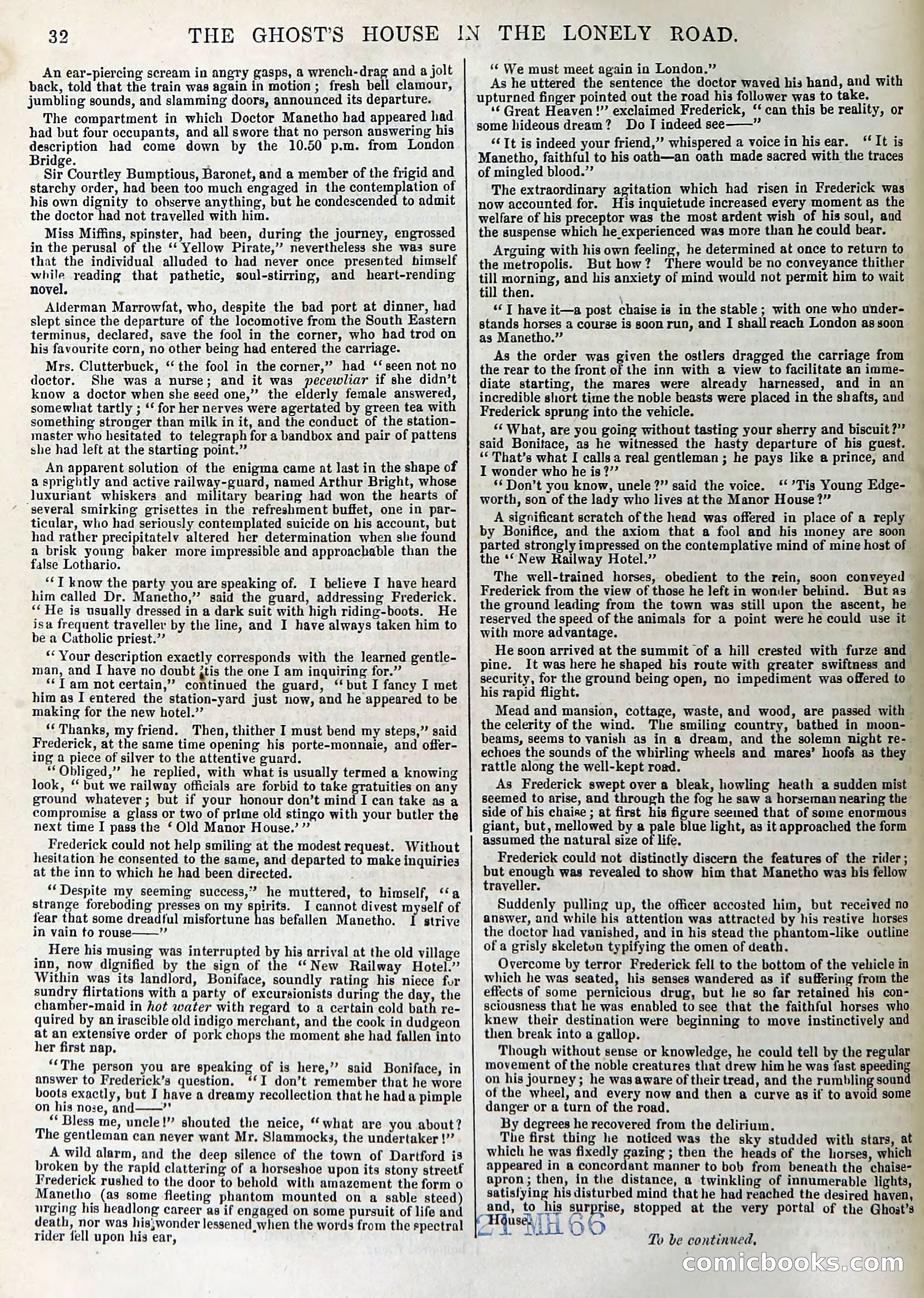
A restored page from Penny Dreadfuls, 1866. Page through the whole issue in the reader above.
📄 Transcribed text from this page (OCR, searchable)
Machine-transcribed from the original scan — historical spelling and the odd misread are preserved.
32 THE GHOST’S An ear-piercing scream in angry gasps, a wrench-drag and a jolt back, told that the train was again in motion; fresh bell clamour, jumbling sounds, and slamming doors, announced its departure. The compartment in which Doctor Manetho had appeared had had but four occupants, and all swore that no person answering his description had come down by the 10.50 p.m. from London Bridge. Sir Courtley Bumptious, Baronet, and a member of the frigid and starchy order, had been too much engaged in the contemplation of his own dignity to observe anything, but he condescended to admit the doctor had not travelled with him. Miss Miffins, spinster, had been, during the journey, engrossed in the perusal of the ‘‘ Yellow Pirate,” nevertheless she wa3 sure that the individual alluded to had never once presented himself while reading that pathetic, soul-stirring, and heart-rending novel. Alderman Marrowfat, who, despite the bad port at dinner, had slept since the departure of the locomotive from the South Eastern terminus, declared, save the fool in the corner, who had trod on his favourite corn, no other being had entered the carriage. Mrs. Clutterbuck, ‘‘ the fool in the corner,” had ‘‘ seen not no doctor. She was a nurse; and it was pecewliar if she didn’t know a doctor when she seed one,’’ the elderly female answered, somewhat tartly ; ‘‘ for her nerves were agertated by green tea with something stronger than milk in it, and the conduct of the station- master who hesitated to telegraph for a bandbox and pair of pattens she had left at the starting point.” An apparent solution of the enigma came at last in the shape of a sprightly and active railway-guard, named Arthur Bright, whose luxuriant whiskers and military bearing had won the hearts of several smirking grisettes in the refreshment buffet, one in par- ticular, who had seriously contemplated suicide on his account, but had rather precipitatelvy altered her determination when she found a brisk young baker more impressible and approachable than the false Lothario. ‘‘T know the party you are speaking of. I believe I have heard him called Dr. Manetho,” said the guard, addressing Frederick. “He is usually dressed in a dark suit with high riding-boots. He isa frequent traveller by the line, and I have always taken him to be a Catholic priest.” ‘* Your description exactly corresponds with the learned gentle- man, and I have no doubt {tis the one I am inquiring for.” “‘T am not certain,” continued the guard, ‘‘ but I fancy I met him as I entered the station-yard just now, and he appeared to be making for the new hotel.’’ ‘Thanks, my friend. Then, thither I must bend my steps,” said Frederick, at the same time opening his porte-monnaie, and offer- ing a piece of silver to the attentive guard. ““Obliged,” he replied, with what is usually termed a knowing look, ‘‘ but we railway officials are forbid to take gratuities on any ground whatever; but if your honour don’t mind I can take as a compromise a glass or two of prime old stingo with your butler the next time I pass the ‘ Old Manor House.’ ”’ Frederick could not help smiling at the modest request. Without hesitation he consented to the same, and departed to make inquiries at the inn to which he had been directed. . “Despite my seeming success,” he muttered, to himself, ‘a strange foreboding presses on my spirits. I cannot divest myself of fear that some dreadful misfortune has befallen Manetho. I strive in vain to rouse——”’ __ Here his musing was interrupted by his arrival at the old village inn, now dignified by the sign of the “New Railway Hotel.” Within was its landlord, Boniface, soundly rating his niece fur sundry flirtations with a party of excursionists during the day, the chambher-maid in hot water with regard to a certain cold bath re- quired by an irascible old indigo merchant, and the cook in dudgeon at an extensive order of pork chops the moment she had fallen into her first nap. “‘The person you are speaking of is here,’’ said Boniface, in answer to Frederick’s question. ‘‘I don’t remember that he wore boots exactly, but I have a dreamy recollection that he had a pimple on his nose, and——”’ “Bless me, uncle!” shouted the neice, “what are you about? The gentleman can never want Mr. Slammocks, the undertaker !”” A wild alarm, and the deep silence of the town of Dartford i3 broken by the rapid clattering of a horseshoe upon its stony streetf Frederick rushed to the door to behold with amazement the form o Manetho (as some fleeting phantom mounted on a sable steed) urging his headlong career as if engaged on some pursuit of life and death, nor was his;wonder lessened whien the words from the spectral rider fell upon his ear, HOUSE IN THE LONELY ROAD. ‘‘ We must meet again in London.” ‘ As he uttered the sentence the doctor waved his hand, and with upturned finger pointed out the road his follower was to take. ‘¢ Great Heaven!” exclaimed Frederick, ‘‘ can this be reality, or some hideous dream? Do I indeed see——” ‘Tt is indeed your friend,’”’ whispered a voicein hisear. ‘It is Manetho, faithful to his oath—an oath made sacred with the traces of mingled blood.” The extraordinary agitation which had risen in Frederick was now accounted for. His inquietude increased every moment as the welfare of his preceptor was the most ardent wish of his soul, and the suspense which he experienced was more than he could bear. Arguing with his own feeling, he determined at once to return to the metropolis. But how? There would be no conveyance thither till morning, and his anxiety of mind would not permit him to wait till then. ““T have it—a post chaise is in the stable ; with one who under- stands horses a course is soon run, and I shall reach London as soon as Manetho.” As the order was given the ostlers dragged the carriage from the rear to the front of the inn with a view to facilitate an imme- diate starting, the mares were already harnessed, and in an incredible short time the noble beasts were placed in the shafts, and Frederick sprung into the vehicle. . ‘‘ What, are you going without tasting your sherry and biscuit?” said Bonitace, as he witnessed the hasty departure of his guest. ‘‘ That’s what I calls a real gentleman ; he pays like a prince, and I wonder who he is ?”” ‘6 Don’t you know, unele ?” said the voice. ‘‘’Tis Young Edge- worth, son of the lady who lives at the Manor House?” A significant scratch of the head was offered in place of a reply by Bonifice, and the axiom that a fool and his money are soon parted strongly impressed on the contemplative mind of mine host of the ‘‘ New Railway Hotel.” The well-trained horses, obedient to the rein, soon conveyed Frederick from the view of those he left in wonder behind. But as the ground leading from the town was still upon the ascent, he reserved the speed of the animals for a point were he could use it with more advantage. He soon arrived at the summit of a hill crested with furze and pine. It was here he shaped his route with greater swiftness and security, for the ground being open, no impediment was offered to his rapid flight. Mead and mansion, cottage, waste, and wood, are passed with the celerity of the wind. The smiling country, bathed in moon- beams, seems to vanish as in a dream, and the solemn night re-— echoes the sounds of the whirling wheels and mares’ hoofs a3 they rattle along the well-kept road. As Frederick swept over a bleak, howling heath a sudden mist seemed to arise, and through the fog he saw a horseman nearing the side of his chaise ; at first his figure seemed that of some enormous giant, but, mellowed by a pale blue light, as it approached the form assumed the natural size of life. Frederick could not distinctly discern the features of the rider; but enough was revealed to show him that Manetho was his fellow traveller. Suddenly pulling up, the officer accosted him, but received no answer, and while his attention was attracted by his restive horses the doctor had vanished, and in his stead the phantom-like outline of a grisly skeletun typifying the omen of death. Overcome by terror Frederick fell to the bottom of the vehicle in which he was seated, his senses wandered as if suffering from the effects of some pernicious drug, but he so far retained his con- sciousness that he was enabled to see that the faithful horses who knew their destination were beginning to move instinctively and then break into a gallop. Though without sense or knowledge, he could tell by the regular movement of the noble creatures that drew him he was fast speedin on his journey ; he was aware of their tread, and the rumbling soun of the wheel, and every now and then a curve as if to avoid some danger or a turn of the road. By degrees he recovered from the delirium. The first thing he noticed was the sky studded with stars, at ee ale are?) - which he was fixedly gazing ; then the heads of the horses, which : appeared in a concordant manner to bob from beneath the chaise- apron; then, in the distance, a twinkling of innumerable lights, satisfying his disturbed mind that he had reached the desired haven, and, to_his sur rise, stopped at the very portal of the Ghost’s | eal OO To be continued, Comichoo Sal(COUM