
Penny Dreadfuls, 1866 · page 268 of 276
Ivan the Terrible; or, Dark Deeds of Night — page 268: what you’re looking at
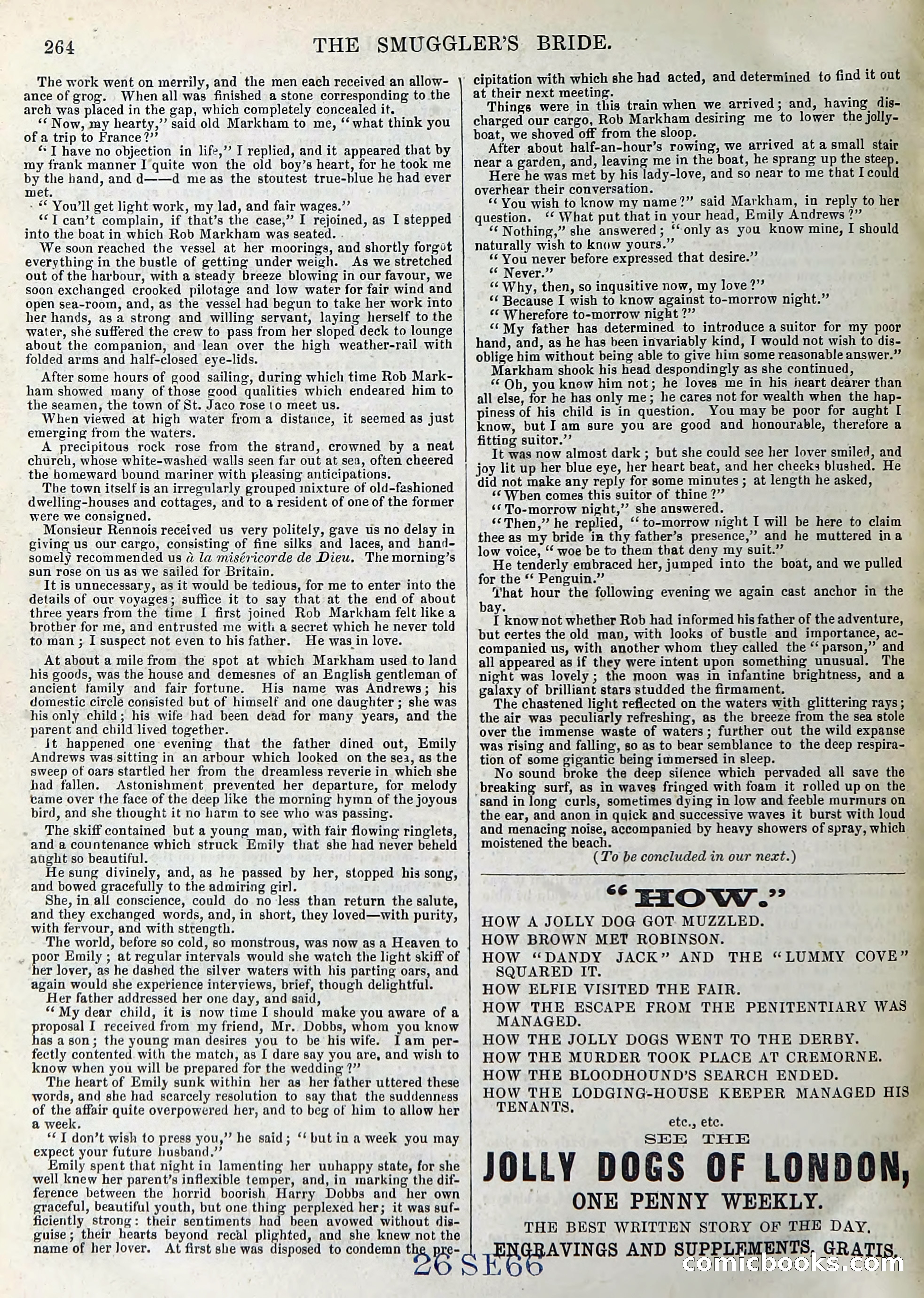
A restored page from Penny Dreadfuls, 1866. Page through the whole issue in the reader above.
📄 Transcribed text from this page (OCR, searchable)
Machine-transcribed from the original scan — historical spelling and the odd misread are preserved.
264 The work went on merrily, and the men each received an allow- ance of grog. When all was finished a stone corresponding to the arch was placed in the gap, which completely concealed it. ‘¢ Now, my hearty,’’ said old Markham to me, ‘‘ what think you of a trip to France ?”’ ‘*T have no objection in life,’’ I replied, and it appeared that by my frank manner I quite won the old boy’s heart, for he took me by the hand, and d——d meas the stoutest true-blue he had ever met. - ** You'll get light work, my lad, and fair wages.”’ ‘‘T can’t complain, if that’s the case,” I rejoined, as I stepped into the boat in which Rob Markham was seated. . We soon reached the vessel at her moorings, and shortly forgot everything in the bustle of getting under weigh. As we stretched out of the harbour, with a steady breeze blowing in our favour, we soon exchanged crooked pilotage and low water for fair wind and open sea-room, and, as the vessel had begun to take her work into her hands, asa strong and willing servant, laying herself to the water, she suffered the crew to pass from her sloped deck to lounge about the companion, and lean over the high weather-rail with folded arms and half-closed eye-lids. After some hours of good sailing, during which time Rob Mark- ham showed many of those good qualities which endeared him to the seamen, the town of St. Jaco rose to meet us. When viewed at high water froma distance, it seemed as just emerging from the waters. A precipitous rock rose from the strand, crowned by a neat church, whose white-washed walls seen far out at sea, often cheered the homeward bound mariner with pleasing anticipations. The town itself is an irregularly grouped inixture of old-fashioned dwelling-houses and cottages, and to a resident of one of the former were we consigned. Monsieur Rennois received us very politely, gave us no delay in giving us our cargo, consisting of fine silks and laces, and hand- somely recommended us a la miséricorde de Dieu. The morning’s sun rose on us as we sailed for Britain. It is unnecessary, as it would be tedious, for me to enter into the details of our voyages; suffice it to say that at the end of about three years from the time I first joined Rob Markham felt like a brother for me, and entrusted me witli a secret which he never told to man ; I suspect not even to his father. He was in love. At about a mile from the spot at which Markham used to land his goods, was the house and demesnes of an English gentleman of ancient family and fair fortune. His name was Andrews; his domestic circle consisted but of himself and one daughter ; she was his only child; his wife had been dead for many years, and the parent and child lived together. it happened one evening that the father dined out, Emily Andrews was sitting in an arbour which looked on the sea, as the sweep of oars startled her from the dreamless reverie in which she had fallen. Astonishment prevented her departure, for melody came over the face of the deep like the morning hymn of the joyous bird, and she thought it no harm to see who was passing. The skiff contained but a young man, with fair flowing ringlets, and a countenance which struck Emily that she had never beheld aight so beautiful. He sung divinely, and, as he passed by her, stopped his sony, and bowed gracefully to the admiring girl. She, in all conscience, could do no less than return the salute, and they exchanged words, and, in short, they loved—with purity, with fervour, and with strength. The world, before so cold, s0 monstrous, was now as a Heaven to . poor Emily ; at regular intervals would she watch the light skiff of er lover, as he dashed the silver waters with his parting oars, and again would she experience interviews, brief, though delightful. Her father addressed her one day, and said, ‘¢ My dear child, it is now time I should make you aware of a proposal I received from my friend, Mr. Dobbs, whom you know as ason; the young man desires you to be his wife. Iam per- fectly contented with the match, as I dare say you are, and wish to know when you will be prepared for the wedding ?” The heart of Emily sunk within her as her father uttered these words, and she had scarcely resolution to say that the suddenness of the affair quite overpowered her, and to beg of him to allow her a week, ** J don’t wish to press you,” he said; ‘‘ but in a week you may expect your future husband.’’ Emily spent that night in lamenting her unhappy state, for she well knew her parent’s inflexible temper, and, in marking the dif- ference between the horrid boorish Harry Dobbs and her own graceful, beautiful youth, but one thing perplexed her; it was suf- ficiently strong: their sentiments had been avowed without dis- guise ; their hearts beyond recal plighted, and she knew not the name of her Jover. At first she was disposed to condemn ‘Be THE SMUGGLER’S BRIDE. ' cipitation with which she had acted, and determined to find it out — at their next meeting. : : 7 Things were in this train when we arrived ; and, having dis- charged our cargo, Rob Markham desiring me to lower the jolly- boat, we shoved off from the sloop. After about half-an-hour’s rowing, we arrived at a small stair oe: near a garden, and, leaving me in the boat, he sprang up the pee Here he was met by his lady-love, and so near to me that Ico overhear their conversation. <¢ You wish to know my name?” said Markham, in reply to her question. ‘‘ What put that in your head, Emily Andrews ?” ‘‘ Nothing,” she answered; ‘“‘only as you know mine, I should naturally wish to know yours.” } | ‘¢ You never before expressed that desire.” 6¢ Never.” ‘¢ Why, then, so inqusitive now, my love?” ‘‘ Because I wish to know against to-morrow night.” ‘© Wherefore to-morrow night ?” ‘‘ My father has determined to introduce a suitor for my poor hand, and, as he has been invariably kind, I would not wish to dis- oblige him without being able to give him some reasonable answer.” Markham shook his head despondingly as she continued, “Oh, you know him not; he loves me in his neart dearer than all else, for he has only me; he cares not for wealth when the hap- piness of his child is in question. You may be poor for aught I know, but Iam sure you are good and honourable, therefore a fitting suitor.’’ It was now almost dark ; but she could see her lover smiled, and joy lit up her blue eye, her heart beat, and her cheeks blushed. He did not make any reply for some minutes ; at length he asked, ‘© When comes this suitor of thine ?” ‘¢ To-morrow night,’’ she answered. “Then,” he replied, ‘‘ to-morrow night I will be here to claim 4 thee as my bride in thy father’s presence,” and he muttered ina — low voice, ‘‘ woe be to them that deny my suit.” He tenderly embraced her, jumped into the boat, and we pulled for the ** Penguin.” / ‘hat hour the following evening we again cast anchor in the bay. i know not whether Rob had informed his father of the adventure, but certes the old map, with looks of bustle and importance, ac- companied us, with another whom they called the *‘ parson,” and all appeared as if they were intent upon something unusual. The night was lovely ; the moon was in infantine brightness, and a galaxy of brilliant stars studded the firmament. : . The chastened light reflected on the waters with glittering rays; i the air was peculiarly refreshing, as the breeze from the sea stole over the immense waste of waters; further out the wild expanse was rising and falling, so as to bear semblance to the deep respira- tion of some gigantic being immersed in sleep. No sound broke the deep silence which pervaded all save the breaking surf, as in waves fringed with foam it rolled up on the sand in long curls, sometimes dying in low and feeble murmurs on the ear, and anon in quick and successive waves it burst with loud and menacing noise, accompanied by heavy showers of spray, which moistened the beach. (To be concluded in our next.) 66 ELO W .”’ HOW A JOLLY DOG GOT MUZZLED. HOW BROWN MET ROBINSON. HOW “DANDY JACK” AND THE “LUMMY COVE” SQUARED IT. HOW ELFIE VISITED THE FAIR. HOW THE ESCAPE FROM THE PENITENTIARY WAS MANAGED. HOW THE JOLLY DOGS WENT TO THE DERBY. HOW THE MURDER TOOK PLACE AT CREMORNE. HOW THE BLOODHOUND’S SEARCH ENDED. HOW THE LODGING-HOUSE KEEPER MANAGED HIS TENANTS, etc., etc. ‘ SEE THE JOLLY DOGS OF LONDON, ONE PENNY WEEKLY. THE BEST WRITTEN STORY OF THE DAY, AVINGS AND SUPPLEMENTS. GRA Foe comicbooksreom ) ; . ’