
Penny Dreadfuls, 1866 · page 260 of 276
Ivan the Terrible; or, Dark Deeds of Night — page 260: what you’re looking at
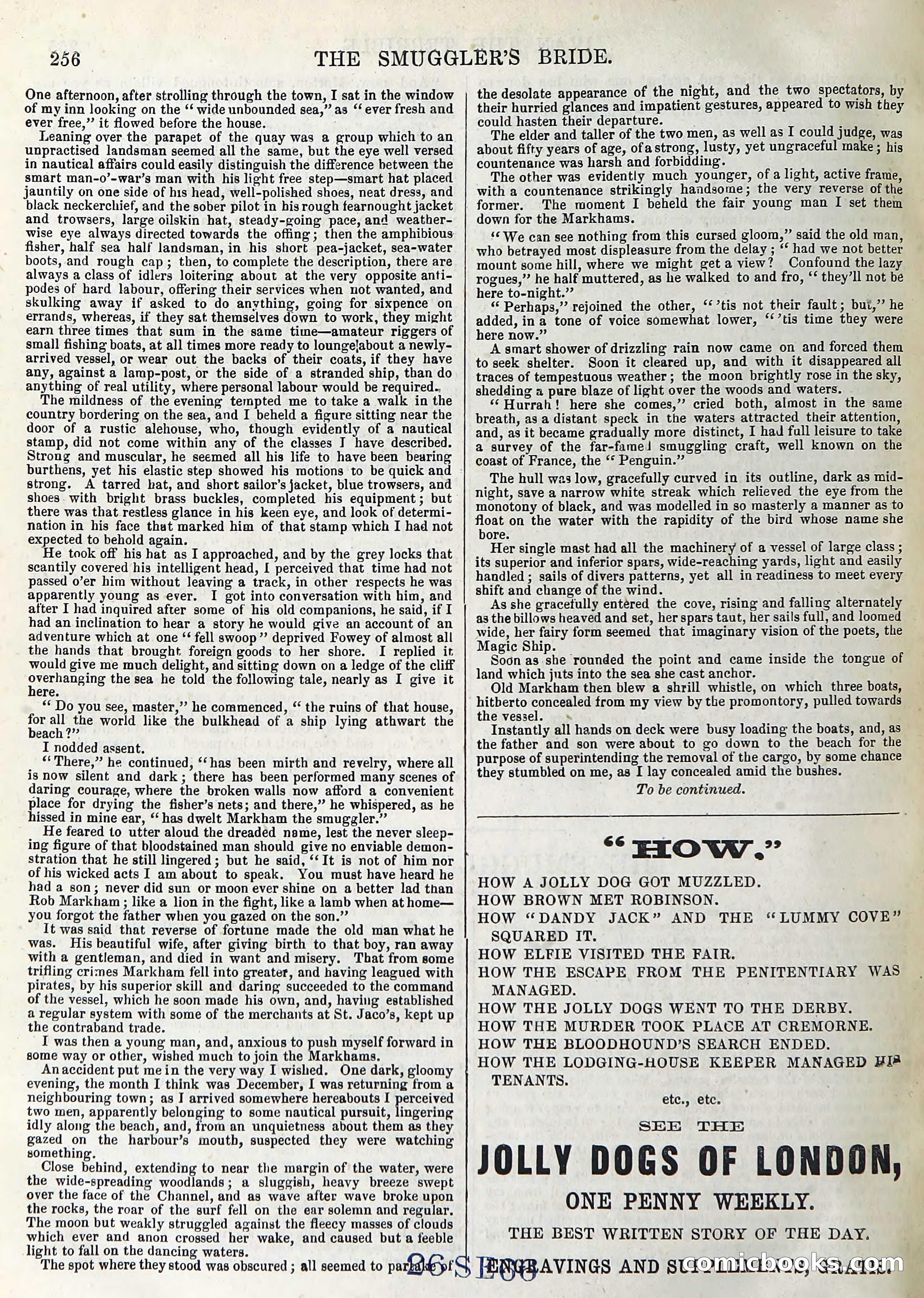
A restored page from Penny Dreadfuls, 1866. Page through the whole issue in the reader above.
📄 Transcribed text from this page (OCR, searchable)
Machine-transcribed from the original scan — historical spelling and the odd misread are preserved.
256 One afternoon, after strolling through the town, I sat in the window of my inn looking on the ‘‘ wide unbounded sea,’ as “‘ ever fresh and ever free,’ it flowed before the house. Leaning over the parapet of the quay was a group which to an unpractised landsman seemed all the same, but the eye well versed in nautical affairs could easily distinguish the difference between the smart man-o’-war’s man with his light free step—smart hat placed jauntily on one side of his head, well-polished shoes, neat dress, and black neckerchief, and the sober pilot in his rough fearnought jacket and trowsers, large oilskin hat, steady-going pace, and weather- wise eye always directed towards the offing; then the amphibious fisher, half sea half landsman, in his short pea-jacket, sea-water boots, and rough cap; then, to complete the description, there are always a class of idlers loitering about at the very opposite anti- podes of hard labour, offering their services when not wanted, and skulking away if asked to do anything, going for sixpence on errands, whereas, if they sat themselves down to work, they might earn three times that sum in the same time—amateur riggers of small fishing boats, at all times more ready to loungelabout a newly- arrived vessel, or wear out the backs of their coats, if they have any, against a lamp-post, or the side of a stranded ship, than do anything of real utility, where personal labour would be required.. The mildness of the evening tempted me to take a walk in the country bordering on the sea, and I beheld a figure sitting near the door of a rustic alehouse, who, though evidently of a nautical stamp, did not come within any of the classes I have described. Strong and muscular, he seemed all his life to have been bearing burthens, yet his elastic step showed his motions to be quick and strong. A tarred hat, and short sailor’s jacket, blue trowsers, and shoes. with bright brass buckles, completed his equipment; but there was that restless glance in his keen eye, and look of determi- nation in his face that marked him of that stamp which I had not expected to behold again. He took off his hat as I approached, and by the grey locks that scantily covered his intelligent head, [ perceived that time had not passed o’er him without leaving a track, in other respects he was apparently young as ever. I got into conversation with him, and after I had inquired after some of his old companions, he said, if I had an inclination to hear a story he would give an account of an adventure which at one ‘‘ fell swoop” deprived Fowey of almost all the hands that brought foreign goods to her shore. I replied it. would give me much delight, and sitting down on a ledge of the cliff overhanging the sea he told the following tale, nearly as I give it ere. ** Do you see, master,”’ he commenced, “ the ruins of that house, sos eg world like the bulkhead of a ship lying athwart the each ?” I nodded assent. _ “There,” he continued, ‘‘has been mirth and revelry, where all is now silent and dark; there has been performed many scenes of daring courage, where the broken walls now afford a convenient place for drying the fisher’s nets; and there,” he whispered, as he hissed in mine ear, ‘‘ has dwelt Markham the smuggler.” _ He feared 1o utter aloud the dreaded name, lest the never sleep- ing figure of that bloodstained man should give no enviable demon- stration that he still lingered; but he said, ‘‘It is not of him nor of his wicked acts I am about to speak. You must have heard he had a son; never did sun or moon ever shine on a better lad than Rob Markham ; like a lion in the fight, like a lamb when at home— you forgot the father when you gazed on the son.” It was said that reverse of fortune made the old man what he was. His beautiful wife, after giving birth to that boy, ran away with a gentleman, and died in want and misery. That from some trifling crimes Markham fell into greater, and having leagued with pirates, by his superior skill and daring’ succeeded to the command of the vessel, which he soon made his own, and, having established a regular system with some of the merchants at St. Jaco’s, kept up the contraband trade. I was then a young man, and, anxious to push myself forward in some way or other, wished much to join the Markhams. Anaccident put mein the very way I wished. One dark, gloomy evening, the month I think was December, I was returning from a neighbouring town; as I arrived somewhere hereabouts I perceived two men, apparently belonging to some nautical pursuit, lingering idly along the beach, and, from an unquietness about them as they gazed on the harbour’s mouth, suspected they were watching something. Close behind, extending to near the margin of the water, were the wide-spreading woodlands; a sluggish, heavy breeze swept over the face of the Channel, and as wave after wave broke upon the rocks, the roar of the surf fell on the ear solemn and regular. The moon but weakly struggled against the fleecy masses of clouds which ever and anon crossed her wake, and caused but a feeble light to fall on the dancing waters. The spot where they stood was obscured ; all seemed to partdléept THE SMUGGLER’S BRIDE. the desolate appearance of the night, and the two spectators, by their hurried glances and impatient gestures, appeared to wish they could hasten their departure. i The elder and taller of the two men, as well as I could judge, was about fifty years of age, ofastrong, lusty, yet ungraceful make ; his countenance was harsh and forbidding. ; The other was evidently much younger, of a light, active frame, with a countenance strikingly handsome; the very reverse of the former. The moment I beheld the fair young man I set them down for the Markhams. ‘© We can see nothing from this cursed gloom,” said the old man, who betrayed most displeasure from the delay ; ‘© had we not better mount some hill, where we might get a view? Confound the lazy rogues,” he half muttered, as he walked to and fro, °° they’ll not be here to-night.”’ ‘“‘ Perhaps,’”’ rejoined the other, ‘‘ tis not their fault; but,” he — added, ina tone of voice somewhat lower, ‘‘’tis time they were here now.” A smart shower of drizzling rain now came on and forced them to seek shelter. Soon it cleared up, and with it disappeared all traces of tempestuous weather; the moon brightly rose in the sky, shedding a pure blaze of light over the woods and waters. ‘Hurrah! here she comes,” cried both, almost in the same breath, as a distant speck in the waters attracted their attention, and, as it became gradually more distinct, I had full leisure to take a survey of the far-fame! smuggling craft, well known on the coast of France, the ‘‘ Penguin.” The hull was low, gracefully curved in its outline, dark as mid- night, save a narrow white streak which relieved the eye from the monotony of black, and was modelled in so masterly a manner as to float on the water with the rapidity of the bird whose name she bore. Her single mast had all the machinery of a vessel of large class ; its superior and inferior spars, wide-reaching yards, light and easily handled ; sails of divers patterns, yet all in readiness to meet every shift and change of the wind. As she gracefully entéred the cove, rising and falling alternately as the billows heaved and set, her spars taut, her sails full, and loomed wide, her fairy form seemed that imaginary vision of the poets, the Magic Ship. Soon as she rounded the point and came inside the tongue of land which juts into the sea she cast anchor. Old Markham then blew a shrill whistle, on which three boats, -hitberto concealed from my view by the promontory, pulled towards the vessel. « Instantly all hands on deck were busy loading the boats, and, as the father and son were about to go down to the beach for the purpose of superintending the removal of the cargo, by some chance they stumbled on me, as I lay concealed amid the bushes. To be continued. ““ FrOWw .” HOW A JOLLY DOG GOT MUZZLED. HOW BROWN MET ROBINSON. HOW “DANDY JACK” AND THE SQUARED IT. HOW ELFIE VISITED THE FAIR. HOW THE ESCAPE FROM THE PENITENTIARY WAS MANAGED. HOW THE JOLLY DOGS WENT TO THE DERBY. HOW THE MURDER TOOK PLACE AT CREMORNE. HOW THE BLOODHOUND’S SEARCH ENDED. HOW THE LODGING-HOUSE KEEPER MANAGED #I* TENANTS. ‘“ LUMMY COVE” etc., etc. SEEK THE JOLLY DOGS OF LONDON, ONE PENNY WEEKLY. THE BEST WRITTEN STORY OF THE DAY. FERGBAVINGS AND SUEVLUNIKS) GRATE