
Penny Dreadfuls, 1866 · page 258 of 276
Ivan the Terrible; or, Dark Deeds of Night — page 258: what you’re looking at
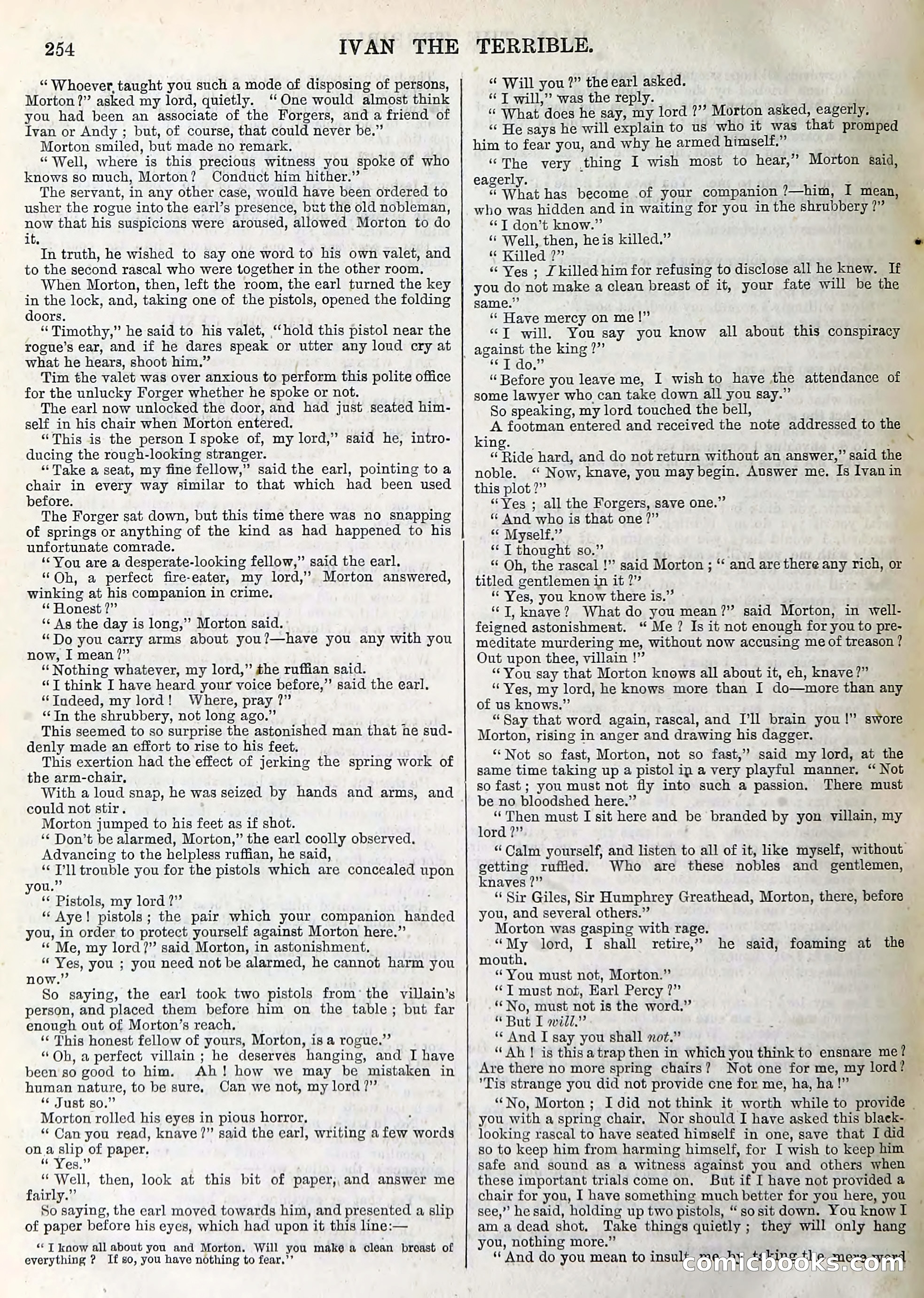
A restored page from Penny Dreadfuls, 1866. Page through the whole issue in the reader above.
📄 Transcribed text from this page (OCR, searchable)
Machine-transcribed from the original scan — historical spelling and the odd misread are preserved.
254 IVAN “ Whoever, taught you such a mode of disposing of persons, Morton?” asked my lord, quietly. ‘‘One would almost think you had been an associate of the Forgers, and a friend of Ivan or Andy ; but, of course, that could never be.” Morton smiled, but made no remark. “ Well, where is this precious witness you spoke of who knows so much, Morton? Conduct him hither.” The servant, in any other case, would have been ordered to usher the rogue into the earl’s presence, but the old nobleman, now that his suspicions were aroused, allowed Morton to do it. In truth, he wished to say one word to his own valet, and to the second rascal who were together in the other room. When Morton, then, left the room, the earl turned the key in the lock, and, taking one of the pistols, opened the folding doors. “Timothy,” he said to his valet, ‘‘hold this pistol near the rogue’s ear, and if he dares speak or utter any loud cry at what he hears, shoot him,” Tim the valet was over anxious to perform this polite office for the unlucky Forger whether he spoke or not. The earl now unlocked the door, and had just seated him- self in his chair when Morton entered. “This is the person I spoke of, my lord,” said he, intro- ducing the rough-looking stranger. ‘Take a seat, my fine fellow,” said the earl, pointing to a chair in every way similar to that which had been used before. The Forger sat down, but this time there was no snapping of springs or anything of the kind as had happened to his unfortunate comrade. ‘<You are a desperate-looking fellow,” said the earl. “Oh, a perfect fire-eater, my lord,’ Morton answered, winking at his companion in crime, ** Honest ?” ‘¢ As the day is long,” Morton said. “Do you carry arms about you?—have you any with you now, I mean 2?” ‘Nothing whatever, my lord,” the ruffian said. “T think I have heard your voice before,” said the earl, ‘““Tndeed, my lord! Where, pray ?” *¢In the shrubbery, not long ago.” This seemed to so surprise the astonished man that ne sud- denly made an effort to rise to his feet. This exertion had the effect of jerking the spring work of the arm-chair, With a loud snap, he was seized by hands and arms, and could not stir. Morton jumped to his feet as if shot. ‘¢ Don’t be alarmed, Morton,” the earl coolly observed. Advancing to the helpless ruffian, he said, ‘< J’ll trouble you for the pistols which are concealed upon you.” ‘* Pistols, my lord ?” ‘‘ Aye! pistols; the pair which your companion handed you, in order to protect yourself against Morton here.”’ ‘‘ Me, my lord?” said Morton, in astonishment, “ Yes, you ; you need not be alarmed, he cannot harm you now.” So saying, the earl took two pistols from’ the villain’s person, and placed them before him on the table; but far enough out of Morton’s reach, ‘This honest fellow of yours, Morton, is a rogue,” “Oh, a perfect villain; he deserves hanging, and I have been so good to him. Ah! how we may be mistaken in human nature, to be sure, Can we not, my lord?” ‘¢ Just so.” Morton rolled his eyes in pious horror, “Can you read, knave?” said the earl, writing a few words on a slip of paper. Yes.” “Well, then, look at this bit of paper,;,and answer me fairly.” So saying, the earl moved towards him, and presented a slip of paper before his eyes, which had upon it this line:— ‘© T know all about you and Morton. Will you make a clean breast of everything ? If so, you have nothing to fear,’’ THE TERRIBLE. “ Will you ?” the earl asked. “ T will,” was the reply. ““ What does he say, my lord ?”’ Morton asked, eagerly, ““ He says he will explain to us who it was that promped him to fear you, and why he armed himself.” . “The very .thing I wish most to hear,” Morton said, eagerly. “ What has become of your companion ?—him, I mean, — who was hidden and in waiting for you in the shrubbery ?” “JT don’t know.” ‘‘ Well, then, heis killed.” “ Killed ?” “Yes ; [killed him for refusing to disclose all he knew. If you do not make a clean breast of it, your fate will be the same.” ‘‘ Have mercy on me!” “J will. You say you know all about this conspiracy _ against the king ?”’ ée I do.”’ “Before you leave me, I wish to have the attendance of some lawyer who can take down all you say.” So speaking, my lord touched the bell, A footman entered and received the note addressed to the king. ri. “Ride hard, and do not return without an answer,” said the noble. ‘ Now, knave, you may begin. Auswer me. Is Ivan in this plot?” “Yes ; all the Forgers, save one.” “ And who is that one ?” “* Myself,” ** T thought so.” ‘‘ Oh, the rascal !’’ said Morton ; ‘‘ and are there any rich, or ~ titled gentlemen in it ?” « Yes, you know there is.” ‘‘T, knave? What do you mean?” said Morton, in well- feigned astonishment. ‘“ Me? Is it not enough for you to pre- meditate murdering me, without now accusing me of treason ? Out upon thee, villain !” “You say that Morton knows all about it, eh, knayve?” “Yes, my lord, he knows more than I do—more than any of us knows.” “ Say that word again, rascal, and I'll brain you !” swore Morton, rising in anger and drawing his dagger. ‘Not so fast, Morton, not so fast,’ said my lord, at the same time taking up a pistol ip a very playful manner. “ Not so fast ; you must not fly into such a passion. There must be no bloodshed here.” ‘Then must I sit here and be branded by yon villain, my lord ?” “Calm yourself, and listen to all of it, like myself, without getting ruffed. Who are these nobles and gentlemen, knaves ?” ‘Sir Giles, Sir Humphrey Greathead, Morton, there, before you, and several others.” Morton was gasping with rage. “My lord, I shall retire,” he said, foaming at the mouth, “You must not, Morton.” ‘T must not, Earl Percy ?” ‘‘No, must not is the word.” © But I will.” ‘¢ And I say you shall not.” “Ah! is thisatrap then in which you think to ensnare me? Are there no more spring chairs? Not one for me, my lord? ~ ‘Tis strange you did not provide cne for me, ha, ha !” ‘ “No, Morton ; I did not think it worth while to provide — you with a spring chair, Nor should I have asked this blaek- looking rascal to have seated himself in one, save that I did so to keep him from harming himself, for I wish to keep him safe and sound as a witness against you and others when these important trials come on. But if I have not provided a chair for you, I have something much better for you here, you see,” he said, holding up two pistols, “so sit down. You know I am adead shot. Take things quietly ; they will only hang you, nothing more.” * And do you mean to insul’= et Choos “9 = J