
Penny Dreadfuls, 1866 · page 238 of 276
Ivan the Terrible; or, Dark Deeds of Night — page 238: what you’re looking at
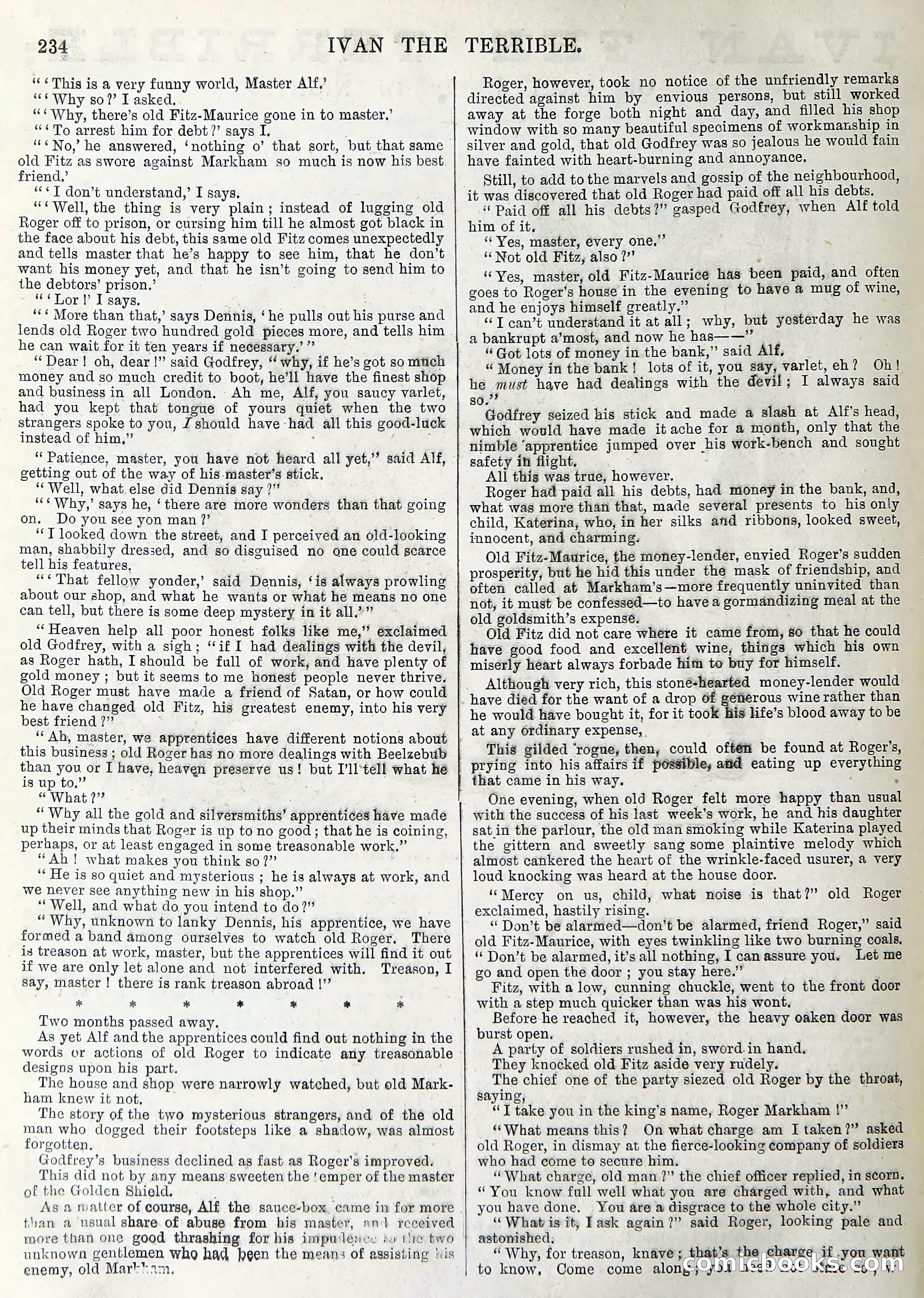
A restored page from Penny Dreadfuls, 1866. Page through the whole issue in the reader above.
📄 Transcribed text from this page (OCR, searchable)
Machine-transcribed from the original scan — historical spelling and the odd misread are preserved.
234 IVAN THE ‘‘¢ This is a very funny world, Master Alf,’ ““ Why so? I asked. “Why, there’s old Fitz-Maurice gone in to master.’ “To arrest him for debt?’ says I, ‘‘* No,’ he answered, ‘nothing o’ that sort, but that same ord ee as swore against Markham so much is now his best riend,’ ““«T don’t understand,’ I says, ‘“““ Well, the thing is very plain; instead of lugging old Roger off to prison, or cursing him till he almost got black in the face about his debt, this same old Fitz comes unexpectedly and tells master that he’s happy to see him, that he don’t want his money yet, and that he isn’t going to send him to the debtors’ prison.’ ‘* Tor 1? I says. ‘** More than that,’ says Dennis, ‘he pulls out his purse and lends old Roger two hundred gold pieces more, and tells him he can wait for it ten years if necessary.’ ”’ “Dear! oh, dear!” said Godfrey, “why, if he’s got so mtich money and so much credit to boot, he’ll have the finest shop and business in all London. Ah me, Alf, you saucy varlet, had you kept that tongue of yours quiet when the two strangers spoke to you, Zshould have had all this good-luck instead of him,” ' ‘‘ Patience, master, you have not heard all yet,” said Alf, getting out of the way of his-master’s stick, ‘Well, what else did Dennis say ?” ‘““¢ Why,’ says he, ‘there are more wonders than that going on. Do you see yon man ?’ ‘‘T looked down the street, and I perceived an old-looking man, shabbily dressed, and so disguised no one could scarce tell his features. ? “* That fellow yonder,’ said Dennis, ‘is always prowling about our shop, and what he wants or what he means no one can tell, but there is some deep mystery in it all.’” ‘““Heaven help all poor honest folks like me,” exclaimed old Godfrey, with a sigh; “if I had dealings with the devil, as Roger hath, I should be full of work, and have plenty of gold money ; but it seems to me honest people never thrive. Old Roger must have made a friend of Satan, or how could he have changed old Fitz, his greatest enemy, into his very best friend ?” ‘Ah, master, we apprentices have different notions about this business ; old Roger has no more dealings with Beelzebub than you or I have, heaven preserve us! but I’lltell what he is up to.” | “What ?” “Why all the gold and silversmiths’ apprentices have made up their minds that Roger is up to no good; that he is coining, peraaps, or at least engaged in some treasonable work.” ‘Ah! what makes you think so?’ ‘‘ He is so quiet and mysterious ; he is always at work, and we never see anything new in his shop.” Z Well, and what do you intend to do?” Why, unknown to lanky Dennis, his apprentice, we have formed a band among ourselves to watch old Roger. There 13 treason at work, master, but the apprentices will find it out if we are only let alone and not interfered with. Treason, I Say, master! there is rank treason abroad |”’ x * * * * # Two months passed away. As yet Alf andthe apprentices could find out nothing in the words or actions of old Roger to indicate any treasonable designs upon his part. The house and shop were narrowly watched, but old Mark- ham knew it not. The story of the two mysterious strangers, and of the old man who dogged their footsteps like a shadow, was almost forgotten, Godfrey’s business declined as fast as Roger’s improved. This did not by any means sweeten the !emper of the master of the Golden Shield. As a matter of course, Alf the sauce-box. came in for more tian a usual share. of abuse from his master, sn} received more than one good thrashing for his impudencve tv tlie two unknown gentlemen who had keen the means of assisting ‘is enemy, old Mart*am, TERRIBLE. Roger, however, took no notice of the unfriendly remarks directed against him by envious persons, but still worked away at the forge both night and day, and filled his shop window with so many beautiful specimens of workmanship in silver and gold, that old Godfrey was so jealous he would fain have fainted with heart-burning and annoyance. Still, to add to the marvels and gossip of the neighbourhood, it was discovered that old Roger had paid off all his debts. “Paid off all his debts?” gasped Godfrey, when Alf told him of it. ‘Yes, master, every one.”’ “ Not old Fitz, also ?”’ : ‘“Yes, master, old Fitz-Maurice has been paid, and often goes to Roger’s house in the evening to have a mug of wine, and he enjoys himself greatly.” ‘“‘T can’t understand it at all; why, but yesterday he was a bankrupt a’most, and now he has——”’ “Got lots of money in the bank,” said Alf, “ Money in the bank! lots of it, you say, varlet, eh? Oh! he must have had dealings with the devil; I always said so.” Godfrey seized his stick and made a slash at Alf’s head, which would have made it ache for a month, only that the nimble ‘apprentice jumped over his work-bench and sought safety in flight, ; All this was true, however. Roger had paid all his debts, had money in the bank, and, what was more than that, made several presents to his only child, Katerina, who, in her silks and ribbons, looked sweet, innocent, and charming. Old Fitz-Maurice, the money-lender, envied Roger’s sudden prosperity, but he hid this under the mask of friendship, and often called at Markham’s—more frequently uninvited than not, it must be confessed—to have a gormandizing meal at the ' old goldsmith’s expense. Old Fitz did not care where it came from, so that he could have good food and excellent wine, things which his own miserly heart always forbade him to buy for himself. Although very rich, this stone-hearted money-lender would have died for the want of a drop Of generous wine rather than he would have bought it, for it took ‘his life’s blood away to be at any ordinary expense, This gilded ‘rogue, then, could offen be found at Roger's, prying into his affairs if possible, amd eating up everything that came in his way. . One evening, when old Roger felt more happy than usual with the success of his last week’s work, he and his daughter sat in the parlour, the old man smoking while Katerina played the gittern and sweetly sang some plaintive melody which almost cankered the heart of the wrinkle-faced usurer, a very loud knocking was heard at the house door. ‘Mercy on us, child, what noise is that?” old Roger exclaimed, hastily rising. “ Don’t be alarmed—don’t be alarmed, friend Roger,” said old Fitz-Maurice, with eyes twinkling like two burning coals. ‘Don’t be alarmed, it’s all nothing, I canassure you. Let me go and open the door ; you stay here.” Fitz, with a low, cunning chuckle, went to the front door with a step much quicker than was his wont, Before he reached it, however, the heavy oaken door was burst open. A party of soldiers rushed in, sword.in hand. They knocked old Fitz aside very rudely. The chief one of the party siezed old Roger by the throat, saying, “T take you in the king’s name, Roger Markham |” “‘What means this? On what charge am I taken?” asked old Roger, in dismay at the fierce-looking company of soldiers who had come to secure him. : “What charge, old man ?” the chief officer replied, in scorn. “You know full well what you are charged with, and what you have done. You are a disgrace to the whole city.” ‘What is it, Task again?” said Roger, looking pale and. astonished, “Why, for treason, knave; that’s the charge) if you w to know, Come come Eom com ‘ é