
Penny Dreadfuls, 1866 · page 232 of 276
Ivan the Terrible; or, Dark Deeds of Night — page 232: what you’re looking at
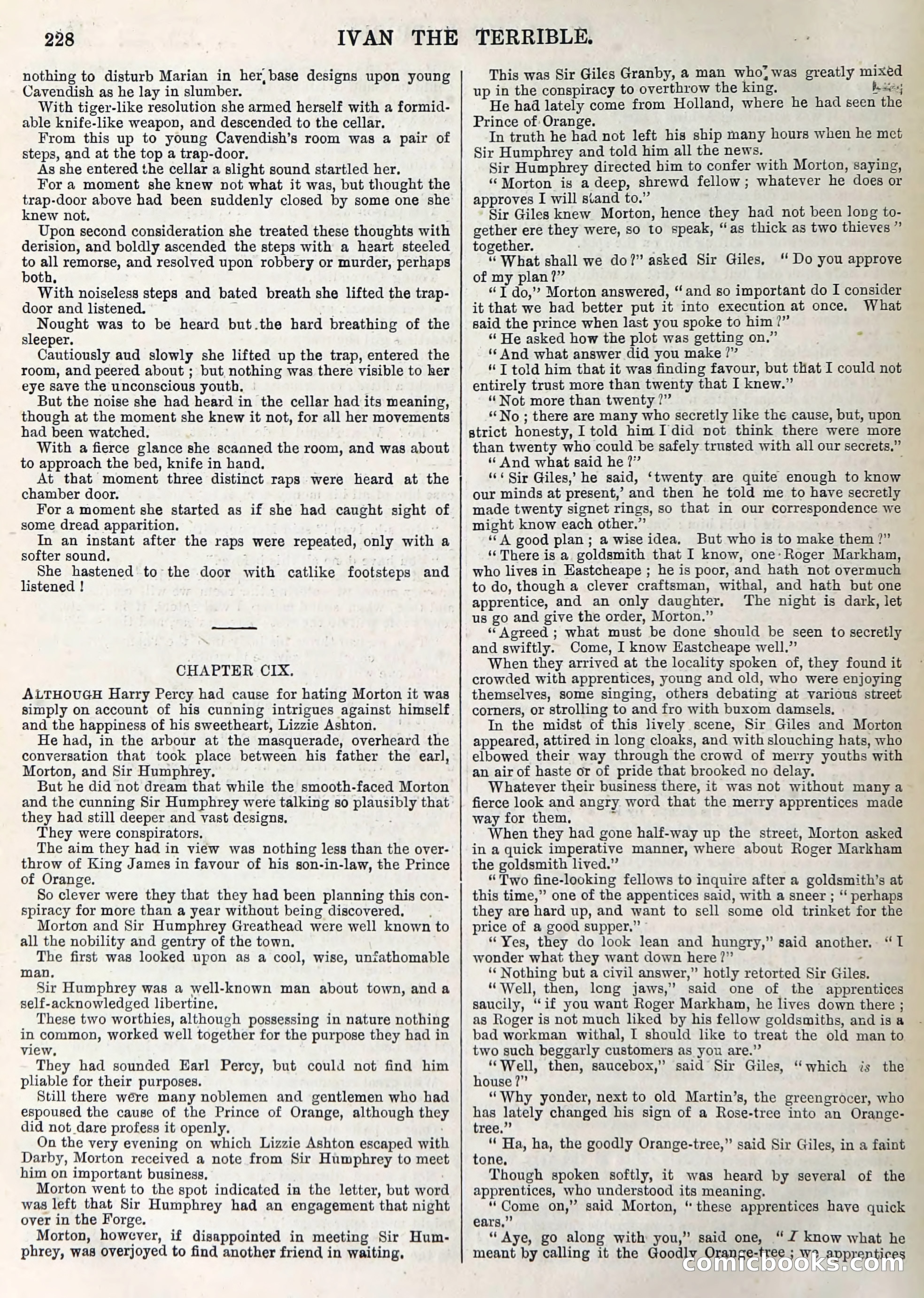
A restored page from Penny Dreadfuls, 1866. Page through the whole issue in the reader above.
📄 Transcribed text from this page (OCR, searchable)
Machine-transcribed from the original scan — historical spelling and the odd misread are preserved.
228 IVAN THE nothing to disturb Marian in her, base designs upon young Cavendish as he lay in slumber. With tiger-like resolution she armed herself with a formid- able knife-like weapon, and descended to the cellar. From this up to young Cavendish’s room was a pair of steps, and at the top a trap-door. As she entered the cellar a slight sound startled her. For a moment she knew not what it was, but thought the trap-door above had been suddenly closed by some one she knew not. Upon second consideration she treated these thoughts with derision, and boldly ascended the steps with a heart steeled to all remorse, and resolved upon robbery or murder, perhaps both, With noiseless steps and bated breath she lifted the trap- door and listened. ; yes Nought was to be heard but.the hard breathing of the sleeper. Cautiously aud slowly she lifted up the trap, entered the room, and peered about ; but, nothing was there visible to her eye save the unconscious youth. But the noise she had heard in the cellar had its meaning, though at the moment she knew it not, for all her movements had been watched. : With a fierce glance she scanned the room, and was about to approach the bed, knife in hand. At that moment three distinct raps were heard at the chamber door. For a moment she started as if she had caught sight of some dread apparition. In an instant after the raps were repeated, only with a softer sound. : e : She hastened to the door with catlike footsteps and listened ! CHAPTER CIX. ALTHOUGH Harry Percy had cause for hating Morton it was simply on account of his cunning intrigues against himself and the happiness of his sweetheart, Lizzie Ashton. He had, in the arbour at the masquerade, overheard the conversation that took place between his father the earl, Morton, and Sir Humphrey. But he did not dream that while the smooth-faced Morton and the cunning Sir Humphrey were talking so plausibly that they had still deeper and vast designs, : They were conspirators. The aim they had in view was nothing less than the over- throw of King James in favour of his son-in-law, the Prince of Orange. So clever were they that they had been planning this con- spiracy for more than a year without being discovered. Morton and Sir Humphrey Greathead were well known to all the nobility and gentry of the town. The first was looked upon as a cool, wise, unitathomable man, Sir Humphrey was a well-known man about town, anda self-acknowledged libertine, These two worthies, although possessing in nature nothing in common, worked well together for the purpose they had in view, They had sounded Earl Perey, but could not find him pliable for their purposes. Still there wére many noblemen and gentlemen who had espoused the cause of the Prince of Orange, although they did not dare profess it openly. On the very evening on which Lizzie Ashton escaped with Darby, Morton received a note from Sir Humphrey to meet him on important business, Morton went to the spot indicated in the letter, but word was left that Sir Humphrey had an engagement that night over in the Forge. Morton, however, if disappointed in meeting Sir Hum- phrey, was overjoyed to find another friend in waiting, TERRIBLE. This was Sir Giles Granby, a man who) was greatly mixed up in the conspiracy to overthrow the king. besex He had lately come from Holland, where he had seen the Prince of: Orange. In truth he had not left his ship many hours when he met Sir Humphrey and told him all the news. — as Sir Humphrey directed him to confer with Morton, saying, “Morton is a deep, shrewd fellow; whatever he does or approves I will stand to.” Sir Giles knew Morton, hence they had not been long to- gether ere they were, so to speak, “as thick as two thieves” together. : | “ What shall we do?” asked Sir Giles, ‘‘ Do you approve of my plan?” “T do,” Morton answered, “and so important do I consider it that we had better put it into execution at once. What said the prince when last you spoke to him ?” ‘He asked how the plot was getting on.” ‘‘ And what answer did you make ?” “T told him that it was finding favour, but that I could not entirely trust more than twenty that I knew.” | “Not more than twenty ?” ‘No ; there are many who secretly like the cause, but, upon strict honesty, I told him I did not think there were more than twenty who could be safely trusted with all our secrets.” “ And what said he ?” ‘‘< Sir Giles,’ he said, ‘twenty are quite enough to know our minds at present,’ and then he told me to have secretly made twenty signet rings, so that in our correspondence we might know each other.”’ ‘‘A good plan; a wise idea, But who is to make them ?” ‘‘There is a goldsmith that I know, one’ Roger Markham, who lives in Eastcheape ; he is poor, and hath not overmuch to do, though a clever craftsman, withal, and hath but one apprentice, and an only daughter, ‘The night is dark, let us go and give the order, Morton.” ‘““ Aoreed ; what must be done should be seen to secretly and swiftly. Come, I know Hastcheape well.” When they arrived at the locality spoken of, they found it crowded with apprentices, young and old, who were enjoying themselves, some singing, others debating at various street corners, or strolling to and fro with buxom damsels,. In the midst of this lively scene, Sir Giles and Morton appeared, attired in long cloaks, and with slouching hats, who elbowed their way through the crowd of merry youths with an air of haste or of pride that brooked no delay. Whatever their business there, it was not without many a fierce look and angry word that the merry apprentices made way for them. When they had gone half-way up the street, Morton asked in a quick imperative manner, where about Roger Markham the goldsmith lived.” “Two fine-looking fellows to inquire after a goldsmith’s at this time,” one of the appentices said, with a sneer ; “ perhaps they are hard up, and want to sell some old trinket for the price of a good supper,” - “Yes, they do look lean and hungry,” said another. “I wonder what they want down here?” , ‘ Nothing but a civil answer,” hotly retorted Sir Giles. “Well, then, long jaws,’ said one of the apprentices saucily, “if you want Roger Markham, he lives down there ; as Roger is not much liked by his fellow goldsmiths, and is a bad workman withal, I should like to treat the old man to two such beggarly customers as you are.” ‘‘ Well, then, saucebox,’” said Sir Giles, ‘“‘which is the house ?” “Why yonder, next to old Martin’s, the greengrocer, who has lately changed his sign of a Rose-tree into an Orange- tree,”’ “ Ha, ha, the goodly Orange-tree,” said Sir Giles, in a faint tone, Though spoken softly, it was heard by several of the apprentices, who understood its meaning. ‘“Come on,” said Morton, “ these apprentices have quick ears,” “ Aye, go along with you,” said one, “Z know what he c meant by calling it the Si CDOS CON: