
Penny Dreadfuls, 1866 · page 217 of 276
Ivan the Terrible; or, Dark Deeds of Night — page 217: what you’re looking at
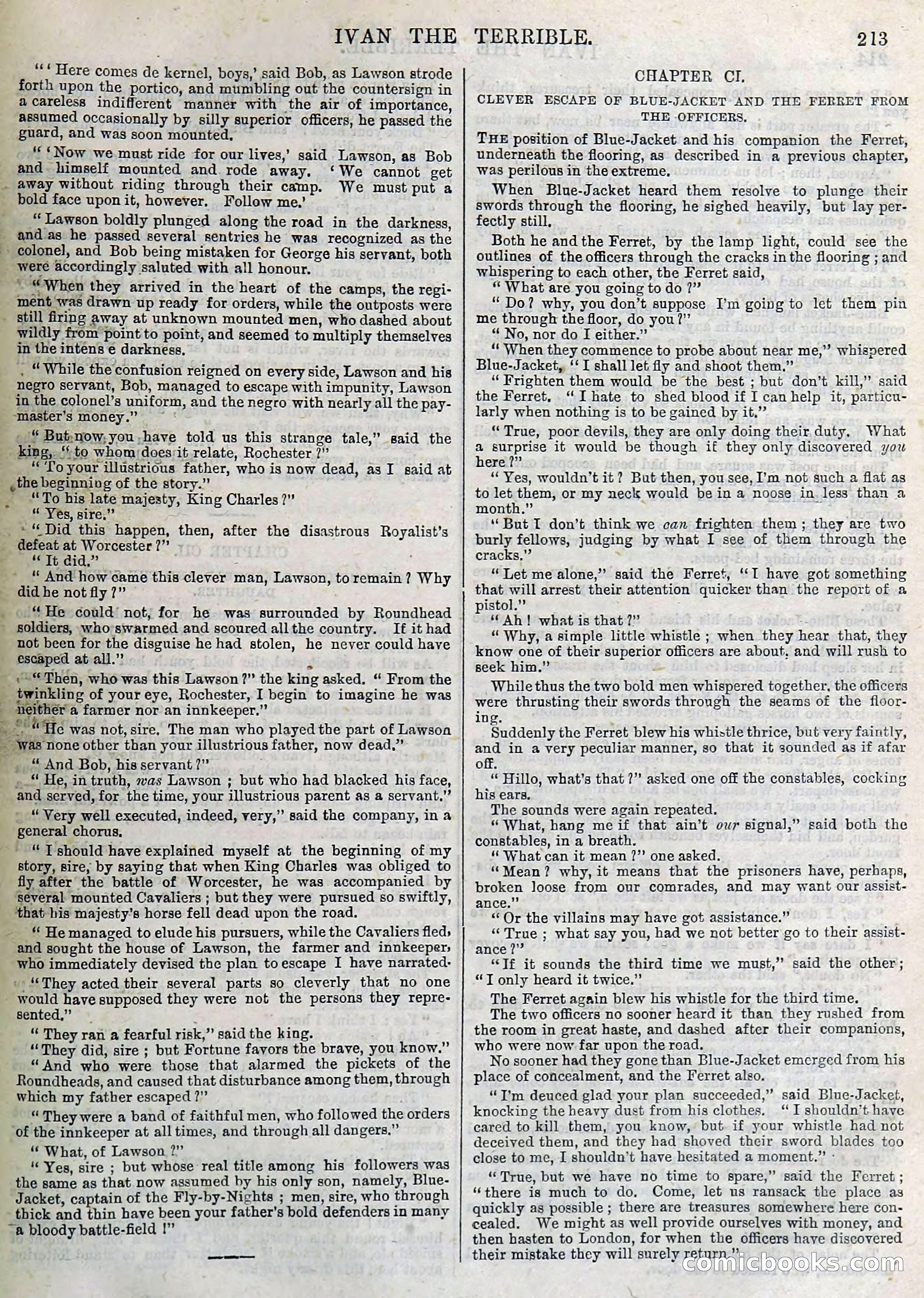
A restored page from Penny Dreadfuls, 1866. Page through the whole issue in the reader above.
📄 Transcribed text from this page (OCR, searchable)
Machine-transcribed from the original scan — historical spelling and the odd misread are preserved.
IVAN THE ““ Here comes de kernel, boys,’ said Bob, as Lawson strode forth upon the portico, and mumbling out the countersign in a careless indifferent manner with the air of importance, ‘assumed occasionally by silly superior officers, he passed the guard, and was soon mounted, se ‘Now we must ride for our lives,’ said Lawson, as Bob _ and himself mounted and rode away, ‘We cannot get away without riding through their camp. We must put a bold face uponit, however. Follow me,’ “ Lawson boldly plunged along the road in the darkness, _andas he passed several sentries he was recognized as the colonel, and Bob being mistaken for George his servant, both _ Were accordingly saluted with all honour. When they arrived in the heart of the camps, the regi- PA ‘- ment was drawn up ready for orders, while the outposts were . we a _ still firing away at unknown mounted men, who dashed about wildly from point to point, and seemed to multiply themselves in the intens e darkness, , “While the confusion reigned on every side, Lawson and his negro servant, Bob, managed to escape with impunity, Lawson _ in the colonel’s uniform, and the negro with nearly all the pay- “master’s money.” : _ |“ But-now,you -have told us this strange tale,” said the _ King,. to whom does:it relate, Rochester ?” __ ** To your illustrious father, who is now dead, asI said at _ the beginning of the story.” “To his late majesty, King Charles ?” Pees, BITE. +» “Did this happen, then, after the disastrous Royalist’s defeat at Worcester?” * eee Sal - ‘< Tt did.” - -_ * And how came this clever man, Lawson, toremain? Why did he not fly 7?” _. “He could’ not, for he was surrounded by Roundhead - soldiers, who swarmed and scoured allthe country. If it had not been for the disguise he had stolen, he never could have escaped at all.” 4 «Then, who was this Lawson?” the king asked. “ From the _ twinkling of your eye, Rochester, I begin to imagine he was either a farmer nor an innkeeper.” We was not, sire, The man who played the part of Lawson ‘as none other than your illustrious father, now dead,” __ “ And Bob, his servant ?” 3 _ _.“ He, in truth, was Lawson ; but who had blacked his face, __and served, for the time, your illustrious parent as a servant,” ; _ “Very well executed, indeed, very,” said the company, in a _ general chorus. - T should have explained myself at the beginning of my . story, sire, by saying that when King Charles was obliged to fly after the battle of Worcester, he was accompanied by _ ‘several mounted Cavaliers ; but they were pursued so swiftly, ‘that his majesty’s horse fell dead upon the road. _ * Hemanaged to elude his pursuers, while the Cavaliers fled, _ and sought the house of Lawson, the farmer and innkeeper; who immediately devised the plan toescape I have narrated- ' They acted their several parts so cleverly that no one - would have supposed they were not the persons they repre- sented,” _ “ They ran a fearful risk,” said the king. “They did, sire ; but Fortune fayors the brave, you know.” “ And who were those that alarmed the pickets of the Roundheads, and caused that disturbance among them, through which my father escaped ?” “ They were a band of faithful men, who followed the orders of the innkeeper at all times, and through all dangers.” “What, of Lawson ?” ‘‘ Yes, sire ; but whose real title among his followers was the same as that now assumed by his only son, namely, Blue- Jacket, captain of the Fly-by-Nights ; men, sire, who through - thick and thin have been your father’s bold defenders in many ~a bloody battle-field |” TERRIBLE. 213 CHAPTER CI. CLEVER ESCAPE OF BLUE-JACKET AND THE FERRET FROM THE -OFFICERS, THE position of Blue-Jacket and his companion the Ferret, underneath the flooring, as described in a previous chapter, was perilous in the extreme, When Blue-Jacket heard them resolve to plunge their swords through the flooring, he sighed heavily, but lay per- fectly still, Both he and the Ferret, by the lamp light, could see the outlines of the officers through the cracks in the flooring ; and whispering to each other, the Ferret said, “ What are you going to do ?” “Do? why, you don’t suppose I’m going to let them pin me through the floor, do you?”’ “ No, nor do I either.” “When they commence to probe about near me,” whispered Blue-Jacket,, ‘‘ I shall let fly and shoot them.” ‘“‘ Wrighten them would be the best ; but don’t kill,” said the Ferret, ‘I hate to shed blood if I can help it, particu- larly when nothing is to be gained by it,” “True, poor devils, they are only doing their.duty, What a surprise it would be though if they only discovered you here ?” “Yes, wouldn’t it? But then, you see, I’m not such a flat as to let them, or my neck would be in a noose in. less than a month.” : “But 1 don’t think we can frighten them ; they are two burly fellows, judging by what I see of them through the cracks,” ‘Let me alone,” said the Ferret, ‘‘I have got something that will arrest their attention quicker than the report of a pistol.” ‘Ah! what is that?” “Why, a simple little whistle ; when they hear that, they know one of their superior officers are about. and will rush to seek him.” -- While thus the two bold men whispered together, the officers were thrusting their swords through the seams of the floor- ing. ; Suddenly the Ferret blew his whistle thrice, but very faintly, and in avery peculiar manner, so that it sounded as if afar off. “Fillo, what’s that?” asked one off the constables, cocking his ears. The sounds were again repeated. “ What, hang meif that ain’t owr signal,” said both the constables, in a breath. “What can it mean ?’’ one asked. “Mean? why, it means that the prisoners have, perhaps, broken loose from our comrades, and may want our assist- ance.” “Or the villains may have got assistance.” “True ; what say you, had we not better go to their assist- ance ?” ‘Tf it sounds the third time we must,’ said the other; “T only heard it twice.” The Ferret again blew his whistle for the third time. The two officers no sooner heard it than they rushed from the room in great haste, and dashed after their companions, who were now far upon the road. No sooner had they gone than Blue-Jacket emerged from his place of concealment, and the Ferret also. “T’m deuced glad your plan succeeded,” said Blue-Jacket, knocking the heavy dust from his clothes. ‘I shouldn’t have cared to kill them, you know, but. if your whistle had not deceived them, and they had shoved their sword blades too close to me, I shouldn’t have hesitated a moment.” - “True, but we have no time to spare,” said the Ferret ; ‘‘there is much to do. Come, let us ransack the place as quickly as possible ; there are treasures somewhere here con- cealed. We might as well provide ourselves with money, and then hasten to London, for when the officers have discovered their mistake they will surely Eom fe 5) ookeecom