
Penny Dreadfuls, 1866 · page 206 of 276
Ivan the Terrible; or, Dark Deeds of Night — page 206: what you’re looking at
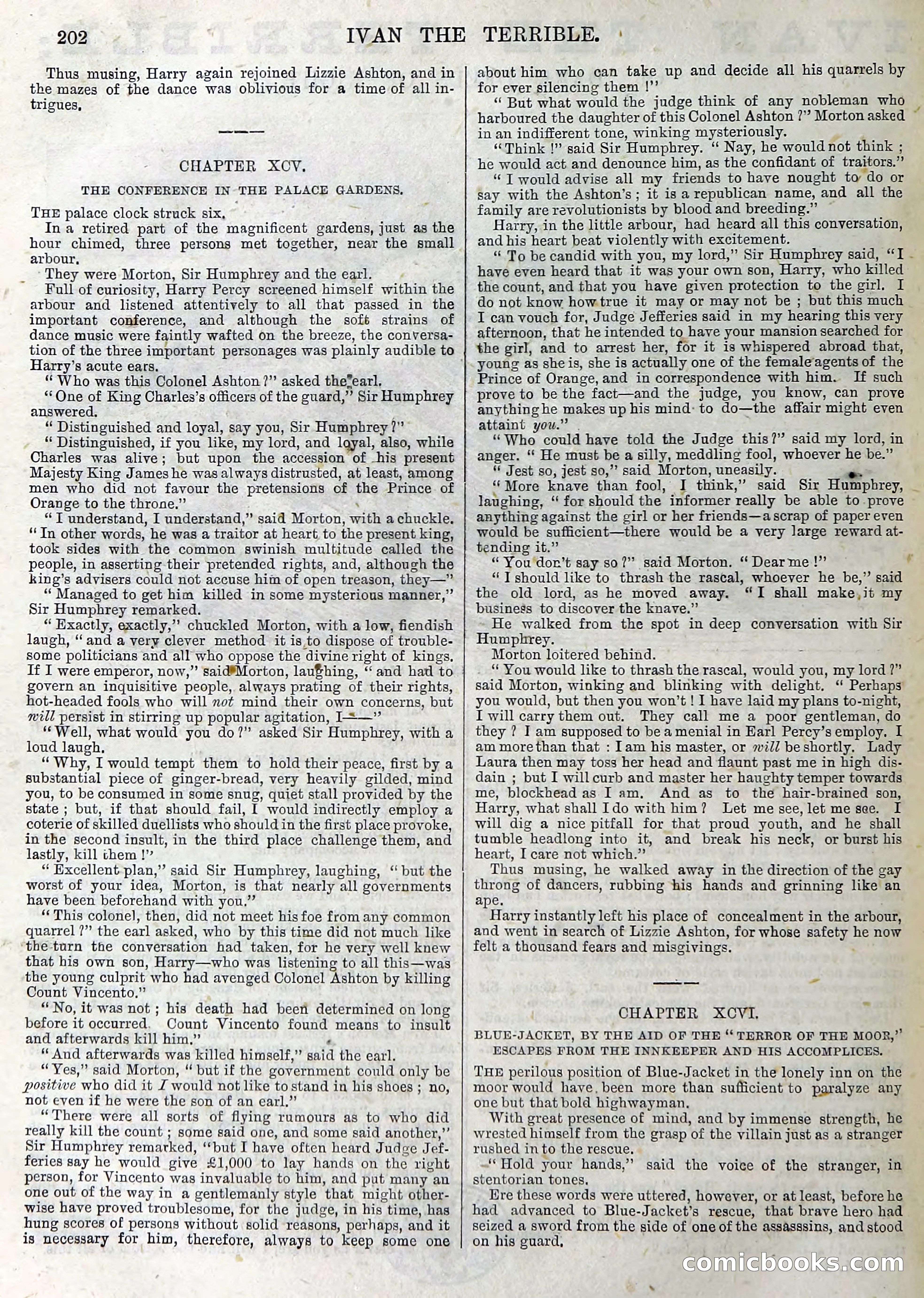
A restored page from Penny Dreadfuls, 1866. Page through the whole issue in the reader above.
📄 Transcribed text from this page (OCR, searchable)
Machine-transcribed from the original scan — historical spelling and the odd misread are preserved.
202 Thus musing, Harry azain rejoined Lizzie Ashton, and in the mazes of the dance was oblivious for a time of all in- trigues, CHAPTER XCY, THE CONFERENCE IN-THE PALACE GARDENS, THE palace clock struck six, In a retired part of the magnificent gardens, just as the hour chimed, three persons met together, near the small arbour, They were Morton, Sir Humphrey and the earl. Full of curiosity, Harry Percy screened himself within the arbour and listened attentively to all that passed in the important conference, and although the soft strains of dance music were faintly wafted on the breeze, the conversa- tion of the three important personages was plainly audible to Harry’s acute ears. “Who was this Colonel Ashton ?’”’ asked the®earl, “One of King Charles’s officers of the guard,”’ Sir Humphrey answered. “ Distinguished and loyal, say you, Sir Humphrey?” “ Distinguished, if you like, my lord, and lgyal, also, while Charles was alive; but upon the accession of -his present Majesty King James he was always distrusted, at least, among men who did not favour the pretensions of the Prince of Orange to the throne.” ‘ “ T understand, I understand,” said Morton, with a chuckle. ‘In other words, he was a traitor at heart to the present king, took sides with the common swinish multitude called the people, in asserting their pretended rights, and, although the king’s advisers could not accuse him of open treason, they—” ““ Managed to get him killed in some mysterious manner,” Sir Humphrey remarked. “ Exactly, exactly,’’ chuckled Morton, with a low, fiendish laugh, “and a very clever method it is to dispose of trouble- some politicians and all who oppose the divine right of kings, If I were emperor, now,’’ said®Morton, lau®hing, “ and had to govern an inquisitive people, always prating of their rights, hot-headed fools who will not mind their own concerns, but mill persist in stirring up popular agitation, [~—” “Well, what would you do?” asked Sir Humphrey, with a loud laugh, “Why, I would tempt them to hold their peace, first by a substantial piece of ginger-bread, very heavily gilded, mind you, to be consumed in some snug, quiet stall provided by the state ; but, if that should fail, I would indirectly employ a coterie of skilled duellists who should in the first place provoke, in the second insult, in the third place challenge them, and lastly, kill them !” “ Excellent plan,” said Sir Humphrey, laughing, ‘“ but the worst of your idea, Morton, is that nearly all governments have been beforehand with you.” “This colonel, then, did not meet his foe from any common quarrel ?” the earl asked, who by this time did not much like ‘the-turn the conversation had taken, for he very well knew that his own son, Harry—who was listening to all this—was the young culprit who had avenged Colonel Ashton by killing Count Vincento.” “No, it was not ; his death had been determined on long before it occurred. Count Vincento found means to insult and afterwards kill him,” ‘ “And afterwards was killed himself,” said the earl. “Yes,” said Morton, “ but if the government could only be positive who did it J would not like to stand in his shoes ; no, not even if he were the son of an earl,’’ “There were all sorts of flying rumours as to who did really kill the count ; some said one, and some said another,” Sir Humphrey remarked, “but I have often heard Judge Jef- feries say he would give £1,000 to lay hands on the right person, for Vincento was invaluable to him, and put many an one out of the way in a gentlemanly style that might other- wise have proved troublesome, for the judge, in his time, has hung scores of persons without solid reasons, perhaps, and it is necessary for him, therefore, always to keep some one IVAN THE TERRIBLE. ° about him who can take up and decide all his quarrels by for ever silencing them !”’ “ But what would the judge think of any nobleman who harboured the daughter of this Colonel Ashton ?” Morton asked in an indifferent tone, winking mysteriously. ° “Think !” said Sir Humphrey. “‘ Nay, he would not think ; he would act and denounce him, as the confidant of traitors.” ‘“ T would advise all my friends to have nought to do or say with the Ashton’s; it is a republican name, and all the family are revolutionists by blood and breeding.” ~ : Harry, in the little arbour, had heard all this conversation, and his heart beat violently with excitement. “ To be candid with you, my lord,” Sir Humphrey said, “TI have even heard that it was your own son, Harry, who killed the count, and that you have given protection to the girl. I / do not know howtrue it may or may not be ; but this much - T can vouch for, Judge Jefferies said in my hearing this very afternoon, that he intended to have your mansion searched for the girl, and to arrest her, for it is whispered abroad that, young as she is, she is actually one of the femaleagents of the Prince of Orange, and in correspondence with him. If such prove to be the fact—and the judge, you know, can prove anything he makes up his mind: to do—the affair might even attaint you.” . “Who could have told the Judge this?” said my lord, in anger. “ He must be a silly, meddling fool, whoever he be.” “ Jest so, jest so,”’ said Morton, uneasily. “More knave than fool, I think,” said Sir Humphrey, — laughing, ‘“ for should the informer really be able to prove ~ anything against the girl or her friends—ascrap of paper even would be sufficient—there would be a very large reward at- tending it.” “ You don’t say so?’ said Morton. “ Dearme !” “ T should like to thrash the rascal, whoever he be,” said the old lord, as he moved away. “I shall make,it my business to discover the knave.” ~ He walked from the spot in deep conversation with Sir Humphrey. Morton loitered behind. = _ “You would like to thrash the rascal, would you, my lord ?” said Morton, winking and blinking with delight. ‘“‘ Perhaps’ you would, but then you won’t ! I have laid my plans to-night, I will carry them out. they ? I am supposed to be a menial in Earl Percy’semploy. I am morethan that : lam his master, or wid/ beshortly. Lady Laura then may toss her head and flaunt past me in high dis- dain ; but I willcurb and master her haughty temper towards me, blockhead as I am. And as to the hair-brained son, Harry, what shall Ido with him? Let me see,let me see. I will dig a nice pitfall for that proud youth, and he shall tumble headlong into it, and break his neck, or burst his heart, I care not which.” They call me a poor gentleman, do — Thus musing, he walked away in the direction of the gay throng of dancers, rubbing his hands and grinning like an ape. . Harry instantly left his place of concealment in the arbour, and went in search of Lizzie Ashton, for whose safety he now felt a thousand fears and misgivings. : CHAPTER XCYI, BLUE-JACKET, BY THE AID OF THE “ TERROR OF THE MOOR,” ESCAPES FROM THE INNKEEPER AND HIS ACCOMPLICES. THE perilous position of Blue-Jacket in the lonely inn on the moor would have, been more than sufficient to paralyze any one but that bold highwayman. With great presence of mind, and by immense strength, he wrested himself from the grasp of the villain just as a stranger rushed in to the rescue. ‘Hold your hands,” said the voice of the stranger, in stentorian tones. Hre these words were uttered, however, or at least, before he had advanced to Blue-Jacket’s rescue, that brave hero had seized a sword from the side of one of the assasssins, and stood on his guard, (eo) books:com im (¢ ®