
Penny Dreadfuls, 1866 · page 195 of 276
Ivan the Terrible; or, Dark Deeds of Night — page 195: what you’re looking at
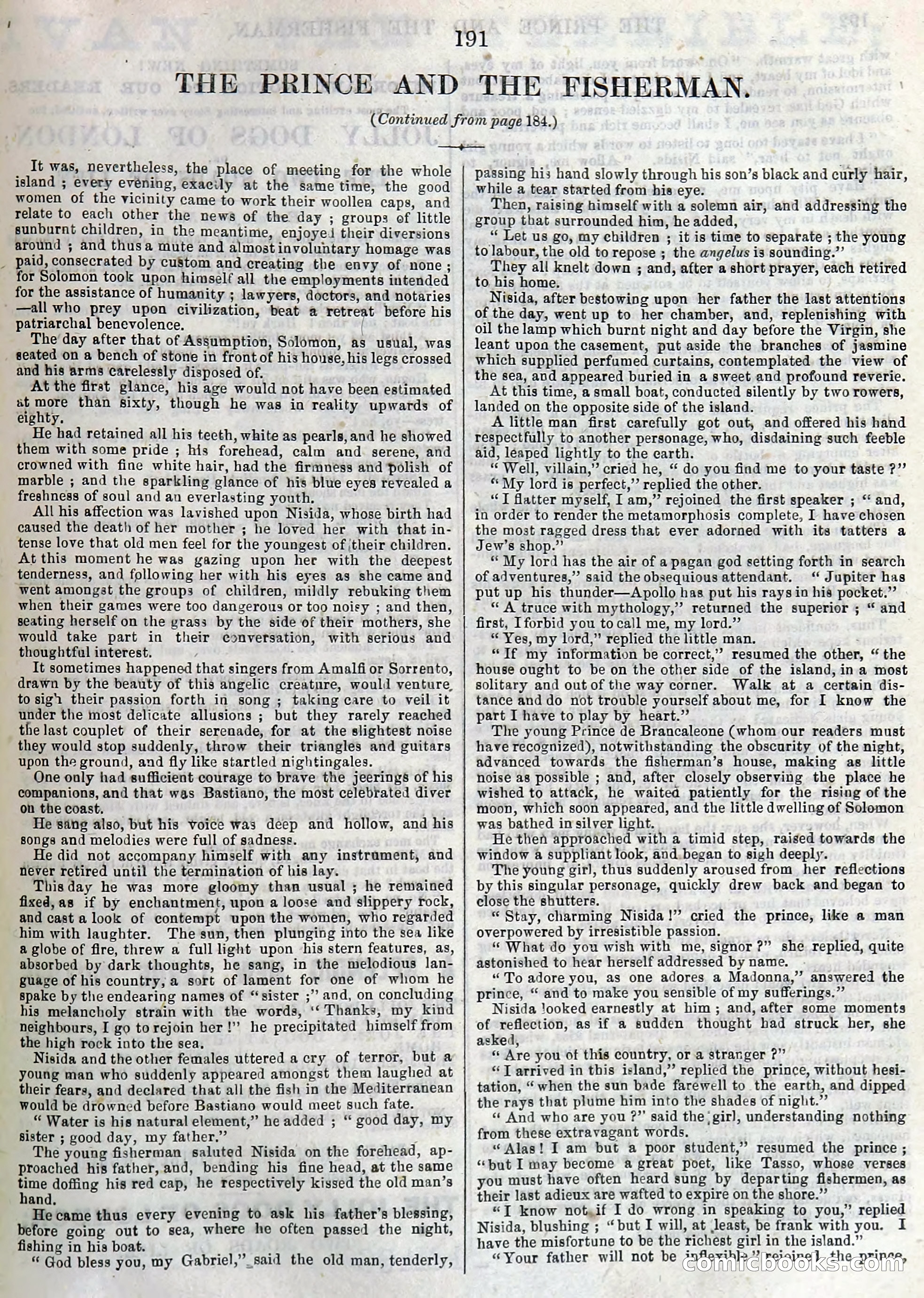
A restored page from Penny Dreadfuls, 1866. Page through the whole issue in the reader above.
📄 Transcribed text from this page (OCR, searchable)
Machine-transcribed from the original scan — historical spelling and the odd misread are preserved.
191 THE PRINCE AND THE FISHERMAN. (Continued from page 184.) — __It was, nevertheless, the place of meeting for the whole island ; every evening, exacily at the same time, the good women of the vicinity came to work their woollen caps, and relate to each other the news of the day ; groups of little sunburnt children, in the meantime, enjoyei their diversions around ; and thusa mute and almost involuntary homage was paid, consecrated by cu8tom and creating the envy of none; for Solomon took upon himself all the employments intended for the assistance of humanity ; lawyers, doctors, and notaries _—all who prey upon civilization, beat a retreat before his patriarchal benevolence. The day after that of Assumption, Solomon, as usual, was _ seated on a bench of stone in front of his house, his legs crossed and his arms carelessly disposed of. At the first glance, his age would not have been estimated at mee than sixty, though he was in reality upwards of eighty. He had retained all his teeth, white as pearls,and he showed them with some pride ; his forehead, calm and. serene, and crowned with fine white hair, had the firmness and polish of marble ; and the sparkling glance of his blue eyes revealed a freshness of soul and au everlasting youth. All his affection was lavished upon Nisida, whose birth had caused the death of her mother ; he loved her with that in- tense love that old men feel for the youngest of their children. At this moment he was gazing upon her with the deepest tenderness, and following her with his eyes as she came and went amongst the groups of children, mildly rebuking them when their games were too dangerous or too noisy ; and then, seating herself on the grass by the side of their mothers, she would take part in their conversation, with serious and thoughtful interest. / It sometimes happened that singers from Amalfi or Sorrento, drawn by the beauty of this angelic creature, would venture to sig their passion forth in song ; taking care to veil it under the most delicate allusions ; but they rarely reached _thelast couplet of their serenade, for at the slightest noise they would stop suddenly, throw their triangles and guitars upon the ground, and fly like startled nightingales. One only had sufficient courage to brave the jeerings of his companions, and that was Bastiano, the most celebrated diver on the coast. He sing also, but his voice was deep and hollow, and his songs and melodies were full of sadness. He did not accompany himself with any instrument, and never retired until the termination of his lay. Thisday he was more gloomy than usual ; he remained fixed, as if by enchantment, upon a loose and slippery rock, and cast a look of contempt upon the women, who regarded him with laughter. The sun, then plunging into the sea like a globe of fire, threw a full light upon his stern features, as, absorbed by dark thoughts, he sang, in the melodious lan- guage of his country, a sort of lament for one of whom he spake by the endearing names of “sister ;” and, on concluding his melancholy strain with the words, ‘‘ Thanks, my kind neighbours, I go torejoin her!” he precipitated himself from the high rock into the sea, Nisida and the other females uttered a cry of terror, but a young man who suddenly appeared amongst them laughed at their fears, and declared that all the fish in the Mediterranean would be drowned before Bastiano would meet such fate. “ Water is his natural element,” he added ; “ good day, my sister ; good day, my father.” The young fisherman saluted Nisida on the forehead, ap- proached his father, and, bending his fine head, at the same pe doffing his red cap, he respectively kissed the old man’s and. He came thus every evening to ask his father’s blessing, ore going out to sea, where he often passed the night, fishing in his boat. ‘ : “ God bless you, my Gabriel,”_said the old man, tenderly, passing his hand slowly through his son’s black and curly hair, while a tear started from his eye. Then, raising himself with a solemn air, and addressing the group that surrounded him, he added, “‘ Let us go, my children ; it is time to separate ; the young to labour, the old to repose ; the angelus is sounding.”’ They all knelt down ; and, after a short prayer, each retired to his home. Nisida, after bestowing upon her father the last attentions of the day, went up to her chamber, and, replenishing with oil the lamp which burnt night and day before the Virgin, she leant upon the casement, put aside the branches of jasmine which supplied perfumed curtains, contemplated the view of the sea, and appeared buried in a sweet and profound reverie. At this time, a small boat, conducted silently by two rowers, landed on the opposite side of the island. A little man first carefully got out, and offered his hand respectfully to another personage, who, disdaining such feeble aid, léaped lightly to the earth. ** Well, villain,’ cried he, “ do you find me to your taste ?” “My lord is perfect,’’ replied the other. “‘T flatter myself, I am,” rejoined the first speaker ; “‘ and, in order to render the metamorphosis complete, I have chosen the most ragged dress that ever adorned with its tatters a Jew’s shop.” “ My lord has the air of a pagan god setting forth in search of adventures,” said the obsequious attendant. ‘ Jupiter has put up his thunder—Apollo has put his raysin his pocket.” “A truce with mythology,” returned the superior ; “ and first, Iforbid you to call me, my lord.” “Yes, my lord,” replied the little man. “If my information be correct,’ resumed the other, “ the house ought to be on the other side of the island, ina most solitary and outof the way corner. Walk at a certain dis- tance and do not trouble yourself about me, for I know the part I have to play by heart.” The young Prince de Brancaleone (whom our readers must have recognized), notwithstanding the obscurity of the night, advanced towards the fisherman’s house, making ag little noise as possible ; and, after closely observing the place he wished to attack, he waited patiently for the rising of the moon, which soon appeared, and the little dwelling of Solomon was bathed inmsilver light. He then approached with a timid step, raised towards the window a suppliant look, and.began to sigh deeply. The young girl, thus suddenly aroused from her reflections by this singular personage, quickly drew back and began to close the shutters. “ Stay, charming Nisida!” cried the prince, like a man overpowered by irresistible passion. ““ What do you wish with me, signor ?” she replied, quite astonished to hear herself addressed by name. “To adore you, as one adores a Madonna,” answered the prince, “ and to make you sensible of my sufferings.”’ Nisida !ooked earnestly at him; and, after some moments of reflection, as if a sudden thought had struck her, she asked “ Are you of this country, or a stranger ?”’ ‘J arrived in this island,” replied the prince, without hesi- tation, “ when the sun bade farewell to the earth, and dipped the rays that plume him into the shades of night.” «* And who are you ?”’ said the ‘girl, understanding nothing from these extravagant words. “Alas! I am but a poor student,’ resumed the prince ; “but I may become a great poet, like Tasso, whose verses you must have often heard sung by departing fishermen, as their last adieux are wafted to expire on the shore.” “J know not if I do wrong in speaking to you,” replied Nisida, blushing ; “but I will, at least, be frank with you. I have the misfortune to be the richest girl in the island.” “Your father will not be GOMIGHOOI<SEC OI