
Penny Dreadfuls, 1866 · page 19 of 276
Ivan the Terrible; or, Dark Deeds of Night — page 19: what you’re looking at
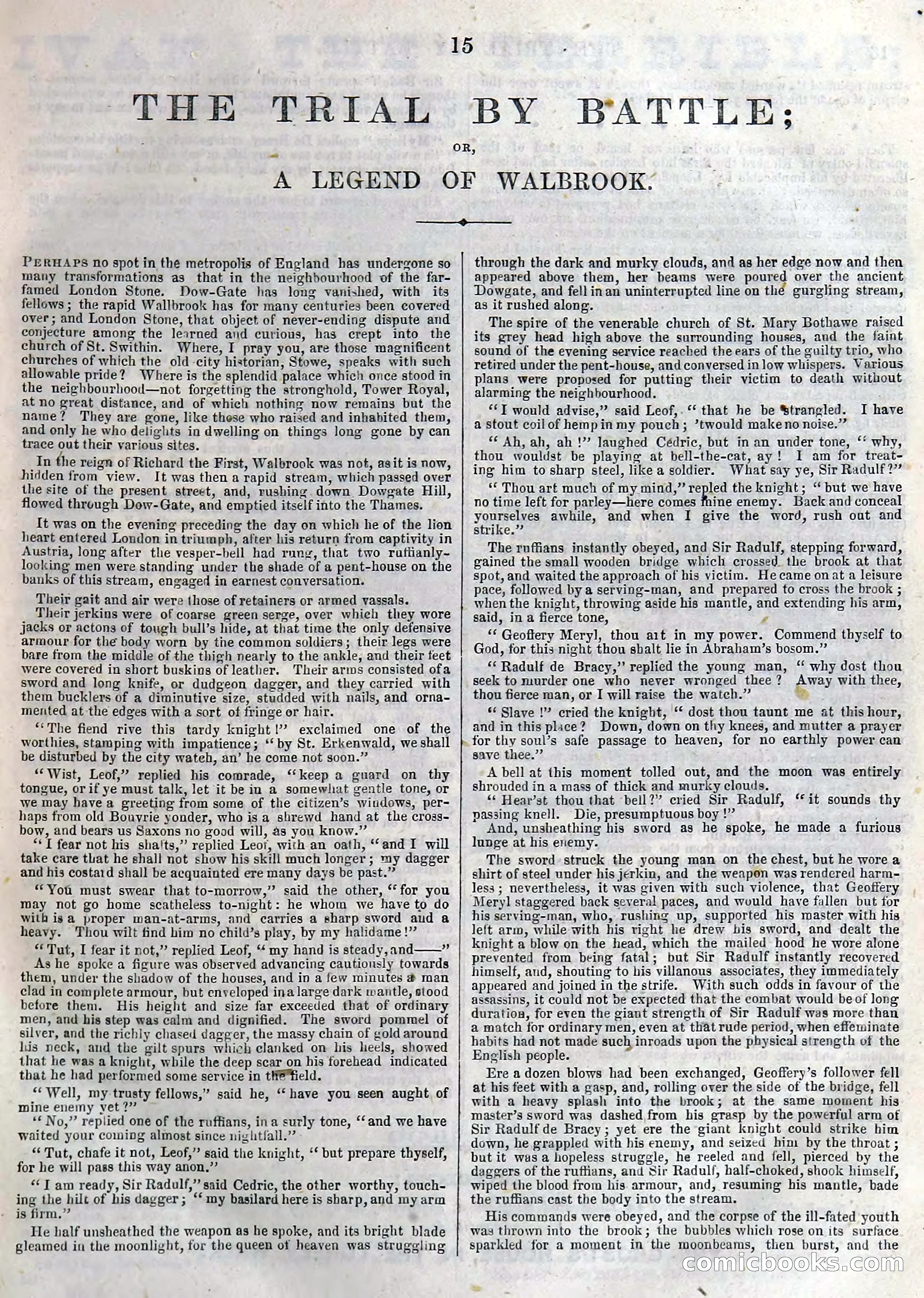
A restored page from Penny Dreadfuls, 1866. Page through the whole issue in the reader above.
📄 Transcribed text from this page (OCR, searchable)
Machine-transcribed from the original scan — historical spelling and the odd misread are preserved.
15 THE TRIAL BY BATTLE; OR, A LEGEND OF WALBROOK. PERHAPS no spot in the metropolis of England has undergone so many transformations as that in the neighbourhood of the far- famed London Stone. Dow-Gate has long vanished, with its fellows ; the rapid Wallbrook has for many centuries been covered over; and London Stone, that object of never-ending dispute and conjecture among the learned and curious, has crept into the church of St. Swithin. Where, I pray you, are those magnificent churches of which the old -city historian, Stowe, speaks with such allowable pride? Where is the splendid palace which once stood in the neighbourhood—not forgetting the stronghold, Tower Royal, at no great distance, and of which nothing now remains but the name? They are gone, like these who raised and inhabited them, and only he who delights in dwelling on things long gone by can trace out their various sites. In the reign of Richard the First, Walbrook was not, asit is now, hidden from view. It was then a rapid stream, which passed over the site of the present street, and, rushing down Dowgate Hill, flowed through Dow-Gate, and emptied itself into the Thames. It was on the evening preceding the day on which he of the lion heart entered London in triumph, after his return from captivity in Austria, long after the vesper-bell had rung, that two rattianly~ looking men were standing under the shade of a pent-house on the banks of this stream, engaged in earnest conversation. Their gait and air were those of retainers or armed vassals. : Their jerkins were of coarse green serge, over which they wore jacks or actons of tough bull’s hide, at that time the only defensive armour for the body worn by the common soldiers; their legs were bare from the middle of the thigh nearly to the ankle, and their feet were covered in short buskins of leather. Their arws consisted ofa sword and long knife, or dudgeon dagger, and they carried with them bucklers of a diminutive size, studded with nails, and orna- mented at the edges with a sort of fringe or hair. “‘The fiend rive this tardy knight |’? exclaimed one of the worthies, stamping with impatience; ‘‘ by St. Erkenwald, we shall be disturbed by the city wateh, an’ he come not soon.” ‘‘Wist, Leof,” replied his comrade, “keep a guard on thy tongue, orif ye must talk, let it be in a somewhat gentle tone, or we may havea greeting from some of the citizen’s wiudows, per- haps from old Bouyrie yonder, who is a shrewd hand at the cross- bow, and bears us Saxons no good will, 4s you know.” “* I fear not his sha/ts,” replied Leor, with an oath, “and I will take care that he shall not show his skill much longer; my dagger and his costaid shall be acquainted ere many days be past.” “You must swear that to-morrow,” said the other, ‘for you may not go home scatheless to-night: he whom we have to do with ig a proper man-at-arms, and carries a sharp sword and a heavy. Thou wilt find him no child’s play, by my halidame!” ** Tut, I fear if not,’ replied Leof, ‘‘ my hand is steady, and——” Ashe spoke a figure was observed advancing cautionsly towards them, under the shadow of the houses, and in a few minutes @ man clad in complete armour, but enveloped ina large dark mantle, stood before them. His height and size far exceeded that of ordinary men, and his step was calm and dignified. The sword pommel of silver, and the richly chased dagger, the massy chain of gold around lis neck, and the gilt spurs which clanked on his heels, showed that he was a knight, while the deep scar on his forehead indicated that he had performed some service in tl@tfield. “Well, my trusty fellows,” said he, ‘‘ have you seen aught of mine enemy vet ?” ‘* No,” replied one of the ruffians, ina surly tone, ‘‘and we have waited your coming almost since nightfall.” “Tut, chafe it not, Leof,” said the knight, ‘‘ but prepare thyself, for he will pass this way anon.” “‘T am ready, Sir Radulf,” said Cedric, the other worthy, touch- ing the hilt of his dagger; ‘‘ my basilard here is sharp, and my arm is firm,” He half unsheathed the weapon as he spoke, and its bright blade gleamed in the moonlight, for the queen of heaven was struggling through the dark and murky clouds, and as her edge now and then appeared above them, her beams were poured over the ancient Dowgate, and fell inan uninterrupted line on the gurgling stream, as it rushed along. _ The spire of the venerable church of St. Mary Bothawe raised its grey head high above the surrounding houses, and the faint sound of the evening service reached the ears of the guilty trio, who retired under the pent-house, and conversed in low whispers. Various plans were proposed for putting their victim to death without alarming the neighbourhood. **¥ would advise,” said Leof,.‘‘ that he be Strangled. a stout coilof hempinmy pouch; ’twould makeno noise.” *€ Ah, ah, ah !”’ Jaughed Cédric, but in an under tone, ‘* why, thou wouldst be playing at bell-the-cat, ay! I am for treat- ing him to sharp steel, like a soldier. What say ye, Sir Radulf?” ** Thou art much of my mind,” repled the knight; ‘‘ but we have no time left for parley—here comes fhine enemy. Back and conceal yourselves awhile, and when I give the word, rush out and strike.” The rnffians instantly obeyed, and Sir Radulf, stepping forward, gained the small wooden bridge which crossed the brook at that spot, and waited the approach of his victim. Hecame onat a leisure pace, followed bya serving-man, and prepared to cross the brook ; when the knight, throwing aside his mantle, and extending his arm, said, in a fierce tone, e ‘* Geoftery Mery], thou ait in my power. Commend thyself to God, for this night thou shalt lie in Abraham’s bosom.” ‘‘ Radulf de Bracy,’’ replied the young man, ‘ why dost thou seek to murder one who never wronged thee ? grey with thee, thou fierce man, or I will raise the watch.” 2 ‘* Slave !” cried the knight, “‘ dost thou taunt me at this hour, and in this place? Down, down on thy knees, and mutter a prayer I have _for thy soul’s safe passage to heaven, for no earthly power can save thee.” A bell at this moment tolled out, and the moon was entirely shrouded in a mass of thick and murky clouds. “« Hear’st thou that bell?” cried Sir Radulf, “it sounds thy passing knell. Die, presumptuous boy !” And, unsheathing his sword as he spoke, he made a furious lunge at his erlemy. The sword struck the young man on the chest, but he wore a shirt of steel under his jerkin, and the weapon was rendered harm- les3 ; nevertheless, it was given with such violence, that Geoftery Meryl staggered back several paces, and would have fallen but tor his serving-man, who, rushing up, supported his master with his left arm, while with his right he drew his sword, and dealt the knight a blow on the head, which the mailed hood he wore alone prevented from being fatal; but Sir Radulf instantly recovered himself, and, shouting to his villanous associates, they immediately appeared and joined in the strife. With such odds in favour of the assassins, it could not be expected that the combat would be of long duration, for even the giant strength of Sir Radulf was more than a match for ordinary men, even at that rude period, when effeminate habits had not made such inroads upon the physical strength of the English people. Ere a dozen blows had been exchanged, Geoffery’s follower fell at his feet with a gasp, and, rolling over the side of the bridge, fell with a heavy splash into the brook; at the same moment his master’s sword was dashed from his grasp by the powerful arm of Sir Radulf de Bracy; yet ere the giant knight could strike him down, he grappled with his enemy, and seized him by the throat ; but it was a hopeless struggle, he reeled and fell, pierced by the daggers of the ruftians, and Sir Radulf, half-choked, shook himself, wiped the blood from his. armour, and, resuming his mantle, bade the ruffians cast the body into the stream. His commands were obeyed, and the corpse of the ill-fated youth was thrown into the brook; the bubbles which rose on its surface sparkled for a moment in the moonbeams, tlien burst, and the (COMMICLOOOKS.CORN = ‘