
Penny Dreadfuls, 1866 · page 171 of 276
Ivan the Terrible; or, Dark Deeds of Night — page 171: what you’re looking at
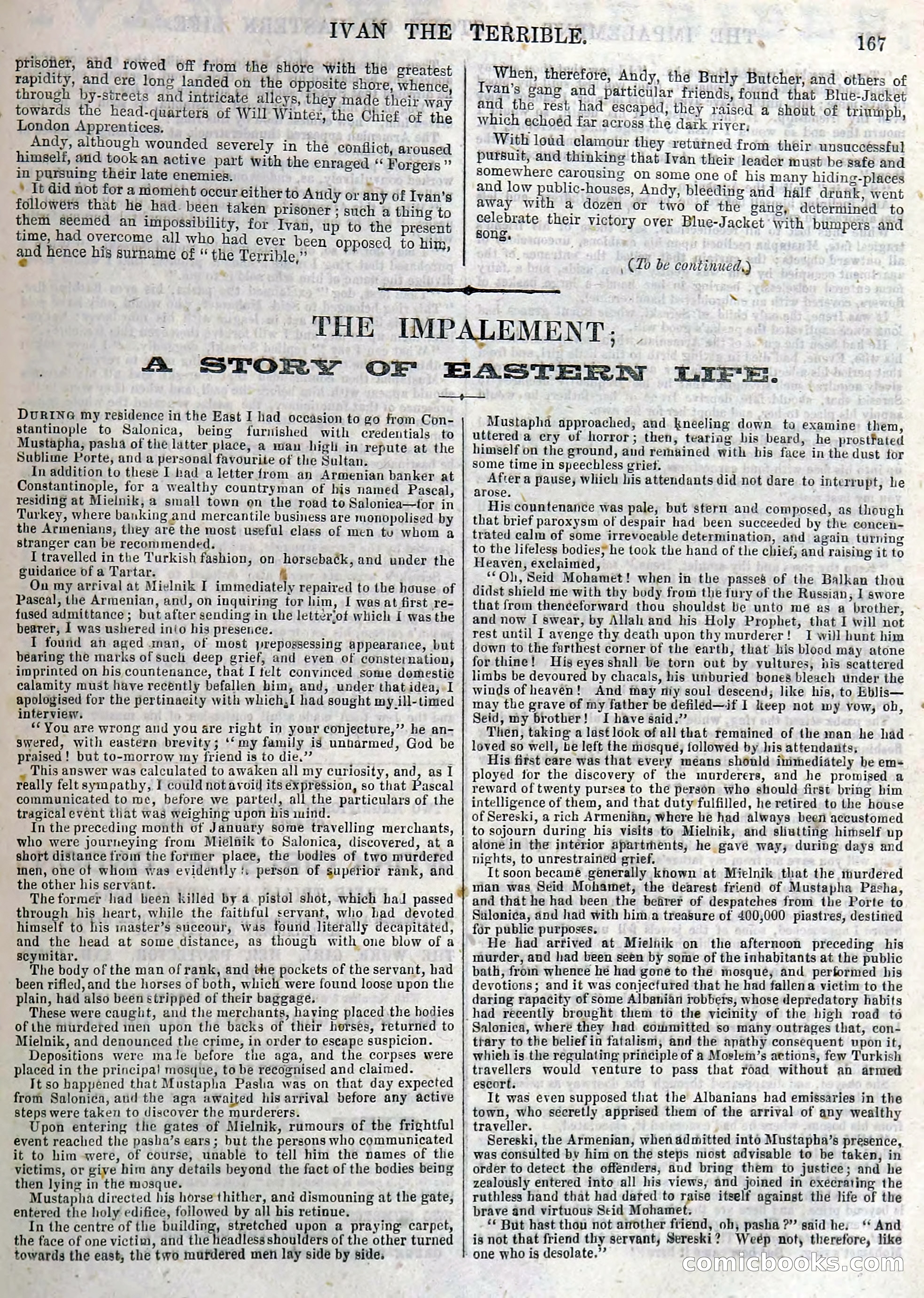
A restored page from Penny Dreadfuls, 1866. Page through the whole issue in the reader above.
📄 Transcribed text from this page (OCR, searchable)
Machine-transcribed from the original scan — historical spelling and the odd misread are preserved.
IVAN THE prisoner, and rowed off from the shore with the greatest rapidity, and ere lon¢ landed oh the opposite shore, whence, through by-streets and intticate alleys, they made their way towards the head-quarters of Will Winter, the Chief of the London Apprentices, Andy, although wounded severely in the conflict, aroused himself, aid tookan active part with the enraged “ Forgers ” athe ats med late enemies. q .* It did not for a moment occur either to Andy or any of Ivan’s followers that he had. been taken nhiabier sacl thing to them seemed an impossibility, for Ivan, up to the present time, had overcome all who had ever been opposed to him, and hence his surname of “ the Terrible,” | & TERRIBLE. 167 When, therefore, Andy, the Barly Butcher, and others of Ivan’s gang and patticilar friends, found that Blue-Jacket and the rest had escaped, they raised a shout of trivinph, which echoéd far across the dark river, With loud clamour they retuined from their unsuccessful pursuit, and thinking that Ivan their leader must be safe and somewhere carousing on some one of his many hiding-placeés and low public-houses, Andy, bleeding and half druhk, went away with a dozen or two of the gang, determined to celebrate their victory over Blue-Jacket with bumpers and song, _ (0 be continued, ~ THE IMPALEMENT; A STORY OF EASTERD Lier. ——_.——_ DURING my residence in the East I had occasion to go from Con- stantinople to Salonica, being furnished with credentials to Mustapha, pasha of the latter place, a wan high in repute at the Sublime Porte, and a personal favourite of the Sultan. _In addition to these I had a letter from an Armenian banker at Constantinople, for a wealthy countryman of his named Pascal, residing at Mielnik,a small town on the road to Salonica—tor in Turkey, where banking and mercantile business are monopolised by the Armenians, they are the most useful class of men tu whom a stranger can be recommended. I travelled in the Turkish fashion, on horsebaék, and under the guidarice of a Tartar. | 4 On my arrival at Mielnik I immediately repaired to the house of Pascal, the Armenian, and, on inquiring tor him, I was at first re- fused admittance; but after sending in the letter‘ot which I was the bearer, I was ushered in(o his presence. I fourid an aged man, of most prepossessing appearance, but bearing the marks of such deep grief, and even of consternation, imprinted on his countenance, that I telt convinced some domestic calamity must have recently befallen him, and, under that idea, I apologised for the pertinacity with which,I had sought my ill-timed interview. ‘You are wrong and you are right in your conjecture,” he an- swered, with eastern brevity; ‘‘my family is unharmed, God be praised! but to-morrow my friend is to die,” ; This answer was calculated to awaken all my curiosity, and, as I really felt sympathy, I could not avoid its éxpression, so that Pascal communicated to me, before we parted, all the particulars of the tragical event tliat was weighing upon his mind. In the preceding month of January some travelling merchants, who were journeying from Miélnik to Salonica, discovered, at a short distance trom the former place, the bodies of two murdered inen, one of whom was evidently ‘: person of superior rank, and the other his servant. Theformer had been killed by a. pistol shot, which had passed through his heart, while the faithful servant, wlio had devoted himself to his inaster’s suceour, Was found literally decapitated, and the head at some distance, as though with one blow of a scymitar. The body of the man of rank, and the pockets of the servant, had been rifled, and the horses of both, which were found loose upon the plain, had also been stripped of their baggage. These were caught, and the merchants, having placed .the hodies of the murdered men upon the backs of their horses, returned to Mielnik, and denounced the crime, in order to escape suspicion. Depositions were male before the aga, and the corpses were placed in the principa! mosque, to be recognised and claimed. It so happéned that Mustapha Paslia was on that day expected from Salonica, and the aga awaited his arrival before any active steps were taken to discover the murderers. ‘ Upon entering the gates of Mielnik, rumours of the frightful event reached the pasha’s ears; but the persons who communicated it to him were, of course, unable to tell him the names of the vietims, or give him any details beyond the fact of the bodies being then lying in the mosque. : : Mustapha directed his horse thither, and dismouning at the gate, entered the holy edifice, followed by all his retinue. ; In the centre of tle building, stretched upon a praying carpet, the face of one victim, and the headless shoulders of the other turned towards the east, the two mufdered men lay side by side. - one who is desolate.” Mustapha approached; and kneeling down ta examine them, uttered a ery of horror; then, tearing bis beard, he prostfated himself on the ground, and remained with his face in the dust tor some time in speechless grief. ‘ After a pause, wliich his attendants did not dare to interrupt, he arose. | His countenance was pale, but sterm and composed, as though that brief paroxysm of despair had been succeeded by the concen- trated calm of some irrevocable determination, and again turning to the lifeless bodies he took the hand of the chief, and raising it to Heaven, exclaimed, **Oh, Seid Mohamet! when in the passe’ of the Balkan thou didst shield me with thy body from the fury of the Russian, I swore that from theneeforward thou shouldst be unto me as a brother, and now I swear, by Allah and his Holy Prophet, that I will not rest until I ayenge thy death upon thy murderer! I will hunt him down to the farthest corner of the earth, that his blood may atone for thine! His eyes shall be torn out by vultures, nis scattered limbs be devoured by chacals, his unburied bones bleach under the winds of heaven! And may niy soul descend; like his, to EbJis— may the grave of my father be defiléd—if I keep not my vow, ob, Seid, my brother! I have said.” Then, taking a last look of all that remained of the man he had loved so well, be left the mosque, followed by his attendauits; His first care was that every méans should initnediately be ems ployed tor the discovery of the murderers, and he promised a reward of twenty purses to the person who should first bring him intelligence of them, and that duty fulfilled, he retired to the house of Sereski, a rick Armenian, Where he had always been accustomed to sojourn during his visits to Mielnik, and sliutting himself up alone in the interior apartments, he gavé way, duribg days and nights, to unrestrained grief. It soon became generally khown at Mielnik that the ihurdered man was Seid Mohamet; the dearest friend of Mustapha Pasha, and that he had been the befrer of despatches from the Porte to Salonica, and had with him a treasure of 400,000 piastres, destined for public purposes, He had arfived at Mielnik on tlhe afternoon preceding his murder, and had been seen by some of the inhabitants at the public bath, from whence he had gone to the mosque, and performed his devotions; and it was conjecfured that he had fallena victim to the daring rapacity of some Albanian robbers, whose depredatory habits _had recently brought them to the vicinity of the high road te Salonica, where they had committed so many outrages that, con- trary to the beliefin fatalism, and the apathy consequent upon it, whieh is the regulating principle of a Moslem’s attions, few Turkish travellers would venture to pass that road without an armed escort. It was even supposed that the Albanians had emissaries in the town, who secretly apprised them of the arrival of any wealthy traveller. Sereski, the Armenian, whenad mitted into Mustapha’s presence, was consulted by him on the steps niost advisable to be taken, in order to detect the offenders, aud bring them to justice; and he zealously entered into all his views, and joined in execrating the ruthless hand that had dared to pe itself against the life of the brave and virtuous Seid Mohamet, *€ But hast thou not arother friend, oh, pasha?” said he: ‘‘ And Weep not, therefore, like is not that friend thy servant, Sereski ? (CORNICE NOOIKKS. Conn