
Penny Dreadfuls, 1866 · page 156 of 276
Ivan the Terrible; or, Dark Deeds of Night — page 156: what you’re looking at
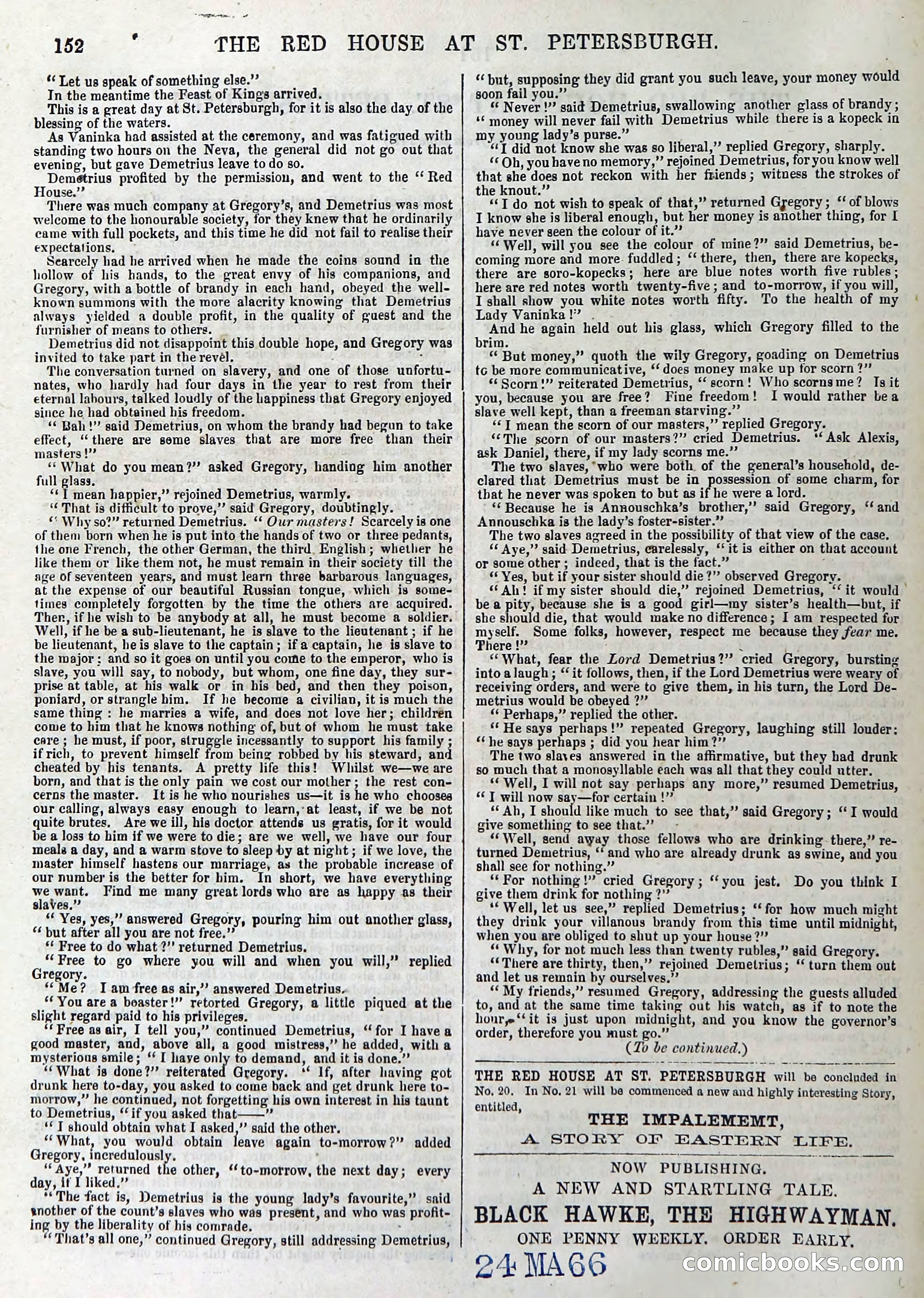
A restored page from Penny Dreadfuls, 1866. Page through the whole issue in the reader above.
📄 Transcribed text from this page (OCR, searchable)
Machine-transcribed from the original scan — historical spelling and the odd misread are preserved.
* sa be “ 152 ‘¢ Let us speak of something else.’’ In the meantime the Feast of Kings arrived. This is a great day at St. Petersburgh, for it is also the day of the blessing of the waters. As Vaninka had assisted at the ceremony, and was fatigued with standing two hours on the Neva, the general did not go out that evening, but gave Demetrius leave to do so. Demétrius profited by the permission, and went to the ‘‘ Red House.” There was much company at Gregory’s, and Demetrius was most welcome to the honourable society, for they knew that he ordinarily came with full pockets, and this time he did not fail to realise their expectations. Searcely had he arrived when he made the coins sound in the hollow of his hands, to the great envy of his companions, and Gregory, with a bottle of brandy in each hand, obeyed the well- known summons with the more alacrity knowing that Demetrius always yielded a double profit, in the quality of guest and the furnisher of means to others. Demetrius did not disappoint this double hope, and Gregory was invited to take part in the revél. : The conversation turned on slavery, and one of those unfortu- nates, who hardly had four days in the year to rest from their eternal labours, talked loudly of the happiness that Gregory enjoyed since he had obtained his freedom. ‘‘ Bah!” said Demetrius, on whom the brandy had begun to take effect, ‘‘there are seme slaves that are more free than their masters !”? ‘What do you mean?” asked Gregory, handing him another full glass. “‘] mean happier,” rejoined Demetrius, warmly. “That is difficult to prove,’”’ said Gregory, doubtingly. ‘“ Why so?” returned Demetrius. ‘‘ Our masters! Scarcely is one of them born when he is put into the hands of two or three pedants, the one French, the other German, the third. English; whether he like them or like them not, he must remain in their society till the age Of seventeen years, and must learn three barbarous languages, at the expense of our beautiful Russian tongue, which is some- times completely forgotten by the time the others are acquired. Ther, if he wish to be anybody at all, he must become a soldier. Well, if he be a sub-lieutenant, he is slave to the lieutenant ; if he be lieutenant, he is slave to the captain; if a captain, he is slave to the major: and so it goes on until you come to the emperor, who is slave, you will say, to nobody, but whom, one fine day, they sur- prise at table, at his walk or in his bed, and then they poison, poniard, or strangle him. If he become a civilian, it is much the same thing : he marries a wife, and does not love her; children come to him that he knows nothing of, but of whom he must take care ; he must, if poor, struggle incessantly to support his family ; if rich, to prevent himself from being robbed by his steward, and cheated by his tenants. A pretty life this! Whilst we—we are born, and that is the only pain we cost our mother; the rest con- cerns the master. It is he who nourishes us—it is he who chooses our calling, always easy enough to Jearn,’at least, if we be not quite brutes. Are we ill, his doctor attends us gratis, for it would be a loss to him if we were to die; are we well, we have our four meals a day, and a warm stove to sleep by at night; if we love, the master himself hastens our marriage, as the probable increase of our number is the better for him. In short, we have everything ool Find me many great lords who are as happy as their slaves. “‘ Yes, yes,”’ answered Gregory, pouring him out another glass, ‘* but after all you are not free.’’ ‘* Free to do what ?”’ returned Demetrius. “Free to go where you will and when you will,” replied Gregory. ‘*Me? Iam free as air,’’ answered Demetrius. *€ You are a boaster!”’ retorted Gregory, a little piqued at the slight regard paid to his privileges. ‘* Free as air, I tell you,” continued Demetrius, ‘for I havea good master, and, above all, a good mistress,” he added, with a mysterious smile; ‘* I haye only to demand, and it is done.”’ ‘What is done?’ raiteratell Gregory. ‘* If, after having got drunk here to-day, you asked to come back and get drunk here to- morrow,” he continued, not forgetting his own interest in his taunt to Demetrius, ‘if you asked that——” ‘*T should obtain what I asked,” said the other. “What, you would obtain leave again to-morrow?” added Gregory, incredulously, ' ‘€ Aye,”’ returned the other, *‘ to-morrow, the next day; every day, if I liked.” ‘**The fact is, Demetrius is the young lady’s favourite,” said gnother of the count’s slaves who was present, and who was profit- ing by the liberality of his comrade. . ‘“That’s all one,” continued Gregory, still addressing Demetrius, i : THE RED HOUSE AT ST. PETERSBURGH. “but, supposing they did grant you such leave, your money would soon fail you.” ‘‘ Never !”” said Demetrius, swallowing another glass of brandy ; ‘© money will never fail with Demetrius while there is a kopeck in my young lady’s purse.” : : . “‘T did not know she was so liberal,” replied Gregory, sharply. ‘¢ Oh, you haveno memory,” rejoined Demetrius, for you know well that she does not reckon with her friends; witness the strokes of the knout.” ““T do not wish to speak of that,” returned Gregory; ‘‘ of blows I know she is liberal enough, but her money is another thing, for I have never seen the colour of it.” : : ‘Well, will you see the colour of mine?” said Demetrius, be- coming more and more. fuddled; ‘‘ there, then, there are kopecks, there are soro-kopecks; here are blue notes worth five rubles; here are red notes worth twenty-five; and to-morrow, if you will, I shall show you white notes worth fifty. To the health of my Lady Vaninka!’ . ‘ And he again held out his glass, which Gregory filled to the brim. “But money,” quoth the wily Gregory, goading on Demetrius tc be more communicative, ‘‘ does money make up for scorn ?” *¢ Scorn!” reiterated Demetrius, ‘‘ scorn! Who scornsme? Is it you, because you are free? Fine freedom! I would rather bea slave well kept, than a freeman starving.” ‘<T mean the scorn of our masters,” replied Gregory. ‘¢The scorn of our masters?” cried Demetrius. ‘‘ Ask Alexis, ask Daniel, there, if my lady scorns me.”’ The two slaves, "who were both of the general’s household, de- clared that Demetrius must be in possession of some charm, for that he never was spoken to but asif he werealord. } ‘¢ Because he is Annouschka’s brother,’’? said Gregory, ‘‘ and Annouschka is the lady’s foster-sister.” The two slaves azreed in the possibility of that view of the case. ‘¢ Aye,” said Demetrius, carelessly, ‘‘ it is either on that account or some other ; indeed, that is the fact.” “‘ Yes, but if your sister should die ?’”’ observed Gregory. ‘‘Ah! if my sister should die,” rejoined Demetrius, ‘‘ it would be a pity, because she is a good girl—my sister’s health—but, if she haat die, that would make no difference; I am respected for mye Some folks, however, respect me because they fear me. here !”” < . ‘““What, fear the Zord Demetrius?” cried Gregory, bursting into alaugh; ‘it follows, then, if the Lord Demetrius were weary of receiving orders, and were to give them, in his turn, the Lord De- metrius would be obeyed ?” ‘¢ Perhaps,” replied the other. ‘* He says perhaps!” repeated Gregory, laughing still louder: ‘he says perhaps ; did you hear him?’’ The two slayes answered in the affirmative, but they had drunk so much that a monosyllable each was all that they could utter. ‘* Well, I will not say perhaps any more,” resumed Demetrius, *¢T will now say—for certain !” ‘Ah, I should like much to see that,” said Gregory; “I would give something to see that.’’ - ‘‘ Well, send away those fellows who are drinking there,” re- turned Demetrius, ‘‘ and who are already drunk as swine, and you shall see for nothing.” “For nothing!” cried Gregory; “you jest. Do you think I give them drink for nothing ?” . ‘* Well, let us see,” replied Demetrius; ‘‘ for how much might they drink your villanous brandy from this time until midnight, when you are obliged to shut up your house?” “Why, for not much less than twenty rubles,” said Gregory. “There are thirty, then,” rejoined Demetrius; ‘‘ turn them out and let us remain by ourselves.”’ ‘* My friends,” resumed Gregory, addressing the guests alluded to, and at the same time taking out his watch, as if to note the honry“‘it is just upon midnight, and you know the governor’s order, therefore you must go.” (Zo be continued.) -_——————— oo THE RED HOUSE AT ST. PETERSBURGH will be concluded in No, 20. In No, 21 will be commenced a new and highly interesting Story, entitled, THE IMPALEMEMT, A STORY OF BHASTERN LIFE. NOW PUBLISHING. A NEW AND STARTLING TALE. BLACK HAWKE, THE HIGHWAYMAN, ONE PENNY WEEKLY, ORDER PARLY, OA: MAGG Eomicbooks-com ee