
Penny Dreadfuls, 1866 · page 139 of 276
Ivan the Terrible; or, Dark Deeds of Night — page 139: what you’re looking at
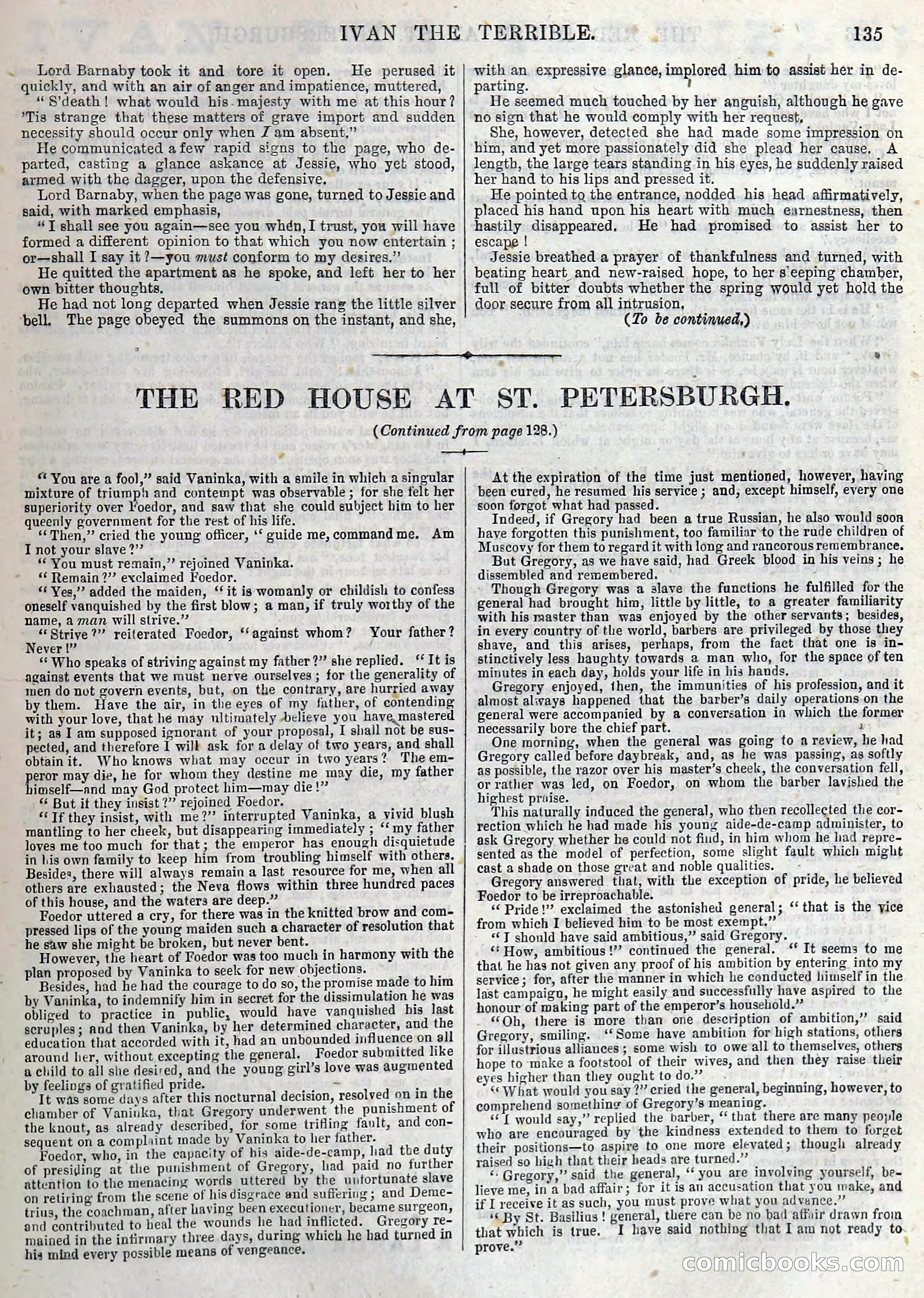
A restored page from Penny Dreadfuls, 1866. Page through the whole issue in the reader above.
📄 Transcribed text from this page (OCR, searchable)
Machine-transcribed from the original scan — historical spelling and the odd misread are preserved.
~ IVAN THE TERRIBLE. Lord Barnaby took it and tore it open. He perused it uickly, and with an air of anger and impatience, muttered, “S’death! what would his.majesty with me at this hour? Tis strange that these matters of grave import and sudden necessity should occur only when Z am absent,” He communicated afew rapid signs to the page, who de- parted, casting a glance askance at Jessie, who yet stood, armed with the dagger, upon the defensive. Lord Barnaby, when the page was gone, turned to Jessie and said, with marked emphasis, “TJ shall see you again—see you whén,I trust, you will have formed a different opinion to that which you now entertain ; or—shall I say it ?—you must conform to my desires.” He quitted the apartment as he spoke, and left her to her own bitter thoughts, He had not long departed when Jessie rang the little silver bell. The page obeyed the summons on the instant, and she, = J 135 with an expressive glance,implored him to assist her in de- parting. ' He seemed much touched by her anguish, although he gave no sign that he would comply with her request, She, however, detected she had made some impression on him, and yet more passionately did she plead her cause, A length, the large tears standing in his eyes, he suddenly raised her hand to his lips and pressed it. He pointed to the entrance, nodded his head affirmatively, placed his hand upon his heart with much earnestness, then hastily disappeared. He had promised to assist her to escape | Jessie breathed a prayer of thankfulness and turned, with beating heart and new-raised hope, to her s'eeping chamber, full of bitter doubts whether the spring would yet hold the door secure from all intrusion, (To be continued,) THE RED HOUSE AT ST. PETERSBURGH. (Continued from page 128.) - —_——_ You are a fool,” said Vaninka, with a smile in which a singular mixture of triumph and contempt was observable ; for she felt her superiority over Foedor, and saw that she could subject him to her queenly government for the rest of his life. “Then,” cried the young officer, ‘‘ guide me, commandme. Am I not your slave?” ‘© You must remain,”’ rejoined Vaninka. ‘¢ Remain ?”’ exclaimed Foedor. ‘t Yes,’ added the maiden, ‘it is womanly or childish to confess oneself vanquished by the first blow; a man, if truly worthy of the name, 2 man will strive.” ve Birive 2” reiterated Foedor, ‘‘against whom? Your father? ever |’ ‘© Who speaks of striving against my father?” she replied. ‘It is against events that we must nerve ourselves ; for the generality of men do not govern events, but, on the contrary, are hurried away by them. Have the air, in the eyes of my father, of contending with your love, that he may ultimately believe you have mastered it; as I am supposed ignorant of your proposal, I shall not be sus- pected, and therefore I wilk ask for a delay of two years, and shall obtain it. Who knows what may occur in two years? The em- pera may die, he for whom they destine me may die, my father imself—and may God protect him—may die!” ‘‘ But it they insist ?”’ rejoined Foedor. ‘Tf they insist, with me?’’ interrupted Vaninka, a vivid blush mantling to her cheek, but disappearing immediately ; “‘my father loyes me too much for that; the emperor has enough disquietude in his own family to keep him from troubling himself with others. — Besides, there will always remain a last resource for me, when all others are exhausted; the Neva flows within three hundred paces of this house, and the waters are deep.” Foedor uttered a cry, for there was in the knitted brow and com- pressed lips of the young maiden such a character of resolution that he saw she might be broken, but never bent. é, However, the heart of Foedor was too much in harmony with the plan proposed by Vaninka to seek for new objections. : Besides, had he had the courage to do so, the promise made to him by Vaninka, to indemnify him in secret for the dissimulation he was obliged to practice in public, would have vanquished his last scruples; and then Vaninka, by her determined character, and the education that accorded with it, had an unbounded influence on all around her, without excepting the general. Foedor submitted like a cliild to all she desired, and the young girl’s love was augmented by feelings of gratified pride. - ; It was some days after this nocturnal decision, resolyed on in the chamber of Vaniuka, that Gregory underwent the punishment of the knout, as already described, for some trifling fault, and con- sequent on a complaint made by Vaninka to her father. Foedor, who, in the capacity of his aide-de-camp, liad the duty of presiding at the punishment of Gregory, had paid no further attention to the menacing words uttered by the unfortunate slave on retiring from the scene of his disgrace and suffering ; and Deme- trius, the coachman, after having been executioner, became surgeon, ond contributed to heal the wounds he had inflicted. Gregory re- mained in the infirmary three days, during which he had turned in his mind every possible means of vengeance. - At the expiration of the time just mentioned, however, having been cured, he resumed his service ; and, except himself, every one soon forgot what had passed. Indeed, if Gregory had been a true Russian, he also would soon have forgotten this punishment, too familiar to the rude children of Muscovy for them to regard it with long and rancorous remembrance. But Gregory, as we have said, had Greek blood in his veins ; he dissembled and remembered. © Though Gregory was a slave the functions he fulfilled for the general had brought him, little by little, to a greater familiarity with his master than was enjoyed by the other servants; besides, in every country of the world, barbers are privileged by those they shave, and this arises, perhaps, from the fact that one is in- stinctively less haughty towards a man who, for the space of ten minutes in each day, holds your life in his hands. Gregory enjoyed, then, the immunities of his profession, and it almost alivays happened that the barber’s daily operations on the general were accompanied by a conversation in which the former necessarily bore the chief part. 4 One morning, when the general was going to a review, he had Gregory called before daybreak, and, as he was passing, as softly as possible, the razor over his master’s cheek, the conversation fell, or rather was led, on Foedor, on whom the barber lavished the highest praise. This naturally induced the general, who then recollected the cor- rection which he had made his young aide-de-camp administer, to ask Gregory whether he could not fiud, in him whom he had repre- sented as the model of perfection, some slight fault which might cast a shade on those great and noble qualities. - Gregory answered that, with the exception of pride, he believed Foedor to be irreproachable. «© Pride!” exclaimed the astonished general; ‘‘ that is the yice from which I believed him to be most exempt.” «¢T shonld have said ambitious,” said Gregory. ‘* How, ambitious !”’ continued the general. ‘ It seems to me that he has not given any proof of his ambition by entering into my service; for, after the manner in which he conducted himself in the last campaign, he might easily and successfully have aspired to the honour of making part of the emperor’s household.” ‘Oh, there is more than one description of ambition,” said Gregory, smiling. ‘‘Some have ambition for high stations, others for illustrious alliances; some wish to owe all to themselves, others hope to make a footstool of their wives, and then they raise their eyes higher than they ought to do.” 499 “© What would you say 2?” cried the general, beginning, however, to comprehend something of Gregory’s meaning. ‘‘ { would say,” replied the barber, “ that there are many people who are encouraged by the kindness extended to them to forget their positions—to aspire to one more elevated; though already raised so high that their heads are turned.” ‘: Gregory,” said the general, ‘‘ you are involving yourself, be~ lieve me, in a bad affair; for it is an accusation that you make, and if I receive it as such, you must prove what you advance.” ‘¢ By St. Basilius ! general, there can be no bad affair drawn from that which is true. I have said nothing that I am not ready to 4 prove.” CORNICE OOOKKS,. CORN <S)