
Penny Dreadfuls, 1866 · page 132 of 276
Ivan the Terrible; or, Dark Deeds of Night — page 132: what you’re looking at
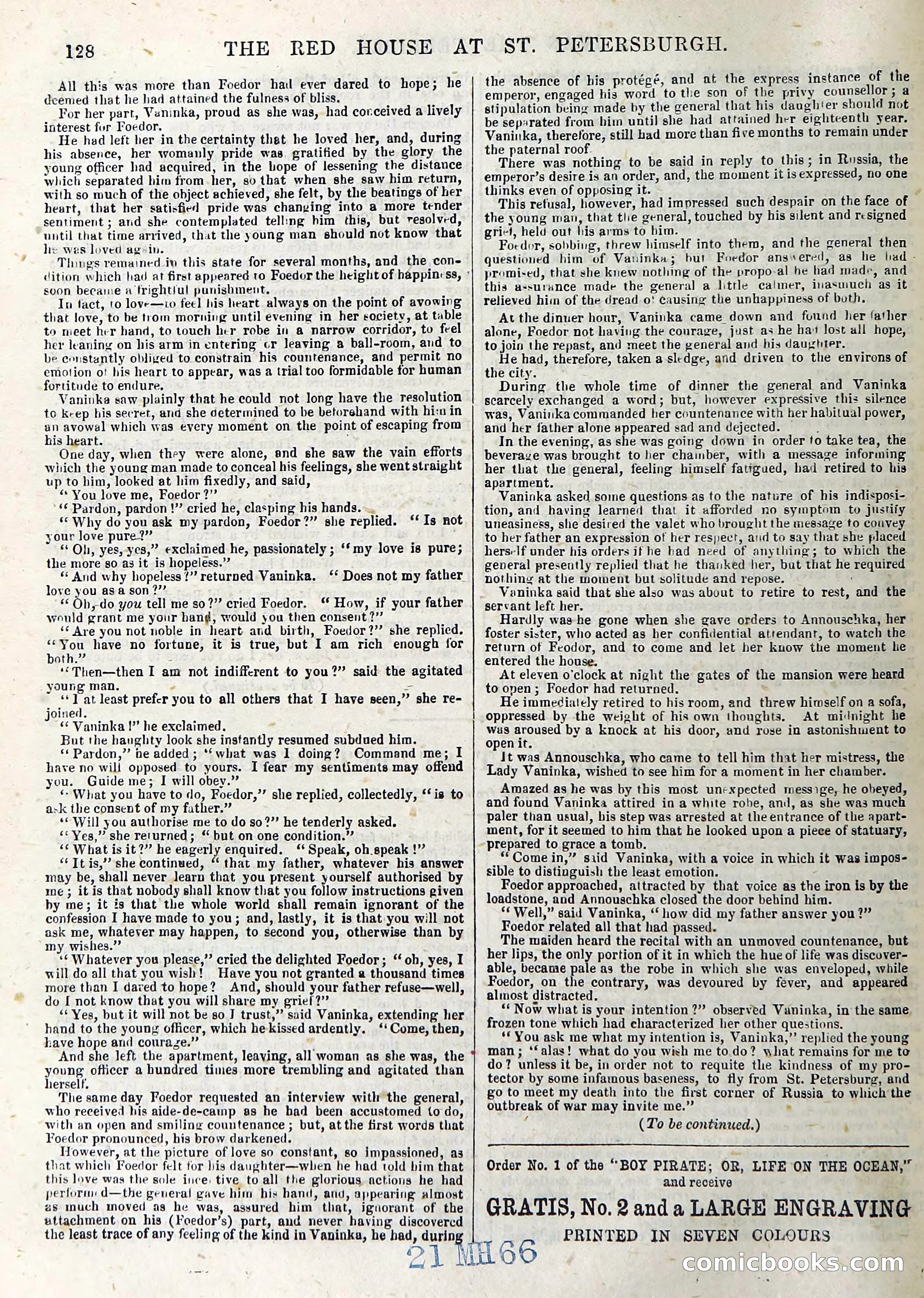
A restored page from Penny Dreadfuls, 1866. Page through the whole issue in the reader above.
📄 Transcribed text from this page (OCR, searchable)
Machine-transcribed from the original scan — historical spelling and the odd misread are preserved.
128 ~ All this was more than Foedor had ever dared to hope; he deemed that he had attained the fulness of bliss. , For her part, Vsninka, proud as she was, had conceived a lively interest fur Foedor. : j He had left her in the certainty thet he loved her, and, during his absence, her womanly pride was. gratified by the glory the young officer had acquired, in the hope of lessening the distance which separated him from her, so that when she saw him return, with so much of the object achieved, she felt, by the beatings of her heart, that her satisfied pride was changing into a more tender sentiment ; and she contemplated telling him this, but resolved, until that time arrived, that the young man should not know that he wes loved agen. Things remained_iv this state for several months, and the con- dition which had at first appeared to Foedor the height of happiness, ° soon became a frightiul punishment. : In fact, to love—io feel his heart always on the point of avowing that love, to be trom morning until evening in her society, at table to meet her hand, to touch her robe in a narrow corridor, to feel her leaning on his arm in entering cr leaving a ball-room, and to be eoustantly obliged to constrain his countenance, and permit no emotion of his heart to appear, was a trial too formidable for human fortitude to endure. ; Vaninka saw plainly that he could not long have the resolution to krep his secret, and she determined to be betorehand with hi:n in an avowal which was every moment on the point of escaping from his heart. : : One day, when they were alone, and she saw the vain efforts which the young man made to conceal his feelings, she went straight up to him, looked at him fixedly, and said, “* You love me, Foedor ?” '*€ Pardon, pardon !” cried he, clasping his hands. .. ‘© Why do you ask my pardon, Foedor?” she replied. ‘‘ Is not your love pure?” ; ; ‘‘ Oh, yes, yes,” exclaimed he, passionately ; ‘‘my love is pure; the more so as it is hopeless.” ‘* And why hopeless?” returned Vaninka. ‘‘ Does not my father love you as a son ?”’ ‘“ Oh,-do you tell me so?” cried Foedor. ‘ How, if your father would grant me your hang, would you then consent ?”’ ‘© Are you not noble in heart and birth, Foedor?” she replied. ‘“‘You have no fortune, it is true, but I am rich enough for both.” 3 ‘‘Then—then I am not indifferent to you?” said the agitated young man. , - ‘‘] at least prefcr you to all others that I have seen,” she re- joined. ‘¢ Vaninka !”’ he exclaimed. ' But the haughty look she instantly resumed subdued him. ‘* Pardon,” he added; ‘‘ what was 1 doing? Command me; I have no will opposed to yours. I fear my sentiments may offend you. Guide me; I will obey.” ‘- What you have to do, Foedor,’’ she replied, collectedly, ‘* is to ask the consent of my father.” ‘© Will you authorise me to do so?”’ he tenderly asked. ‘< Yes,” she returned; ‘ but on one condition.” “¢ What is it?” he eagerly enquired. ‘* Speak, oh speak !” “¢ Tt is,’ she continued, ‘‘ that my father, whatever his answer may be, shall never learn that you present. yourself authorised by ine; it is that nobody shall know that you follow instructions given by me; it #3 that the whole world shall remain ignorant of the confession I have made to you; and, lastly, it is that you will not ask me, whatever may happen, to second you, otherwise than by my wishes.” ‘¢ Whatever you please,” cried the delighted Foedor; ‘oh, yes, I will do all that you wish! Have you not granted a thousand times more than I daved to hope? And, should your father refuse—well, do [ not know that you will share my grief ?”’ “‘ Yes, but it will not be so J trust,’’ said Vaninka, extending her hand to the young officer, which he kissed ardently. ‘‘ Come, then, have hope and couraze.” : And she left the apartment, leaving, all woman as she was, the young officer a hundred times more trembling and agitated than herself, The same day Foedor requested an interview with the general, who received his aide-de-cainp as he bad been accustomed to do, with an open and smiling countenance ; but, at the first words that Foedor pronounced, his brow darkened. However, at the picture of love so constant, so impassioned, a3 that which Foedor felt for his daughter—when he had told bim that this love wag the sole ince: tive to all the glorious actions he had perform: d—the general gave him his hand, and, appearing almost zs much moved as he was, assured him that, ignorant of the uttachment on his (Foedor’s) part, and never having discovered the least trace of any feeling of the kind in Vaninka, he had, durin 2) haxy THE RED HOUSE AT ST. PETERSBURGH. WELSS the absence of his protégé, and at the express instance of the emperor, engaged his word to the son of the privy counsellor; a stipulation being made by the general that his daughter should not be separated from him until she had attained her eighteenth year. Vaninka, therefore, still had more than five months to remain under the paternal roof. die. : There was nothing to be said in reply to this; in Russia, the emperor’s desire is an order, and, the moment it is expressed, no one thinks even of opposing it. : ¥ This refusal, however, had impressed such despair on the face of the young man, that tle general, touched by his silent and resigned gricf, held out his arms to him. Fodor, sobbing, threw himself into them, and the general then questioned him of Vaninka; but Foedor answered, as he bad - promi-ed, that she knew nothing of the propo-al he had made, and this assurance made the general a little calmer, inasmuch as it relieved him of the dread o! causing the unhappiness of both. At the dinuer hour, Vaninka came down and found her father alone, Foedor not having the courage, just as he ha Jost all hope, to join the repast, and meet the general and his daughter. He had, therefore, taken a sledge, and driven to the environs of the city. DUnLE the whole time of dinner the general and Vaninka scarcely exchanged a word; but, however expressive this silence was, Vaninka commanded ber countenance with her habitual power, and her father alone appeared sad and dejected. In the evening, as she was going down in order to take tea, the beverave was brought to her chamber, with a message informing her that the general, feeling himself fatigued, had retired to his apartment. Vaninka asked some questions as to the nature of his indisposi- tion, and having learned that it afforded no symptom to justiiy uneasiness, she desired the valet who brought the message to couvey to her father an expression of her respect, aid to say that she placed hers-If under his orders if he had need of anything; to which the general presently replied that he thanked her, but that he required nothing at the moment but solitude and repose. \ Vaninka said that she also was about to retire to rest, and the servant left her. Hardly was he gone when she gave orders to Annouschka, her foster sister, who acted as her confidential attendant, to watch the return of Feodor, and to come and let her know the moment he entered the house. At eleven o'clock at night the gates of the mansion were heard to open ; Foedor had returned. . ; He immediately retired to his room, and threw himself on a sofa, oppressed by the weight of his own thoughts. At midnight he wus aroused by a knock at his door, and rose in astonishwent to open it. Jt was Annouschka, who came to tell him that her mistress, the Lady Vaninka, wished to see him for a moment in her chamber. Amazed as he was by this most unexpected messige, he obeyed, and found Vaninka attired in a white robe, and, as she wa3 much paler than usual, his step was arrested at the entrance of the apart- ment, for it seemed to him that he looked upon a pieee of statuary, -prepared to grace a tomb. ““Come in,” siid Vaninka, with a voice in which it was impos- sible to distinguish the least emotion. Foedor approached, attracted by that voice as the iron is by the loadstone, and Annouschka closed the door behind him. ‘€ Well,” said Vaninka, ‘‘ how did my father answer you?” Foedor related all that had passed. The maiden heard the recital with an unmoved countenance, but her lips, the ay, portion of it in which the hue of life was discover- able, became pale as the robe in which she was enveloped, while Foedor, on the contrary, was deyoured by fever, and appeared almost distracted. *‘ Now what is your intention ?”” observed Vaninka, in the same. frozen tone which had characterized her other questions. ** You ask me what my intention is, Vaninka,’”’ replied the young man; ‘‘alas! what do you wish me todo? what remains for me to do? unless it be, in order not to requite tlhe kindness of my pro- tector by some infamous baseness, to fly from St. Petersburg, and go to meet my death into the first corner of Russia to which the outbreak of war may invite me.” . (To be continued.) ; : Order No. 1 of the “BOY PIRATE; OR, LIFE ON THE OCEAN,” and receive GRATIS, No.2 anda LARGE ENGRAVING PRINTED IN SEVEN COLOURS ~ comicbooksicom