
Penny Dreadfuls, 1866 · page 115 of 276
Ivan the Terrible; or, Dark Deeds of Night — page 115: what you’re looking at
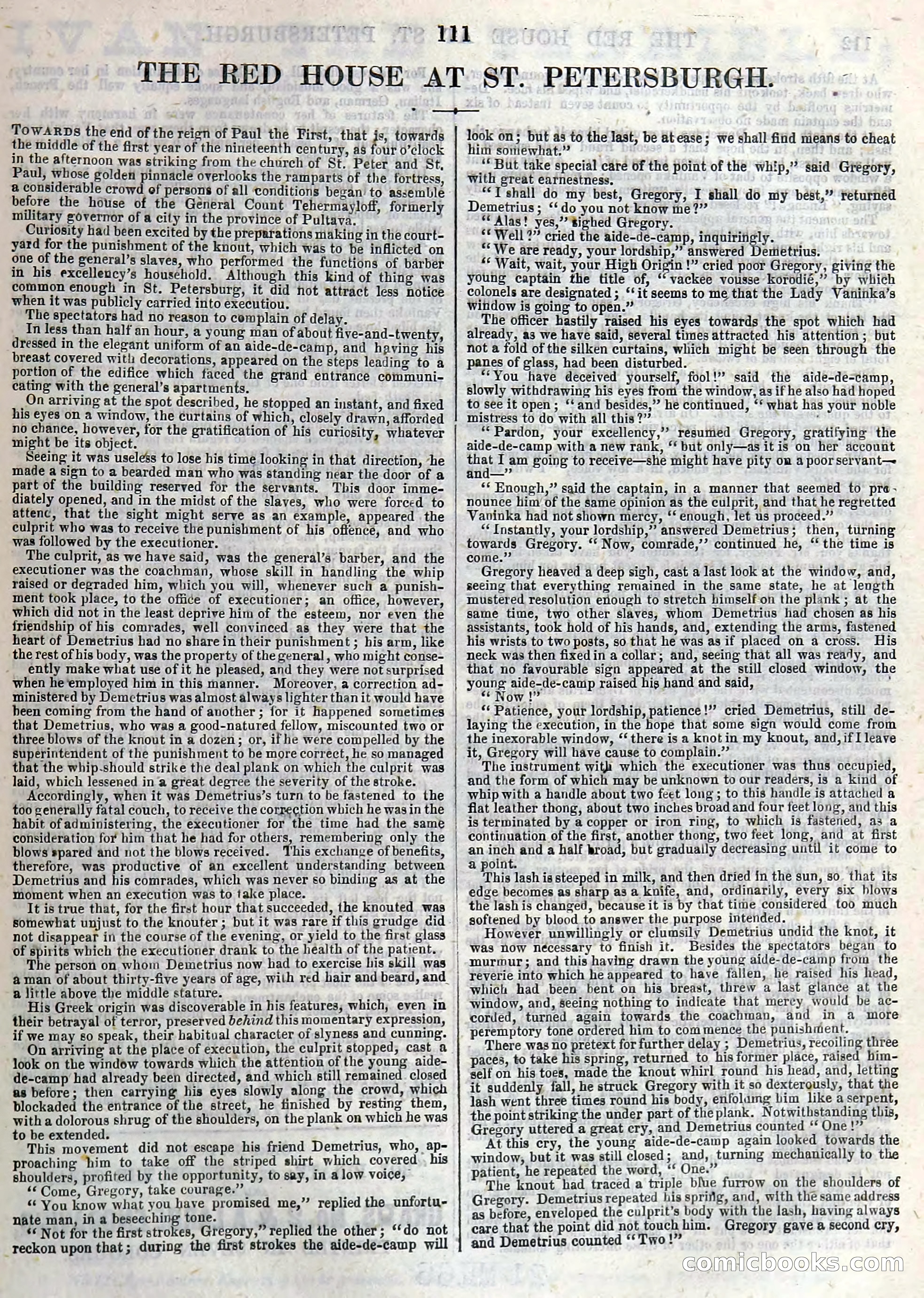
A restored page from Penny Dreadfuls, 1866. Page through the whole issue in the reader above.
📄 Transcribed text from this page (OCR, searchable)
Machine-transcribed from the original scan — historical spelling and the odd misread are preserved.
— THE RED HOUSE AT ST. PETERSBURGH. _ + ~ TOWARDS the end of the reign of Paul the First, that is, towards the middle of the first year of the nineteenth century, a8 four o’clock in the afternoon was striking from the church of St. Peter and St, Paul, whose golden A peel overlooks the ramparts of the fortress, a considerable crowd of persons of all conditions bezan to assemble before the house of the General Count Tehermayloff, formerly military governor of a cily in the province of Pultava. Curiosity had been excited by the preparations making in the court- yard for the punishment of the knout, whith was to be inflicted on one of the general’s slaves, who performed the functions of barber in his excelleucy’s household. Although this kind of thing was common enough in St. Petersburg, it did not attract less notice when it was publicly carried into executiou. The spectators had no reason to complain of delay. In less than half an hour, a young man of about five-and-twenty, dressed in the elegant uniform of an aide-de-camp, and haying his breast covered with decorations, appeared on the steps leading to a portion of the edifice which faced the grand entrance communi- cating with the general’s apartments. On arriving at the spot described, he stopped an instant, and fixed his eyes on a window, the curtains of which, closely drawn, afforded no chance, however, for the gratification of his curiosity, whatever might be its object. ‘ Seeing it was useless to lose his time looking in that direction, “he made a sign to a bearded man who was standing near the door of a part of the building reserved for the servants. This door imme- diately opened, and in the midst of the slaves, who were forced to attenc, that the sight might serve as an example, appeared the culprit who was to receive the punishment of his offence, and who was followed by the executioner. The culprit, as we have said, was the general’s barber, and the executioner was the coachman, whose skill in handling the whip raised or degraded him, which you will, whenever such a punish- ment took place, to the office of executioner; an office, however, which did not in the least deprive him of the esteem, nor even the friendship of his comrades, well convinced as they were that the heart of Demetrius had no share in their punishment ; his arm, like the rest of his body, was the property of the general, who might conse- ently make what use of it he pleased, and they were not surprised when he’‘employed him in this manner. Moreover, a correction ad- ministered by Demetrius was almost always lighter than it would have been coming from the hand of another ; for it Happened sometimes that Demetrius, who was a good-natured fellow, miscounted two or three blows of the knout in a dozen; or, if he were compelled by the superintendent of the punishment to be more correct, he so managed that the whip-should strike the deal plank on which the culprit was laid, which lessened in a great degree the severity of the stroke. Accordingly, when it was Demetrius’s turn to be fastened to the too generally fatal couch, to receive the correction which he was in the habit of administering, the executioner for the time had the same consideration for him that he had for others, remembering only the blows spared and not the blows received. This exchange of benefits, therefore, was productive of an excellent understanding between Demetrius and his comrades, which was never s0 binding as at the moment when an execution was to take place. It is true that, for the first hour that succeeded, the knouted was See ee eee eee SS SSS... | somewhat unjust to the knouter ; but it was rare if this grudge gid | not disappear in the course of the evening, or yield to the first glass of spirits which the executioner drank to the health of the patient. The person on whom Demetrius now had to exercise his skill was a man of about thirty-five years of age, with red hair and beard, and a little above the middle stature. , ' His Greek origin was discoverable in his features, which, even in their betrayal of terror, preserved behind this momentary expression, if we may s0 speak, their habitual character of slyness and cunning. On arriving at the place of execution, the culprit stopped, cast a look on the window towards which the attention of the young aide- de-camp had already been directed, and which still remained closed as before; then carrying his eyes slowly along the crowd, which blockaded the entrance of the street, he finished by resting them, with a dolorous shrug of the shoulders, on the plank on which he was to be extended. : This movement did not escape his friend Demetrius, who, ap- proaching him to take off the striped shirt which covered, his shoulders, profited by the opportunity, to say, in a low voice, “© Come, Gregory, take courage.” “ You know what you have promised me,” te man, in a beseeching tone. meee Not for the first atrolees. Gregory,” replied the other; “‘do not reckon upon that; during the first strokes the aide-de-camp will replied the unfortu- look on; but as to the last, be atease; we shall fiiid nieans to cheat him somewhat.” _ ** But take special care of the point of the whip,” said Grégory, with great earnestness. “I shall do my best, Gregory, I shall do my best,” returned Demetrius; ‘‘do you not know me?” ** Alas! yes,’ tighed Gregory. ** Well 2?” cried the aide-de-camp, inquirifgly. “We are ready, your lordship,” answered Dettetiiua: “* Wait, wait, your High Origin!” cried poor Gregory, giving the young captain the title of, ‘“‘ vackee vousse korodié,” by which colonels are designated; ‘‘it seems to me that the Lady Vaniiika’s Witidow is going to open.” The officer hastily raised his eyes towards the spot which had already, as we have said, several times attracted his attention; but not a fold of the silken curtains, which might be seen through the panes of glass, had been disturbed. **You have deceived yourself, fool!” said the aide-de-camp, slowly withdrawing his eyes from the window, as if he also had hoped to see it open; ‘‘ and besides,” he continued, ‘* what has your noble mistress to do with all this?” ; ; ** Pardon, your excellency,”’ resumed Gregory, gratifying the aide-de-camp with a new rank, ‘* but only—as itis on her account at I aun going to receive—she might have pity om a poorservant~ and—’ ** Enough,” said the captain, in a manner that seemed to pre. nounce him of the Same opinion as the culprit, and that he regretted Vaninka had not shown mercy, ‘‘ enough, let us proceed.” “Instantly, your lordship,” answered Demetrius; then, turning towards Gregory. ‘* Now, comrade,’’ continued he, ‘‘ the time is come. Gregory heaved a deep sigh, cast a last look at the window, and, seeing that everything remained in the same state, he at length mustered resolution enough to stretch himself-on the plank; at the same time, two other slaves, whom Demetrius had chosen as his assistants, took hold of his hands, and, extending the arms, fastened his wrists to two posts, so that he was as if placed on a cross. His neck was then fixedin a collar; and, seeing that all was ready, and that no favourable sign appeared at the still closed window, the young aide-de-canip raised his hand and said, ‘ ** Now !” “¢ Patience, your lordship, patience!” cried Demetrius, still de- laying the execution, in the hope that some sign would come from the inexorable window, ‘‘ there is a knot in my knout, and, if leave it, Gregory will have cause to complain.” The instrument with which the executioner was thus occupied, and the form of which may be unknown to our readers, is a kind of whip with a handle about two feet long; to this handle is attached a flat leather thong, about two inches broad and four feet long, and this is terminated by a copper or iron ring, to which is fastened, a3 a continuation of the first, another thong, two feet long, and at first an inch and a half broad, but gradually decreasing until it come to a point. his lash is steeped in milk, and then dried in the sun, so_ that its edge becomes as sharp as a knife, and, ordinarily, every six hlows the lash is changed, because it is by that time considered too much softened by blood to answer the purpose intended. _ : However. unwillingly or clumsily Demetrius undid the knot, it was now necessary to finish it. Besides the spectators began to murmur; and this having drawn the young aide-de-camp from the reverie into which he appeared to have fallen, he raised his head, which had been bent on his breast, threw a last glance at the window, and, seeing nothing to indicate that merey would be ac- corded, turned again towards the coachman, and in a more peremptory tone ordered him to commence the punishment. There was no pretext for further delay ; Demetrius, recoiling three paces, to take his spring, returned to his former place, raised bim- self on his toes, made the knout whirl round his head, and, letting it suddenly fall, he struck Gregory with it so dexterously, that the lash went three times round his body, enfolamg him like aserpent, the point striking the under part of theplank. N otwithstanding this, Gregory uttered a great cry, and Demetrius counted “ One!” At this ery, the young aide-de-camp again looked towards the window, but it was still closed; and, turning mechanically to the patient, he repeated the word, * One.” The knout had traced a triple blue furrow on the shoulders of Gregory. Demetrius repeated his spring, and, with the same address as before, enveloped the culprit’s body with the lash, having always care that the point did not touchhim. Gregory gave a second cry, and Demetrius counted ‘* Two!” (CO Michdoo SoCOMN