
Penny Dreadfuls, 1866 · page 107 of 276
Ivan the Terrible; or, Dark Deeds of Night — page 107: what you’re looking at
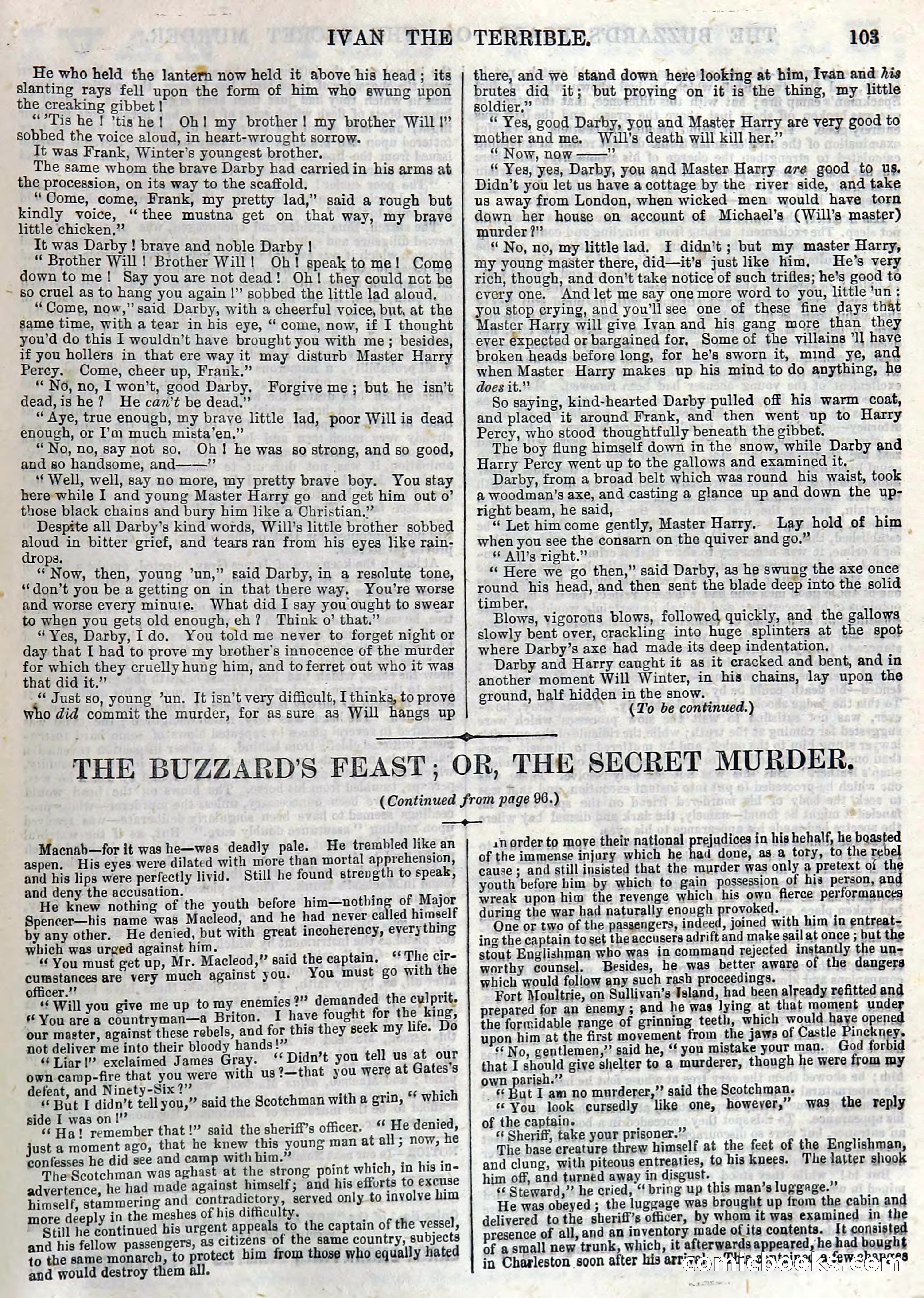
A restored page from Penny Dreadfuls, 1866. Page through the whole issue in the reader above.
📄 Transcribed text from this page (OCR, searchable)
Machine-transcribed from the original scan — historical spelling and the odd misread are preserved.
! IVAN THE He who held the lantern now held it above his head; its slanting rays fell upon the form of him who swung upon the creaking gibbet ] “Tis he ! ’tishe! Oh! my brother! my brother Will !” sobbed the voice aloud, in heart-wrought sorrow. It was Frank, Winter’s youngest brother. The same whom the brave Darby had carried in his arms at the procession, on its way to the scaffold. nome; come, pee my pretty lad,” said a rough but indly voice ee mustna get on that wa little chicken.” 3 neha. SAPS It was Darby ! brave and noble Darby ! ‘‘ Brother Will! Brother Will! Oh! speak to me! Come down tome! Say you are not dead! Oh! they could not be so cruel as to hang you again |” sobbed the little lad aloud. ~ ‘f Come, now,’’said Darby, with a cheerful voice, but, at the same time, with a tear in his eye, “‘ come, now, if I thought you'd do this I wouldn’t have brought you with me; besides, if you hollers in that ere way it may disturb Master Harry Percy. Come, cheer up, Frank.” ogee ‘No, no, I won’t, good Darby. Forgive me; but he isn’t dead,ishe? He can’t be dead.” . “ Aye, true enough, my braye little lad, poor Willis dead enongh, or I’m much mista’en,” ¢ “No, no, say not so, Oh! he was so strong, and so good, and so handsome, and——”’ ‘f Well, well, say no more, my pretty brave boy. You stay here while I and young Master Harry go and get him out 0’ those black chains and bury him like a Christian.” Despite all Darby’s kind words, Will’s little brother sobbed pee in bitter grief, and tears ran from his eyes like rain- ops. ** Now, then, young ’un,” said Darby, in a resolute tone, “don’t you be a getting on in that there way. You’re worse and worse every minute. What did I say you ought to swear to when you gets old enough, eh? Think o’ that.” “Yes, Darby, I do. You told me never to forget night or day that I had to prove my brother's innocence of the murder for which they cruelly hung him, and to ferret out who it was that did it.’’ : _ Just so, young ’un. It isn’t very difficult, I thinks, to prove who did commit the murder, for assure as Will hangs up TERRIBLE. 103 there, and we stand down here looking at him, Ivan and his brutes did it; but proying on it is the thing, my little soldier,” , “ Yes, good Darby, you and Master Harry are very good to mother and me, Will’s death will kill her.” 6 Now, now ; 9 ; ° Yes, yes, Darby, you and Master Harry are good to us. Didn’t you let us have a cottage by the river side, and take us away from London, when wicked men would have torn down her house on account of Michael’s (Will’s master) murder ?” “ No, no, my little lad. I didn’t; but my master Harry, my young master there, did—it’s just like him, He’s very rich, though, and don’t take notice of such trifles; he’s good to every one. And let me say one more word to you, little ’un: you stop erying, and you’ll see one of these fine days that Master Harry will give Ivan and his gang more than they eyer expected or bargained for, Some of the villains ‘ll have broken heads before long, for he’s sworn it, mind ye, and when Master Harry makes up his mind to do anything, he does it.” So saying, kind-hearted Darby pulled off his warm coat, and placed it around Frank, and then went up to Harry Percy, who stood thoughtfully beneath the gibbet. The boy flung himself down in the snow, while Darby and Harry Percy went up to the gallows and examined it, Darby, from a broad belt which was round his waist, took a woodman’s axe, and casting a glance up and down the up- right beam, he said, “ Let himcome gently, Master Harry. Lay hold of him when you see the consarn on the quiver and go.” * All’s right.” “ Here we go then,” said Darby, as he swung the axe once round his head, and then sent the blade deep into the solid timber, Blows, vigorous blows, followed quickly, and the gallows slowly bent over, crackling into huge splinters at the spot where Darby’s axe had made its deep indentation, Darby and Harry caught it as it cracked and bent, and in another moment Will Winter, in his chains, lay upon the ground, half hidden in the snow. (To be continued.) THE BUZZARD’S FEAST; OR, THE SECRET MURDER. (Continued from page 96.) —+— Macnab—for it was he—wes deadly pale. He trembled like an aspen. His eyes were dilated with more than mortal apprehension, and his lips were perfectly livid. Still he found strength to speak, and deny the accusation. a : He knew nothing of the youth before him—nothing of Major Spencer—his name was Macleod, and he had never ¢ led himself by any other. He denied, but with great incoherency, everything which was urged against him. asa “You must get up, Mr. Macleod,” said the captain. ‘The cir- cumstances are very much against you. You must go with the officer.”’ | ; «‘ Will you give me up to my enemies?” demanded the cylprit. § You afer 8 esanteyinayi Briton. I have fought for the king, our master, against TERE ee ed ior this they seek my life. Do ! l into their bloo ands!” me Tien 1 fexetairtied James oan . Didn’t you tell us at our own camp-fire that you were with us ?—that you were at Gates’s eat, and Ninety-Six ?” ; ace But I didn’t tell you,” said the Scotchman with a grin, ** which tH n qi? ’ ar Srv comemher that!” said the sheriff’s officer. “ He denied, just a moment ago, that he knew this young man at all; now, he confesses he did see and camp with him.” ; J et Saat The Scotchman was aghast at the strong point which, in his in- advertence, he had made against himself; and his effurts to excuse himself, stammering and contradictory, served only to involve him more deeply in the meshes of his difficulty. ; Still he continued his urgent appeals to the captain of the vessel, and his fellow passengers, as citizens of the same country, subjects to the same monarch, to protect him from those who equally hated and would destroy them all. anorder to move their national prejadiogs in his hehalf, he boasted of the immense injury which he had done, as a tory, to the rebel cause ; and still insisted that the murder was only a pretext oi the youth before him by which to gain possession of his person, and wreak upon him the reyenge which his own fierce performances during the war had naturally enough provoked. ' One or two of the passengers, indeed, joined with him in entreat- ing the captain to set the accusers adrift and make sail at once ; but the stout Englishman who was in command rejected instantly the un- worthy counsel. Besides, he was better aware of the dangers which would follow any such rash proceedings. Fort Moultrie, on Sullivan’s Island, had been already refitted and prepared for an enemy ; and he was lying at that moment undep the formidable range of grinning teeth, which would haye opened upon him at the first movement from the jaws of Castle Pinckney. «No, gentlemen,’ said he, “ you mistake your man. God forbid that I should give shelter to a murderer, though he were from my wn parigh.” ~ ¢f Bat I am no murderer,’’ said the Scotchman. ‘You look cursedly like one, however,” of he capiains ; f ‘¢ Sheriff, fake your prisoner. The ee epee se himself at the feet of the Englishman, and clung, with piteous entreaties, to his knees. The latter shook him off, and turned away in disgust. — ‘¢ Steward,” he cried, ‘ bring up this man’s luggage.” He was obeyed; the luggage was brought up from the cabin and delivered tothe sheriff’s officer, by whom it was examined in the presence of all, and an inventory made of its contents. It consisted of a small new trunk, which, it afterwards appeared ‘he had bought in Charleston soon after his arr’z?.) boOGiKmcucoinin was the reply