
Penny Dreadfuls, 1841 · page 234 of 248
Angelina: Or, The Mystery of St. Mark's Abbey — page 234: what you’re looking at
A restored page from Penny Dreadfuls, 1841. Page through the whole issue in the reader above.
📄 Transcribed text from this page (OCR, searchable)
Machine-transcribed from the original scan — historical spelling and the odd misread are preserved.
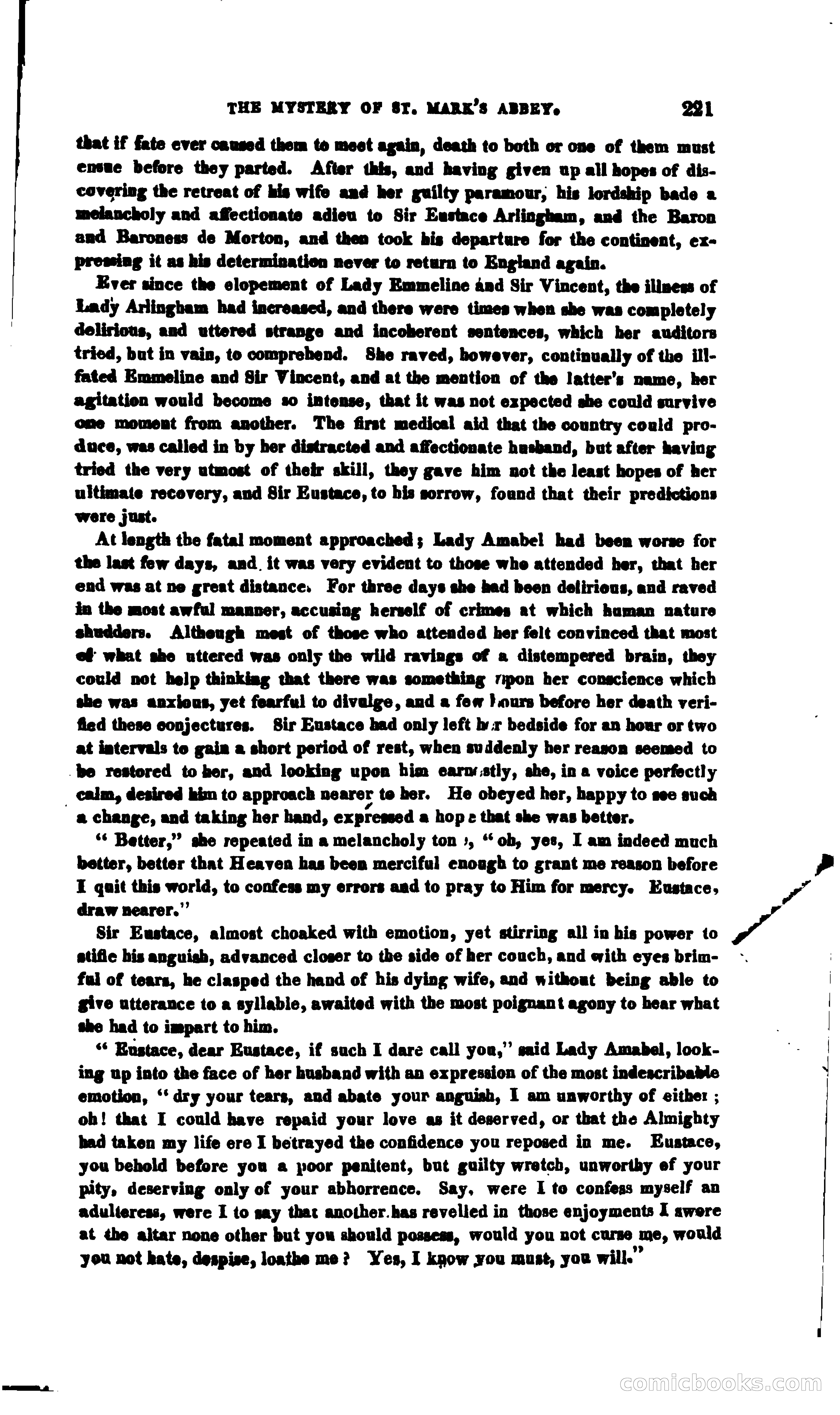
THE MYSTERY OF ST. MARK’S ABBEY. 291 that if fate ever caused them to meot again, death to both or one of them must ensue before they parted. After this, and having given up all hopes of dis- covering the retreat of his wife and her guilty paramour, his lordship bade a melancholy and affectionate adieu to Sir Eustace Arlingham, and the Baron and Baroness de Morton, and then took his departare for the continent, ex- pressing it as his determination never to return to England again. Ever since the elopement of Lady Emmeline and Sir Vincent, the illness of Lady Arlingham had increased, and there were times when she was com pletely delirious, and uttered strange and incoherent sentences, which her auditors tried, but in vain, to comprehend. She raved, however, continually of the ill- fated Emmeline and Sir Vincent, and at the mention of the latter’s name, her agitation would become so intonse, that it was not expected she could survive one mouient from another. The first medical aid that the country could pro- duce, was called in by her distracted and affectionate husband, but after having tried the very utmost of their skill, they gave him not the least hopes of her ultimate recovery, and Sir Eustace, to bis sorrow, found that their predictions were just. At length the fatal moment approached; Lady Amabe!l had been worse for the last few days, and it was very evident to those whe attended her, that her end was at ne great distance. For three days she had been delirious, and raved in the most awful manner, accusing herself of crimes at which human nature shudders. Altheugh mest of those who attended her felt convinced that most ef what she uttered was only the wild ravings of a distempered brain, they could not help thinking that there was something mpon her conscience which she was anxious, yet fearful to divalge, and a few } ours before her death veri- fied these conjectures. Sir Eustace had only left lyr bedside for an hour or two at intervals te gaia a short period of rest, when suddenly her reason seemed to be restored to her, and looking upon him earn stly, she, in a voice perfectly calm, desired kim to approach nearer te her. He obeyed her, happy to see such a change, and taking her hand, expressed a hope that she was better. ‘* Better,” she repeated in a melancholy ton :, “ob, yes, I am indeed much better, better that Heaven has been merciful enough to grant me reason before E quit this world, to confess my errors aad to pray to Him for mercy. Eustace, draw nearer.’ Sir Eustace, almost choaked with emotion, yet stirring all in his power to atifie his anguish, advanced closer to the side of her couch, and q@ith eyes brim- ful of tears, he clasped the hand of his dying wife, and without being able to give utterance to a syllable, awaited with the most poignant agony to hear what she had to impart to him. ‘* Eustace, dear Eustace, if such I dare call you,’ said Lady Amabel, look- ing up into the face of her husband with an expression of the most indescribable emotion, ‘‘ dry your tears, and abate your anguish, I am unworthy of either ; oh! that I could have repaid your love as it deserved, or that the Almighty had taken my life ere I betrayed the confidence you reposed in me. Eustace, you behold before you a poor penitent, but guilty wretch, unworthy ef your pity, deserving only of your abhorrence. Say, were I to confess myself an adulieress, were I to say that another.has revelled in those enjoyments I swere at the altar none other but you should possess, would you not curse me, would you not hate, despise, loathe me? Yes, I kgow you must, you will.” GOMMGIOO 1(GO)