
Penny Dreadfuls, 1881 · page 9 of 38
Alice Bridge of Norwich — page 9: what you’re looking at
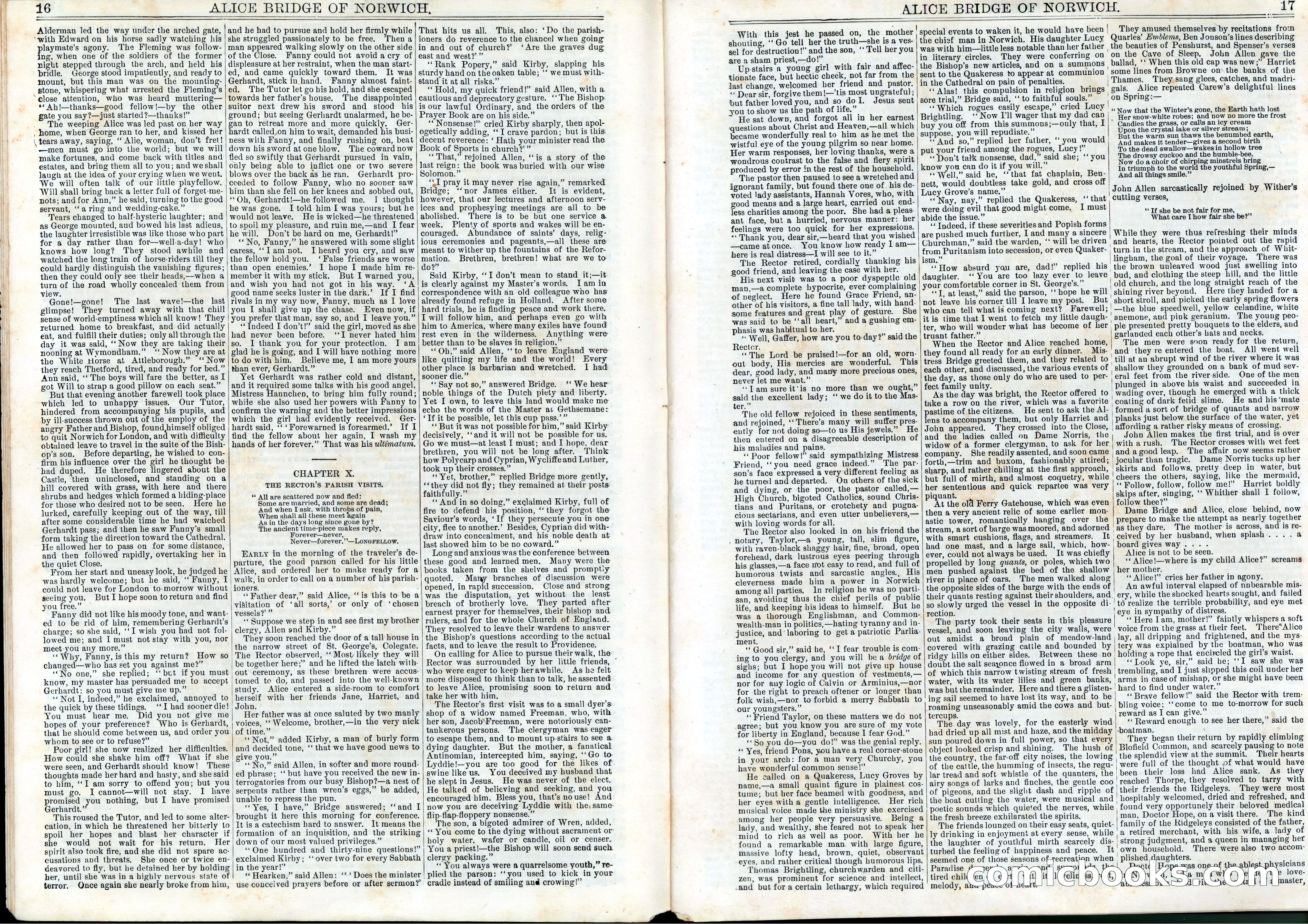
A restored page from Penny Dreadfuls, 1881. Page through the whole issue in the reader above.
📄 Transcribed text from this page (OCR, searchable)
Machine-transcribed from the original scan — historical spelling and the odd misread are preserved.
16 ALICE BRIDGE OF NORWICH, Alderman led the way under the arched gate, and he had to pursue and hold her firmly while “with Edward on his horse sadly watching his | she struggled passionately to be free. Then a laymate’s agony. The Fleming was follow- | man appeared walking slowly on the other side ing, when one of the soldiers of the former | of the Close. Fanny could not avoid acry of night stepped through the arch, and held his | displeasure at her restraint, when the man start- pridle. George stood impatiently, and ready to|ed, and came quickly toward them. It was mount, but this man was on the mounting- | Gerhardt, stick injhand. Fanny almost faint- _ Stone, whispering what arrested the Fleming’s|ed. The Tutor let go his hold, and she escaped close attention, who was heard muttering— | towards her father’s house. The disappointed **Ah|—thanks—good fellow!l—by the other/suitor next drew his sword and stood his gate you say?—just started ?— thanks!” ground; but seeing Gerhardt unalarmed, he be- . The weeping Alice was led past on her way | gan to retreat more and more qpiekly. Ger- is , home, when George ran to her, and kissed her | hardt called,on him to wait, demanded busi- \ tears away, saying, “ Alie, woman, don’t fret! ness with Fanny, and finally rushing on, beat —men must go into the world; but we will | down his sword at one blow. The coward now make fortunes, and come back with titles and | fled so swiftly that Gerhardt pursued in vain, estates, and bring them all to you; and weshall | only being able to inflict one or two severe laugh at the idea of your crying when we went, We will often talk of our little playfellow. Will shall bring back a letter full or forget-me- nots; and for Ann,” he said, turning to the good servant, ‘‘a ring and wedding-cake,” Tears changed to half-hysteric laughter; and as George mounted, and bowed his last adieus, blows over the back as he ran. Gerhardt pro- ceeded to follow Fanny, who no sooner saw him than she fell on her knees and sobbed out, ‘Oh, Gerhardt!—he followed me. I thought he was gone. I told him I was yours; but he would not leave. He is wicked—he threatened to spoil my pleasure, and ruin me,—and I fear the laughter irresistible was like those who part | he will. Don’t be hard on me, Gerhardt!” for a day rather than for—well-a-day! who knows how long? They stood awhile and watched the long train of horse-riders till they ““No, Fanny,” he answered with some slight earess, ‘‘ITam not. I heard you cry, and saw the fellow hold you. ‘False friends are worse could hardly distinguish the vanishing figures; |than open enemies.’ I hope I made him re- then they could only see their heads,-when a | member it with my stick, But I warned you, turn of the road wholly concealed them from|and wish you had not got in his way. ‘A view. good name seeks luster in the darz.’ If I find Gone!—gone! The last wavel—the last | rivals in my way now, Fanny, much as I love glimpse! They turned away with that chill| you I shall give up the chase. Even now, if sense of world-emptiness which all know! They | you prefer that man, say so, and I leave you.” returned home to breakfast, and did actually ‘Indeed I don’t!” said the girl, moved as she eat, and fulfill their duties; only all through the | had never been before. ‘‘I never hated him day it was said, ‘Now they are taking their|so. I thank you for your protection. I am nooning at Wymondham.” ‘‘ Now they are at | glad he is going, and I will have nothing more the White Horse at Attleborough.” ‘‘ Now)|to do with him. Believe me, I am more yours they reach Thetford, tired, and ready for bed.” Ann said, ‘‘ The boys will fare the better, as I got Will to strap a good pillow on each seat.” But that evening another farewell took place which led to unhappy issues. Our Tutor, hindered from accompanying his pupils, and by ill-success thrown out of the employ of the angry Father and Bishop, found,himself obliged to quit Norwich for London, and with difficulty obtained leave to travel in the suite of the Bish- op’sson, Before departing, he wished to con- firm his influence over the girl he thought be had duped. He therefore lingered about the Castle, then uninclosed, and standing on a hill covered with grass, with here and there shrubs and hedges which formed a hiding-place for those who-desired not to be seen. Here he lurked, carefully keeping out of the way, till after some considerable time he had watched Gerhardt pass; and then he saw Fanny’s small form taking the direction toward the Cathedral. He allowed her to pass on for some distance, and then followed rapidly, overtaking her in the quiet Close. than ever, Gerhardt.” Yet Gerhardt was rather cold and distant, and it required some talks with his good angel, Mistress Hannchen, to bring him fully round; while she also used her powers with Fanny to confirm the warning and the better impressions which the girl had evidently received. Ger- hardt said, ‘‘ ‘Forewarned is forearmed.’ If I find the fellow about her again, I wash my hands of her forever.” That was his wliimatum. CHAPTER X. THE RECTOR’S PARISH VISITS. * All are scattered now and fled: Some are married, and some are dead; And when I ask, with throbs of pain, When shall all these meet again As in the days long since gone by? The ancient time-piece makes reply, Forever—never, Never—forever,’’—LoNGFELLOW. FAaRty in the morning of the traveler’s de- parture, the good parson called for his little From her start and uneasy look, he judged he | Alice, and ordered her to make ready for a was hardly welcome; but he said, “Fanny, 1) walk, in order to call on a number of his parish- could not leave for London to-morrow without | ioners. seeing you. But I hope soon toreturn and find you free.” “Pather dear,” said Alice, ‘‘is this to be a visitation of ‘all sorts,’ or only of ‘chosen Fanny did not like his moody tone, and want- | vessels?’ ” ed to be rid of him, remembering Gerhardt’s charge; so she said, ‘‘I wish you had not fol- lowed me; and I must not stay with’ you, nor meet-you any more.” “Why, Fanny, is this my return? How s0 changed—who has set you against me?” ‘No one,” she replied; ‘‘ but if you must know, my master has persuaded me to accept Gerhardt: so you must give me up.” ‘Not I, indeed,” he exclaimed, annoyed to the quick by these tidings. ‘‘ I had sooner die! You must hear me. Did you not give me hopes of your preference? Who is Gerhardt, “« Suppose we step in and see first my brother clergy, Allen snd Kirby.” They soon reached the door of a tall house in the narrow street of St. George’s, Colegate. The Rector observed, ‘‘ Most likely they will be together here;” and he lifted the latch with. out’ceremony, as these brethren were accus- tomed te do, and passed into the well-known study. Alice entered a side-room to comfort herself with her friends Jane, Harriet, and John. Her father was at once saluted by two man] voices, ‘‘ Welcome, brother,—in the very nic that he should come between us, and order you | of time.” whom to see or to refuse?” Poor girl! she now realized her difficulties. How could she shake him off? What if she were seen, and Gerhardt should know! These thoughts made her hard and hasty, and she said to him, “I am sorry to offend you; but you must go. I cannot—will not stay. I have promised you nothing, but I have promised Gerhardt.” This roused the Tutor, and Jed to some alter- cation, in which he threatened her bitterly to spoil her hopes and blast her character if she would not wait for his return. Her spirit also took fire, and she did not spare ac- cusations and threats, She once or twice en- deavored to fly, but he detained her by holding her, until she was in a highly nervous state of terror. Once again she nearly broke from him, “Not,” added Kirby, a man of burly form and decided tone, ‘‘ that we have good news to give you.” “No,” said Allen, in softer and more round- ed phrase; ‘‘ but have you received the new in- terrogatories from our busy Bishop?—a nest of serpents rather than wren’s eggs,” he added, unable to repress the pun. ‘©Ves, I have,” Bridge answered; ‘‘and I brought it here this morning for conference. It is a catechism hard to answer. It means the formation of an inquisition, and the striking down of our most valued privileges.” “One hundred and thirty-nine questions!” exclaimed Kirby; ‘over two for every Sabbath in the year!” ‘“‘ Hearken,” said Allen: ‘‘‘ Does the minister use conceived prayers before or after sermon?’ That hits us all. This, also: ‘Do the parish- ioners do reverence to the chancel when going in and out of church?’ ‘Are the graves dug east and west?’ ” ‘Rank Popery,” said Kirby, slapping his, sturdy hand on the oaken table; ‘‘ we must with- stand it at all risks,” “ Hold, my quick friend!” said Allen, with a cautious and deprecatory gesture. ‘‘The Bishop: is our lawful Ordinary, and the orders of the Prayer Book are on his side.” ‘* Nonsense!” cried Kirby sharply, then apol- ogetically adding, ‘‘I crave pardon; but is this. decent reverence: ‘ Hath your minister read the Book of Sports in church? ” “That,” rejoined Allen, ‘‘is a story of the last reign: the book was buried with our wise Solomon.” ‘i pray it may never rise again,” remarked Bridge; ‘‘nor James either. It is evident, however, that our lectures and afternoon serv- ices and prophesying meetings are all to be abolished. There is to be but one service a week, Plenty of sports and wakes will be en- couraged. Abundance of saints’ days, relig- ious ceremonies and pageants,—all these are meant to wither up the fountains of the Refor- mates Brethren, brethren! what are we to 0?” Said Kirby, ‘‘I don’t mean to stand it;—it is clearly against my Master’s words. Iam in correspondence with an old colleague who has: already found refuge in Holland. After some hard trials, he is finding peace and work there. I will follow him, and perhaps even go with him to America, where many exiles have found rest even in the wilderness. Anything were better than to be slaves in religion.” ‘“©Oh,” said Allen, ‘‘to leave England were like quitting my life and the world! Every other place is barbarian and wretched. I had sooner die.” “Say not so,” answered Bridge. ‘* We hear noble things of the Dutch piety and liberty. Yet I own, to leave this land would make me echo the words of the Master at Gethsemane: ‘Tf it be possible, let this cup pass.’” “But it was not possible for him,” said Kirby decisively, ‘‘and it will not be possible for us. Go we must—at least I must; and I hope, dear brethren, you will not be long after. Think how Polycarp and Cyprian, Wycliffe and Luther, took up their crosses.” «Yet, brother,” replied Bridge more gently, ‘<they did not fly; they remained at their posts faithfully.” ‘And in so doing,” exclaimed Kirby, full of fire to defend his position, ‘‘ they forgot the Saviour’s words, ‘If they persecute you in one city, flee to another.’ Besides, Cyprian did with- draw into concealment, and his noble death at last showed him to be no coward.” ‘ Long and anxious was the conference between these good and learned men. Many were the books taken from the shelves and promptiy quoted. Mary branches of discussion were opened, in rapid succession. Close and strong was the disputation, yet without the least breach of brotherly love. They parted after earnest prayer for themselves, their bishop and rulers, and for the whole Church of England. They resolved to leave their wardens to answer the Bishop’s questions according to the actual facts, and to leave the result to Providence, On calling for Alice to pursue their walk, the Rector was surrounded by her little friends, ~ who were eager to keep herawhile. As he felt more disposed to think than to talk, he assented to leave Alice, promising soon to return and take her with him. The Rector’s first visit was to a small dyer’s- shop of a widow named Freeman, who, with her son, Jacob\Freeman, were notoriously can- tankerous persons. The clergyman was eager to escape them, and to mount up-stairs to see a dying daughter. But the mother, a fanatical Antinomian, intercepted him, saying, ‘‘Go to- Lyddie!—you are too good for the likes of swine like us, You deceived my husband that he slept in Jesus. He was never of the elect. He talked of believing and seeking, and you encouraged him. Bless you, that’s no use! tnd now you are deceiving Lyddie with the,same flip-flap-floppery nonsense.” The son, a bigoted admirer of Wren, added, “You come to the dying without sacrament or holy water, wafer or candle, oil or censer. You a priest!—the Bishop will soon send such clergy packing.” “You always were a quarrelsome youth,” re- | plied the parson: ‘‘you used to kick in your cradle instead of smiling and crowing!” ALICE BRIDGE OF NORWICH. 17 —_——— With this jest he passed on, the mother | shouting, ‘‘Go tell her the truth—she is a ves- sel for destruction!” and the son, ‘* Tell her you are a sham priest,—do!” : Up-stairs a young girl with fair and affec- tionate face, but hectic cheek, not far from the last change, welcomed her friend and pastor. +« Dear sir, forgive them |—'tis most ungrateful; but father loved you, and so dol. Jesus sent you to show us the path of life.” He sat down, and forgot all in her earnest questions about Christ and Heaven,—all which became wonderfully real to him as he met the wistful eye of the young pilgrim so near home. Her warm responses, her loving thanks, were a wondrous contrast to the false and fiery spirit produced by error in the rest of the household. The pastor then paused to see a wretched and ignorant family, but found there one of his de- voted lady assistants, Hannah Vores, who, with good means and a large heart, carried out end- Tess charities among the poor. She had a pleas. ant face, but a hurried, nervous manner: her feelings were too quick for her expressions. “Thank you, dear sir,—heard that you wished —came at once.. You know how ready I am— here is real distress—I will see to it.” The Rector retired, cordially thanking his good friend, and leaving the case with her. His next visit was to a poor dyspeptle old man,—a complete hypocrite, ever complaining of neglect. Here he found Grace Friend, an- other of his visitors, a fine tall lady, with hand. some features and great play of gesture. She was said to be ‘‘all heart,” and a gushing em- phasis was habitual to her. “Well, Gaffer, how are you to-day?” said the Rectcr. “The Lord be praised!—for an old, worn- out body, His mercies are wonderful, This dear, good lady, and many more precious ones, never let me want.” “Tam gure it‘is no more than we ought,” gaid the excellent lady; ‘‘ we do it to the Mas- ie The old fellow rejoiced in these sentiments, and rejoined, ‘‘There’s many will suffer pres- eutly for not doing so—to us His jewels.” He then entered on a disagreeable description of his maladies and pains. “Poor fellow!” said sympathizing Mistress Friend, ‘‘you need grace indeed.” The par- son’s face expressed a very different feeling as he turned and departed. On others of the sick and dying, or the poor, the pastor called,— High Church, bigoted Catholics, sound Chris- tians and Puritans, or crotchety and pugna- cious sectarians, and even utter unbelievers,— with loving words for all. The Rector also Jooked in on his friend the . notary, Taylor,—a young, tall, slim figure, with raven-black shaggy hair, fine, broad, open forehead, dark lustrous eyes peering through his glasses,—a face rot easy to read, and full of humorous twists and sarcastic angles., His cleverness made him a power in Norwich among all parties. In religion he was no parti- gan, avoiding thus the chief perils of public life, and keeping his ideas to himself. But he was a thorough Englishman, and Common- wealth-man in politics,—hating tyranny and in- justice, and‘laboring to get a patriotic Parlia- ment. “ Good sir,” said he, ‘‘I fear trouble is com- ing to you clergy, and you will be a bridge of sighs; but I hope you will not give up house and income for any question of vestments,— nor for auy logic of Calvin or Arminius,—nor for the right to preach oftener or longer than folk wish,—nor to forbid a merry Sabbath to our youngsters.” “Friend Taylor, on these matters we do not -agree; but you know you are sure of my vote for liberty in England, because I fear God.” “‘8o0 you do—you do!” was the genial reply. “Ves, friend Pons, you have a real corner-stone in your arch: for a man very Churchy, you have wonderful common sense!” He galled on a Quakeress, Lucy Groves by name,—a small quaint figure in plainest cos- tume; but her face beamed with gocdness, and her eyes with a gentle intelligence. Her rich musical voice made the ministry she exercised among her people very persuasive. Being a lady, and wealthy, she feared not to speak her mind to rich as well as poor. With her he found a remarkable man. with large figure, massive lofty head, brown, quiet, observant eyes, and rather critical though humorous lips. Thomas Brightling, churchwarden and _citi- zen, was prominent for science and intellect, -and but for a certain lethargy, which required special events to waken it, he would have been the chief man in Norwich. His daughter Lucy, was with him—little less notable than her father in literary circles. They were conferring on the Bishop's new articles, and on a summons sent to the Quakeress to appear at communion in the Cathedral on pain of penalties. “Alas! this compulsion in religion brings sore trial,” Bridge said, ‘‘ to faithful souls.” ‘“Which rogues easily escape,” cried Lucy Brightling. ‘‘ Now I’ll wager that my dad can buy you off from this summons;—ouly that, I suppose, you will repudiate.” “And so,” replied her father, ‘you would | put your friend among the rogues, Lucy !” “Don’t talk nonsense, dad,” said she; ‘‘ you know you can do it if you will.” “Well,” said he, ‘‘that fat chaplain, Ben- nett, would doubtless take gold, and cross off Lucy Grove’s name.” ‘Nay, nay,” replied the Quakeress, ‘‘ that were doing evil that good might come. I must abide the issue.” ‘Indeed, if these severities and Popish forms are pushed much further, I and many a sincere Churchman,” said the warden, ‘* will be driven from Puritanism into secession, or even Quaker- ism.” “How absurd you are, dad!” replied his daughter. ‘‘ You are too lazy ever to leave your comfortable corner in St. George's.” “Tat least,” said the parson, ‘‘ hope he will not leave his corner till I leave my post. But who can tell what is coming next? Farewell; it is time that I went to fetch my little daugh- ter, who will wonder what has become of her truant father.” . When the Rector and Alice reached home, they found all ready for an early dinner. Mis- tress Bridge greeted them, and they related to each other, and discussed, the various events of the day, as those only do who are used to per- fect family unity. As the day was bright, the Rector offered to tuke a row on the river, which was a favorite pastime of the citizens. He sent to ask the Al- lens to accompany them, but only Harriet and John appeared. They crossed into_the Close, and the ladies called on Dame Norris, the widow of a former clergyman, to ask for her company. She readily assented, and soon came forth,—trim and buxom, fashionably attired; sharp, and rather chilling at the first approach, but full of mirth, and almost coquetry, while her sententious and quick repartee was very ei t the old Ferry Gatehouse, which was even then a very ancient relic of some earlier mon. astic tower, romantically hanging over the stream, a sort of barge was moored, and adorned with smart cushions, flags, and streamers. It had one mast, and a Jarge sail, which, how- ever, could not always be used. It was chiefly propelled by long guants, or poles, which two men pushed against the bed of the shallow river in place of oars. The men walked along the opposite sides of the barge with the ends of their quants resting against their shoulders, and | so