
Penny Dreadfuls, 1881 · page 7 of 38
Alice Bridge of Norwich — page 7: what you’re looking at
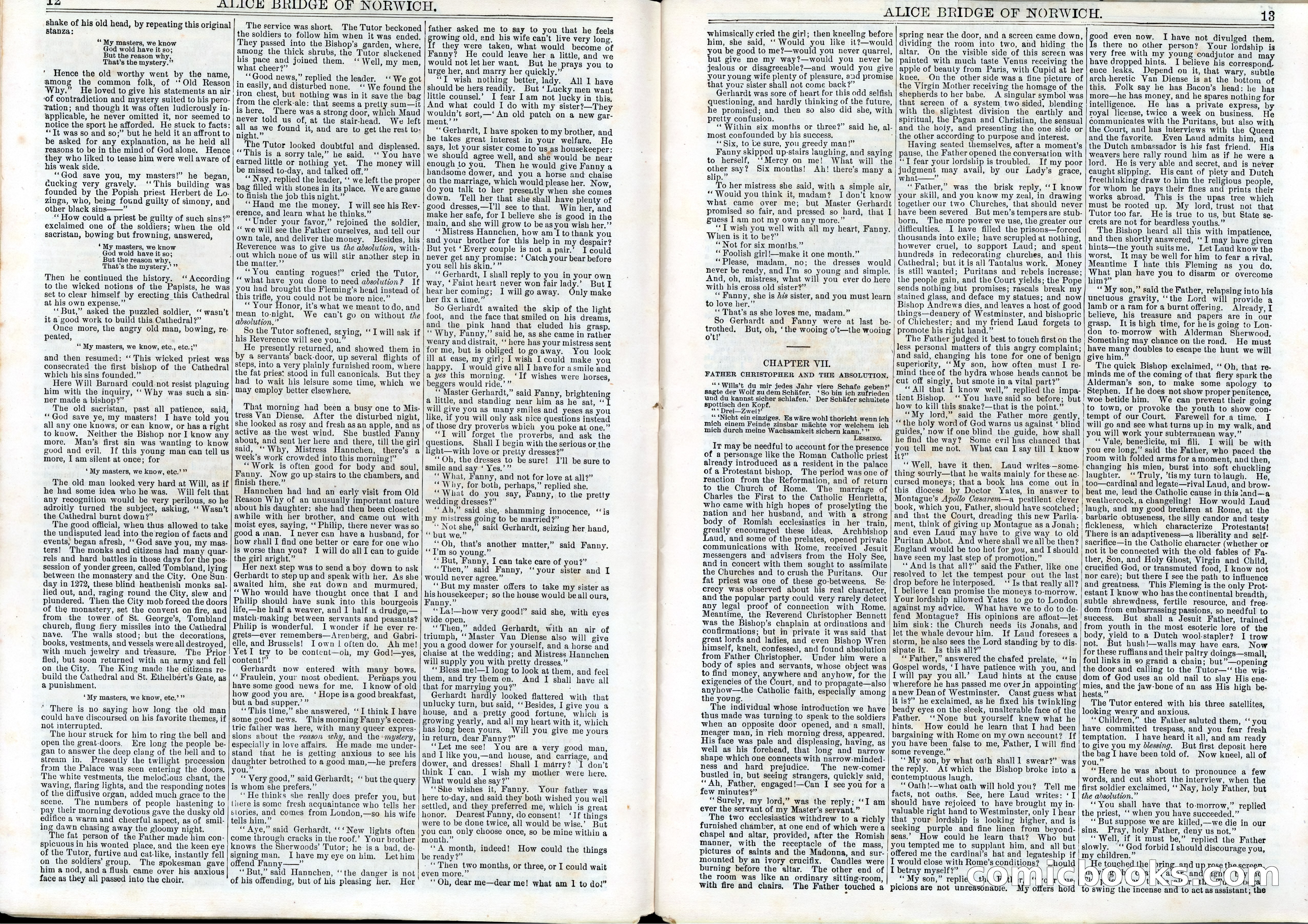
A restored page from Penny Dreadfuls, 1881. Page through the whole issue in the reader above.
📄 Transcribed text from this page (OCR, searchable)
Machine-transcribed from the original scan — historical spelling and the odd misread are preserved.
ALIOH DHIDGH OF NORWICH, i shake of his old head, by repeating this original stanza: “ My masters, we know God wold have it s0; But the reason why, That's the mystery.” ' Hence the old worthy went by the name, among the common folk, of ‘‘Old Reason Why.” He loved to give his statements an air ‘of contradiction and mystery suited to his pero- ration; and though it was often ludicrously in- applicable, he never omitted it, nor seemed to notice the sport he afforded. He stuck to facts: “‘Tt was so and so;” but he held it an affront to be asked for any explanation, as he held all reasons to be in the mind of God alone. Hence they who liked to tease him were well aware of his weak side. “God save you, my masters!” he began, Cucking very gravely. ‘This building was founded by the Popish priest Herbert de Lo- zinga, who, being found guilty of simony, and other black sins——” “How could a priest be guilty of such sins?” exclaimed one of the soldiers; when the old sacristan, bowing but frowning, answered, ‘My masters, we know God wold have it so; But the reason why, That's the mystery.’ ’’ Then he continued the history. ‘ According to the wicked notions of the Papists, he was set to clear himself by erecting this Cathedral at his own expense.” ‘« But,” asked the puzzled soldier, ‘‘ wasn’t it a good work to build this, Cathedral?” Once more, the angry old man, bowing, re- peated, ‘My masters, we know, etc., etc.;” and then resumed; ‘‘ This wicked priest was consecrated the first bishop of the Cathedral which his sins founded.” Here Will Barnard could-not resist plaguing him with the inquiry, ‘‘ Why was such a sin- ner made a bishop?” The old sacristan, past all patience, said, “God save ye, my masters! I have told you all any one knows, or can know, or has a right to know. Neither the Bishop nor I know any more. Man’s first sin was wanting to know good and evil. If this young man can tell us more, I am silent at once; for ‘My masters, we know, etc.’” The old man looked very hard at Will, as if he had some idea who he was, Will felt that any recognition would be very perilous, so he adroitly turned the subject, asking, ‘‘ Wasn’t the Cathedral burnt down?” The good official, when thus allowed to take the undisputed lead into the region of facts and events, began afresh, ‘‘ God save you, my mas- ters! The monks and citizens had many quar- rels and hard battles in those, days for the pos- session of yonder green, called Tombland, lying between the monastery and the City. One Sun- day in 1272, these blind heathenish monks sal- lied out, and, raging round the City, slew and plundered. Then the City mob forced the doors of the monastery, set the convent on fire, and from the tower, of St. George’s, Tombland church, flung fiery missiles into the Cathedral nave. The walls stood; but the decorations, books, vestments, and vessels were all destroyed, with much jewelry and treasure. The Prior fled, but soon returned with an army and fell on the City. The King made the citizens re- build the Cathedral and St. Ethelbert’s Gate, as a punishment, ‘My masters, we know, ete,’ ” " There is no saying how long the old man could have discoursed on his favorite themes, if not interrupted. The hour struck for him to ring the bell and open the great-doors. Ere long the people be- gan to answer the deep clang of the hell and to stream in. Presently the twilight precession from the Palace was seen entering the doors. The white vestments, the melodious chant, the waving, flaring lights, and the responding notes of the diffusive organ, added much grace to the scene. The numbers of people hastening to pay their morning devotious gave the dusky old edifice a warm and cheerful aspect, as of smil- ing dawn chasing away the gloomy night. The fat person of the Father made him con- spicuous in his wonted place, and the keen eye of the Tutor, furtive and cat-like, instantly fell on the soldiers’ group. The spokesman gave him a nod, and a flush came over his anxious face as they all passed into the choir, The service was short. The Tutor beckoned the soldiers to follow him when it was ended. They passed into the Bishop’s garden, where, among the thick shrubs, the Tutor slackened his pace and joined them. ‘ Well, my men, what cheer?” _ ‘Good news,” replied the leader. ‘‘We got in easily, and disturbed none. ‘ We found the iron chest, but nothing was in it save the bag from the clerk-ale: that seems a pretty sum—it ishere. There was a strong door, which Maud never told us of, at the stair-head. We left all as we found it, and are to get the rest to- night.” The Tutor looked doubtful and displeased. “This is a sorry tale,” he said. ‘‘ You have earned little or nothing yet. The money will be missed to-day, and talked off.” ‘* Nay, replied the leader, ‘‘ we left the proper bag filled with stones in its place. We are game to finish the job this night.” “Hand me the money. I will see his Rev- erence, and learn what he thinks,” ‘‘Under your favor,” rejoined the soldier, “‘ we will see the Father ourselves, and tell our own tale, and deliver the money. Besides, his Reverence was to give us the absolution, with- ‘out which none of us will stir another step in the matter.”’ “You canting rogues!” cried the Tutor, “‘what have you done to need absolution? If you had brought the Fleming’s head instead of this trifle, you could not be more nice.” “Your Honor, it’s what we meant to do, and mean to-night. We can't go on without the absolution.” So the Tutor softened, seying, ‘‘I will ask if his Reverence will see you.” He presently returned, and showed them in by a servants’ back-door, up several flights of steps, into a very plainly furnished room, where the fat priest stood in full canonicals. But they had to wait his leisure some time, which we may employ better elsewhere. That morning had been a busy one to Mis- tress Van Diense. After the disturbed night, she looked as rosy and fresh as an apple, and as active as-the west wind. She bustled Fanny about, and sent her here and there, till the girl said, ‘‘Why, Mistress Hannchen, there’s a week’s work crowded into this morning!” “Work is often good for body and soul, Fanny. Now go up-stairs to the chambers, and finish there.” . Hannchen had had an early visit from Old Reason Why of an unusually important nature about his daughter: she had then been closeted awhile with her brother, and came out with moist eyes, saying, ‘‘ Philip, there never was so | goodaiman. I never can havea husband, for how shall I find one better or care for one who is worse than you? I will do allI can to guide the girl aright.” Her next step was to send a boy down to ask Gerhardt to step up and speak with her. As she awaited him, she sat down and murmured, “Who would have thought once that I and Philip should have sunk into this bourgeois life,—he half a weaver, and I half a drudge, — match-making between servants and peasants? Philip is wonderful. I wonder if he ever re- grets—ever remembers—Arenberg, and Qabri- elle, and Brussels! I own | often do. Ah me! Yet I try to be content—oh, my God!—yes, content!” Gerhardt now entered with many bows. “Fraulein, your most obedient. Perhaps you have some good news for me. I know of old how good you are. ‘ Hope isa good breakfast, but a bad supper.’ ” “This time,” she answered, ‘‘I think I have some good news. This morning Fanny’s eccen- tric father was here, with many queer expres- sions about the reason why, and the ‘mystery, especially in love affairs. He made me under- stand that he is getting anxious to see his daughter betrothed to a good man,—he prefers ou.” 4 “ Very good,” said Gerhardt; ‘but the query is whom she prefers,”’ ‘He thinks she really does prefer you, but tere is some fresh acquaintance who tells her stories, and comes from London,—so his wife tells him.” “Aye,” said Gerhardt, ‘‘‘ New lights often come through cracks in the roof.’ Your brother knows the Sherwoods’ Tutor; he is a bad, de- signing man. I have myeye onhim. Lethim offend Fanny-——” “But,” said Hannchen, “the danger is not of his offending, but of his pleasing her. Her father asked me to say to you that he feels (qpomene old, end his wife can’t live very long. f they were taken, what would become of Fanny? He could leave her a little, and we would not let her want, But he prays you to urge her, and marry her quickly.” “T wish nothing better, lady. All 1 have should be hers readily. But ‘ Lucky men want little counsel.’ I fear Iam not lucky in this, And what could I do with my sister?—They wouldn’t sort,—‘ An old patch on a new gar- ment.’ ” “Gerhardt, I have spoken to my brother, and he takes great interest in your welfare. He says, let your sister come to us_as housekeeper: we should agree well, and she would be neat enough to you. Then he would give Fanny a handsome dower, and you a horse and chaise on the marriage, which would please her. Now, do you talk to her presently when she comes down. Tell her that she shall have plenty of good dresses,—I’ll see to that. Win her, and make her safe, for I believe she is good in the main, and she will grow to beas you wish her,”’ ‘‘ Mistress Hannchen, how am I to thank you and your brother for this help in my despair? But yet ‘Every couple is not a pair.’ I could never get any promise: ‘Catch your bear before you sell his skin.’ ” “Gerhardt, I shall reply to you in your own way, ‘Faint heart never won fair lady.’ But I hear her coming; I will goaway. Only make her fix a time.” So Gerhardt awaited the skip of the light foot, and the face that smiled on his dreams, and the pink hand that eluded his grasp. ‘Why, Fanny,” said he, as she came in rather weary and distrait, ‘‘ here has your mistress sent for me, but is obliged to go away. You look ill at ease, my girl; I wish I could make you happy. I would give all I have for asmile and a yes this morning. ‘If wishes were horses, beggers would ride.’ ” “ Master Gerhardt,” said Fanny, brightening a little, and standing near him as he sat, “1 will give you as many smiles and yeses as you like, if you will only ask nice questions instead of those dry proverbs which you poke at one.” “T will forget the proverbs, and ask the questions, Shall I begin with the serious or the light—with love or pretty dresses?” ‘‘Qh, the dresses to be sure! I'll be sure to smile and say ‘ Yes.’” “What, Fanny, and not for love at all?” “Why, for both, perhaps,” replied she. ‘““What do you say, Fanny, to the pretty wedding dresses?” “Ah,” said she, shamming innocence, ‘‘is my mistress going to be married?” ‘Not she,” said Gerhardt, seizing her hand, “but we,” ‘Oh, that’s another matter,” said Fanny. ‘*T’m so young,” ‘* But, Fanny, I can take care of you?” “Then,” said Fanny, ‘‘your sister and I would never agree.” “‘But my master offers to take my sister as his housekeeper; so the house would be all ours, Fanny.” “‘Lal—how very good!” said she, with eyes wide open. ‘‘Then,” added Gerhardt, with an air of triumph, ‘‘Master Van Diense also will give you a good dower for yourself, and a horse and chaise at the wedding; and Mistress Hannchen will supply you with pretty dresses.” “‘ Bless me!—I long to look at them, and fecl them, and try them on. And I shall have all that for marrying you?” ; Gerhardt hardly looked flattered with that unlucky turn, but said, ‘‘ Besides, I give you a house, and a pretty good fortune, which is growing yearly, and all my heart with it, which has long been yours. Will you give me yours in return, dear Fanny?” “Let me see! You are a very good man, and I like you,—and house, and carriage, and dower, and dresses! Shall I marry? ‘I don’t think I’can. I wish my mother were here. ‘What would she say?” ‘‘She wishes it, Fanny. Your father was here to-day, and said they both wished you well settled, and they preferred me, which is great honor. Dearest Fanny, doconsent! ‘If things were to be done twice, all would be wise.’ But you can only choose once, so be mine within a month.” “A month, indeed! How could the things be ready?” - “Then two months, or three, or I could wait ; even more,” ‘Oh, dear me—dear me! what am 1 to do!” ALICE BRI DGE OF NORWICH. 13 TERE ee © eS in whimsically cried the girl; then kneeling before him, she said, ‘‘ Would you like it?—would you be good to me?—would you never quarrel, but give me my way?—would you never be jealous or disagreeable?—and would you give your young wife plenty of pleasure, and promise that your sister shall not come back?” Gerhardt was sore of heart for this odd selfish questioning, and hardly thinking of the future, he promised; and then so also did she, with pretty confusion. : ‘‘ Within six months or three?” said he, al- most confounded by his success. ‘Six, to be sure, you greedy man!” Fanny skipped up-stairs laughing, and saying to herself, ‘‘Mercy on me! What will the other say? Six months! Ah! there’s many a slip.” To her mistress she said, with a simple air, “‘ Would you think it, madam? I don’t know what came over me; but Master Gerhardt promised so fair, and pressed so hard, that I guess I am not my own any more.” ‘*T wish you well with all my heart, Fanny. When is it to be?” “Not for six months,” “ Foolish girll—make it one month.” “Please, madam, no; the dresses would never be ready, and I’m so young and simple. And, oh, mistress, what will you ever do here with his cross old sister?” ‘‘ Fanny, she is As sister, and you must learn to love her.” ‘ That’s as she loves me, madam.” So Gerhardt and Fanny were at last be- trothed, But, oh, ‘the wooing o’t—the wooing ot!’ CHAPTER VII. FATHER CHRISTOPHER AND THE ABSOLUTION, ‘“** Wills’*t du mir jedes Jahr viere Schafe geben?” sagte der Wolf zudem Schiifer, ‘So bin ich zufrieden und du kannst sicher schlafen.’ Der Schifer schultete Spottisch den Kopf. “* Drei—Zwei?” “ ‘Nicht ein einziges, Es ware wohl tnoricht wenn ich mich einem Feinde zinsbar michte vor welchem ich mnich durch meine Wachsamkeit sichern kann,’ ” LEssina. It may be needful to account for the presence of a personage like the Roman Catholic priest already introduced asa resident in the palace of a Protestant bishop, The period was one of reaction from the Reformation, and of return to the Church of Rome. The marriage of Charles the First to the Catholic Henrietta, who came with high hopes of proselyting the nation and her husband, and with a strong body of Romish ecclesiastics in her train, greatly encouraged these ideas. Archbishop Laud, and some of the prelates, opened private communications with Rome, received Jesuit messengers and advisers from the Holy See, and in concert with them sought to assimilate the Churches and to crush the Puritans. Our fat priest was one of these go-betweens. Se- crecy was observed about his real character, and the popular party could very rarely detect any legal proof of connection with Rome. Meantime, the Reverend Christopher Bennett was the Bishop’s chaplain at ordinations and confirmations; but in private it was said that great lords and ladies, and even Bishop Wren himself, knelt, confessed, and found absolution from Father Christopher. Under him were a body of spies and servants, whose object. was to find money, anywhere and anyhow, for the exigencies of the Court, and to propagate—also anyhow—the Catholic faith, especially among the young. The individual whose introduction we have thus made was turning to speak to the soldiers when an opposite door opened, anda small, Ieager man, in rich morning dress, appeared. His face was pale and displeasing, having, as well as his forehead, that long and narrow shape which one connects with narrow-minded- ness and hard prejudice. The new-comer bustled in, but seeing strangers, quicklv said, “Ah, Father, engaged!—Can I see you for a few minutes?” “Surely, my lord,” was the reply; ‘‘I am ever the servant of my Master's servant,” The two ecclesiastics withdrew to a richly furnished chamber, at one end of which were a chapel and altar, provided, after the Romish Manner, with the receptacle of the mass, Pictures of saints and the Madonna, and sur- mounted by an ivory crucifix. Candles were burning before the altar. The other end of the room was like an ordinary sitting-room, With fire and chairs, The Father touched a spring near the door, and a screen came down, dividing the room into two, and hiding the altar. On the visible side of this screen was painted with much taste Venus receiving the apple of beauty from Paris, with Cupid at her knee. On the other side was a fine picture of the Virgin Mother receiving the homage of the shepherds to her babe. A singular symbol was that screen of a system two-sided, blending with the slightest division the earthly and spiritual, the Pagan and Christian, the sensual and the hoiy, and presenting the one side or | the other according to purpose and interest. Having seated themselves, after a moment’s pause, the Father opened the conversation with “I fear your lordship is troubled. If my poor judgment may avail, by our Lady’s grace, what " ‘Father,’ was the brisk reply, ‘‘I know your skill, and you know my zeal, in drawing together our two Churches, that should never have been severed. But men’s tempers are stub- born. The more power we use, the greater our difficulties. I have filled the prisons—forced thousands into exile; have scrupled at nothing, however cruel, to support Laud; and spent hundreds in redecorating churches, ani this Cathedral; but it is all Tantalus work. Money is still wanted; Puritans and rebels increase; | the people gain, and the Court yields;-the Pope sends nothing but promises; rascals break my stained glass, and deface my statues; and now Bishop Andrews dies, and leaves a host of good things—deanery of Westminster, and bishopric of Chichester; and my friend Laud forgets to promote his right hand.” The Father judged it best to touch first on the {less personal matters of this angry complaint; and said, changing his tone for one of benign superiority, ‘‘My son, how often must I re- mind thee of the hydra whose heads cannot be ‘cut off singly, but smote in a vital part?” “All that I know well,” replied the impa- tient Bishop. ‘‘ You have said so before; but how to kill this snake?—that is the point.” “My lord,” said the Father more - gently, “‘the holy word of God warns us against ‘ blind guides,’ now if one blind the guide, how shall he find the way? Some evil has chanced that you tell me not. What can I say till I know it?” ‘‘Well, have it then. Laud writes-—some- thing sourly—that he waits mainly for these ac- cursed moneys; that a book has come out in this diocese by Doctor Yates, in answer to Montague’s Apollo Cesarem—a pestilent clever book, which you, Father, should have scotched ; and that the Court, dreading this new Parlia- ment, think of giving up Montague as a Jonah; Puritan Abbot. And where shall we all be then? England would be too hot for you, and I should have seen my last step of promotion.” ‘* And is that all?” said the Father, like one resolved to let the tempest pour out the last drop before he interposed. ‘‘ Is that really all? I believe I can promise the moneys to-motrow. Your lordship allowed Yates to go to London against my advice. What have we to do to de- fend Montague? His opinions are afloat—let him sink: the Church needs iis Jonahs, and let the whale devour him. If Laud foresees a storm, he also sees the Lord standing by to dis- sipate it. Is this all?” “‘ Father,” answered the chafed prelate, ‘‘in Gospel words, ‘I have patience with you, and I will pay you all.’ Laud hints at the cause wherefore he has passed me over in appointing’ anew Dean of Westminster. Canst guess what it is?” he exclaimed, as he fixed his twinkling beady eyes on the sleek, unalterable face of the Father. ‘‘None but yourself knew what he hints. How could he learn that I had been bargaining with Rome on my own account? If you have been false to me, Father, I will find some revenge,” “‘My son, by what oath shall 1 swear?” was the reply. At which the Bishop broke