
Penny Dreadfuls, 1881 · page 34 of 38
Alice Bridge of Norwich — page 34: what you’re looking at
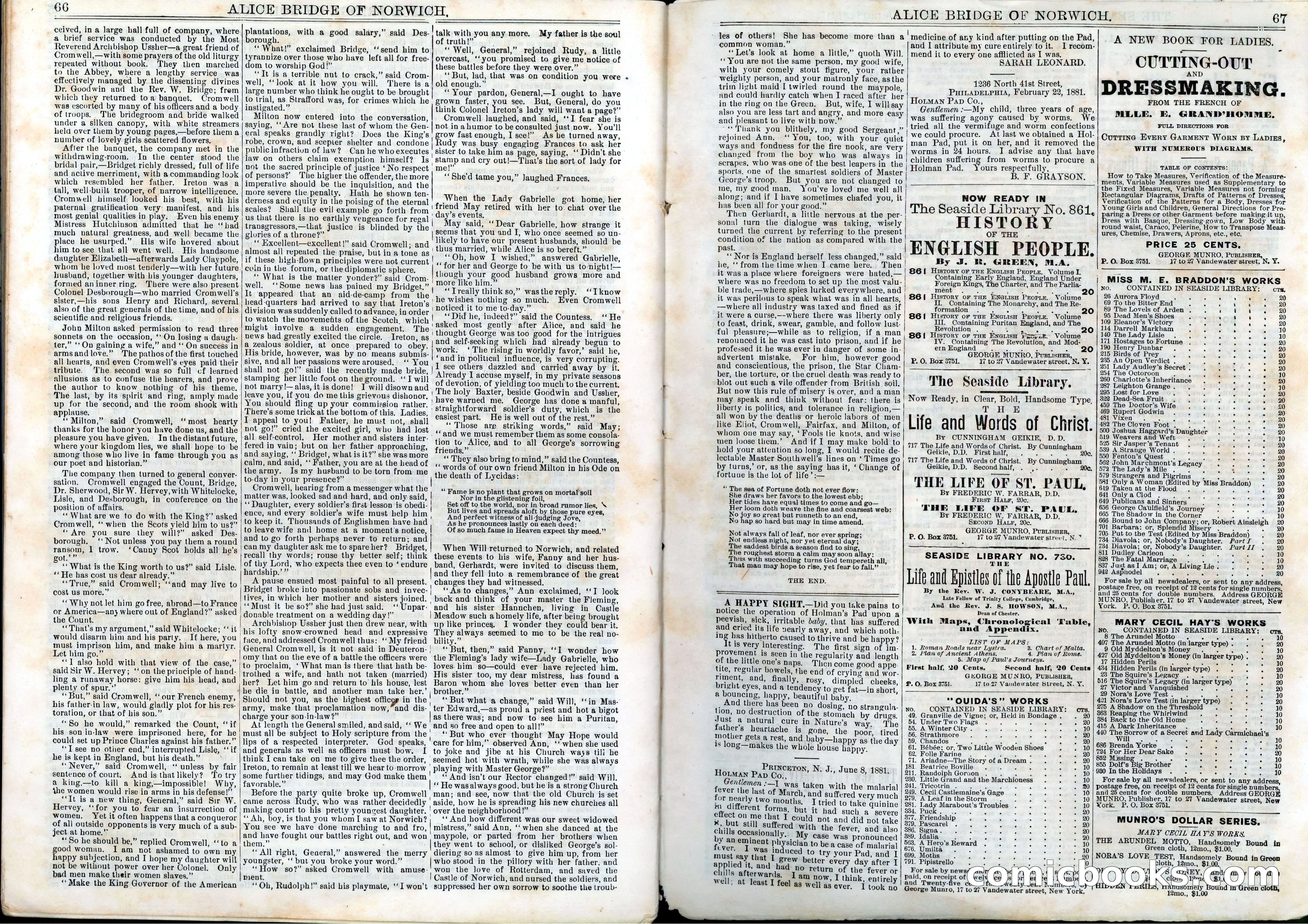
A restored page from Penny Dreadfuls, 1881. Page through the whole issue in the reader above.
📄 Transcribed text from this page (OCR, searchable)
Machine-transcribed from the original scan — historical spelling and the odd misread are preserved.
nS ALICE BRIDGE OF NORWICH, ceived, in a large hall fu)l of company, where a brief service was conducted by the Most Reverend Archbishop Ussher—a great friend of Crom well,—with some prayers of the old liturgy repeated without book. They then marched to the Abbey, where a lengthy service was effectively managed by the dissenting divines Dr. Goodwin and the Rev. W. Bridge; from which they returned toa banquet. Cromwell was escorted by many of his officers and a body of troops. The bridegroom and bride walked under a silken canopy, with white streamers lield over them by young pages,—before them a number of lovely girls scattered flowers, After the banquet, the company met in the withdrawing-room. In the center stood the bridal pair,—Bridget richly dressed, full of life and aclive merriment, with acommanding look which resembled her father. Ireton was a tall, well-built trooper, of narrow intellivence. Cromwell himself, looked his best, with his paternal gratification very: manifest, and his most genial qualities in play, Even his enemy Mistress Hutchinson admitted that he ‘bad much natural greatness, and well became the place he usurped.” His wife hovered about him to see that all went well. His handsome daughter Elizabeth—uafterwards Lady Clay pole, whom he loved most tenderly—with her future husband, tovether with his younger daughters, formed aninner_ring, There were also present Colonel Desborough—who married Cromwell’s sister,—his sons Henry and Richard, several also of the great generals of the time, and of his scientific and religious friends. John Milton asked permission to read three sonnets on the occasion, ‘On losing a daugh- ter,” ‘*On gaining a wife,” and ‘‘ On success in armsand love.” ‘The pathos of the first touched all hearts, and even Cromwell's eyes paid their tribute. ‘The second was so full cf learned allusions as to confuse the hearers, and prove the author to know nothing of his theme. The last, by its spirit and ring, amply made up for the second, and the room shook with applause, “Milton,” said Cromwell, ‘most hearty thanks for the honor you have done us, and the pleasure you have given. In the distant future, where your kingdom lies, we shall hope to be among those who live in fame through you as | our poet and historian.” The company then turned to general conver- sation. Cromwell engaged the Count, Bridge, Dr. Sherwood, Sir W. Hervey, with Whitelocke, Lisle, and Desborough, in conference on the position of affairs, ‘“What are we to do with the King?’ asked Cromwell, ‘‘ when the Scots yield him to us?” “Are you sure they will?” asked Des- borough. ‘' Not unless you pay them a round ransom, 1 trow, ‘Canny Scot holds all he’s ‘ote “What is the King worth to us?” said Lisle. ‘* He has cost us dear already.” “True,” said Cromwell; ‘‘and may live to cost us more.” ‘Why not let him go free, abroad—to France or America—any where out of England?” asked the Count. ‘‘That’s my argument,” said Whitelocke; ‘‘ it would disarm him and his party. If here, you must imprison him, and make him a martyr. Let him go.” ‘‘T also hold with that view of the case,” said Sir W. Hervey; ‘‘on the principle of hand- ling a runaway horse: give him his head, and plenty of spur.’’ * But,” said Cromwell, ‘‘our French enemy, his father-in law, would gladly plot for his res- toration, or that of his son.”’ * So he would,” remarked the Count, ‘if his son in-law were imprisoned here, for he could set up Prince Charles against his father.” “T see no otier end,” interrupted Lisle, ‘if he is kept in England, but his death.” ) “ Never,” said Cromwell, ‘‘ unless by fair sentence of court, And is that likely? To try a king,—to kill a king,—impossible! Why, ihe women would rise.in arms in his defense!” “It is a new thing, General,” said Sir W. Hervey, ‘for you to fear an insurrection of women, Yet it often happens that a conqueror of all outside opponents is very much of a sub- ject at home.” ‘So he should be,” replied Cromwell, ‘to a good womnn. I am not ashamed to own my happy subjection, and I hope my daughter wiil not be without power over her Colonel. Only bad men make their women slaves,” ‘‘Make the King Governor of the American ‘all self-control. plantations, with a good salary,” said Des! walk with you any more, borough, “What!” exclaimed Bridge, ‘‘send him to tyrannize over those who have left all for free- dom to worship God!” ‘It is a terrible nut to crack,” said Crom- well, ‘look at it how you will, There is a large number who think he ought to be brought to trial, as Strafford was, for crimes which he instigated.” Milton now entered into the conversation, saying, ‘‘Are not these last of whom the Gen- eral speaks grandly right? Does the King’s robe, crown, and scepter shelter and condone publicinfraction of law? Can he who executes law on others claim exemption himself? Is not the sacred principle of justice ‘No respect of persons?’ The higher the offender, the more imperative should be the inquisition, and the more severe the penalty, Hath he shown ten- derness and equity in the poising of the eternal scales? Shall the evilexample go forth from us that there is no earthly vengeance for regal transgressors,—tkat justice is blinded by the glories of a throne?” ‘* Excellent—excellent!” said Cromwell; and almost all repeated the, praise, but in a tone as if these high-flown principles were not current coin in the forum, or the diplomatic sphere, “* What is the matter yonder?” suid Crom. well. ‘Some news has pained my Bridget.” It ‘appeared that an aid-decamp from the head-quarters had arrived to say that Ireton’s division was suddenly-called to advance, in order to watch the movemeats of the Scotch, which might involve a sudden engagement. The news had greatly excited the circle. Ireton, as a zealous soldier, at once prepared to obey. His bride, however, was by no means submis- sive, and all her passions were aroused, ‘‘ You shall not go!” said the recently made bride, stamping her little foot on the ground. ‘I will not marry !—alas, itis done! I will disown and leave you, if you do me this grievous dishonor, You should fling up your commission rather. There’s some trick at the bottom of this. Ladies, I appeal to you! Father; he must not, shall not go!” cried the excited girl, who had lost Her mother and sisters inter- fered in vain; but on her father approaching, and saying, ‘‘ Bridget, what is il?” she was more calm, and said, ‘‘ Father, you are at the head of the army. Is my husband to be torn from me to-day in your presence?” Cromwell, hearing from a messenger what the matter was, looked sad and hard, and only said, ‘‘Daughter, every soldier’s first lesson ‘is obedi- ence, and every soldier’s wife must help him to keep it. Thousands of Englishmen have had to leave wife ani] home at a moment's notice, and to go forth perhaps never to return: and can my daughter ask me to spareher? Bridget, recall thy words; rouse thy better self; think of thy Lord, who expects thee even to ‘ endure hardship.’” A pause ensued most painful to all present. Bridget broke into passionate sobs and invec- tives, in which her mother and sisters joined. : ‘*Must it be so?” she had just said. ‘ donable treatment on a wedding day!” Archbishop Ussher just then drew near, with his lofty snow-crowned head and expressive face, and addressed Cromwell thus: ‘‘ My friend npar: General Cromwell, is it not said in Deuteron- | omy that on the eve of a battle the officers were to proclaim, ‘ What man is there that hath be- trothed a wife, and bath not taken (married) ;her? Let him go and return to his house, lest }he die in battle, and another man take her.’ Should not you, as the highest officep in the army, make that proclamation now,’ and dis- charge your son-in-law?” At length the General smiled, and said, ‘‘ We must all be subject to Holy'scripture from the lips of a respected interpreter. and generals as well as officers must bow. I think I can take on me to give thee the order, Treton, to remain at least till we hear to-morrow some further tidings, and may God make them favorable.” Before the party quite broke up, Cromwell came across Rudy, who was rather decidedly making court to his pretty youncest daughter. “ Ah, boy, is that you whom I saw at Norwich? You see we have done marching to and fro, and have fought our battles right out, and won them,” : “All right, Geaeral,” answered the merry youngster, ‘‘ but you broke your word.” ‘““How so?” asked Cromwell with amuse: nent. “Oh, Rudolph!” said his playmate, ‘‘I won’t God speaks, | My father is the soul of truth!” ‘ ‘Well, General,” rejoined Rudy, a little overcast, ‘‘you promised to. give me notice of these battles before they were over.” ‘* But, lad, that was on condition you were old enough.” ‘Your pardon, General,—I ought to have grown faster, you see, But, General, do you think Colonel Ireton’s lady will want a page?” Cromwell. laughed, and said, ‘*I fear she is not in ahumor to be consulted just now. You'll grow fast enough, I sce!” As he turned away, Rudy was busy engaging Frances to ask her sister to take him as page, saying, ‘‘ Didn't she cae and cry out!—That’s the sort of lady for me! ‘‘She'd tame you,” Jaughed Frances. When the Lady Gabrielle got home, her friend May retired with her to. chat over the ' day’s events, | May said, ‘‘Dear Gabrielle, how strange it seems that you and I, who once seemed so un- likely to have our present husbands, should be | thus married, while Alice is so bereft.” “Oh, how I wished,” answered Gabrielle, “for her and George to be with us to-night!— though your good husband grows more and more like him.” ! **Treally think so,” wasthereply. ‘‘Iknow 1 he wishes nothing so much. Even Cromwell | noticed it to me to-day.” | ‘*Did he, indeed?” said the Countess. ‘He ‘asked most gently after Alice, and said he | thought George was too good for the intrigues and self-seeking which had already begun to work, ‘The rising in worldly favor,’ said he, ‘and in political influence, is very corrupting. jl see others dazzled and carried away by it. Already I accuse myself, in my private seasons of devotion, of yielding too much to the current. | The holy Baxter, beside Goodwin and Ussher, | have warned me, George has'done a manful, ‘straightforward ‘soldier’s duty, which is the easiest part. He is well out of the rest.” “Those are striking words,” said May; “and we must remember them as some consola- tion to Alice, and to all George’s sorrowing friends,” ** They also bring to mind,” said the Countess, ‘* words of our own friend Milton in his Ode on the death of Lycidas: “Fame is no plant that grows on mortal’soil Nor in the glistening foil, Set off to the world, nor in broad rumor lies, \ But lives and spreads aloft by those pure eyes, And perfect witness of all-judging Jove, As he pronounces lastly on each deed: Of so much fame in Heaven expect thy meed,” When Will returned to Norwich, and related these events to his wife, Fanny and her hus- band, Gerhardt, were invited to discuss them, and they fell into. a remembrance of the great changes they had witnessed. | *tAs to changes,” Ann exclaimed, ‘‘I look back and think of your master the Fleming, and his sister Hannchen, living in Castle Meadow such ahomely life, after being brought up like princes, I wonder they could bear it. They always seemed to me to be the real no- bility.” “But, then,” said Fanny, ‘‘I wonder how the Fleming's lady wife—Lady Gabrielle, who loves: him so—could ever have rejected him. His sister too, my dear mistress, has found a Baron whom she loves better even than her | brother.” ' ter Edward,—as proud a priest and hot a bigot as there was; and now to'see him a Puritan, and 80 free aud open to all!” ‘But who ever thought May Hope would care for him,’* observed Ann, ‘‘ when she used to joke and jibe at his Church ways till he seemed hot! with wrath, while she was always | playing with Master George?” “ And isn’t our Rector changed!” said Will. ‘* He wasalways good, but he is a strong Ohurch man; and see, now that the old Church is set aside, how he is spreading his new churches all over the neighborhood!” | ‘*And how different was our sweet widowed mistress,” said Ann, ‘‘ when she danced at the maypole, or parted from her brothers when they went to school, or disliked George’s sol- diering so as almost to give him up, from her who stood in the pillory with her father, and wou the love of Rotterdam, and saved the Castle of Norwich, and nursed the soldiers, and suppressed her own sorrow to soothe the troub- “ But what a change,” said Will, ‘‘in Mas- — CRT ee ALICE BRIDGE OF NORWICH. 67 les of others! She has become more than a common woman.” “Let’s look at home a little,” quoth Will. “You are not the same person, my good wife, with your comely stout figure, your rather weighty person, and your matronly face, asthe trim light maid I twirled round the maypole, and could hardly catch when I raced after her in the ring on the Green, But, wife, I willsay also you are less tart and angry, and more easy and pleasant to live with now.” 3 ~‘**TPhank you blithely, my good Sergeant,” rejoined Ann. i ways and fondness for the fire nook, are very changed from the boy who was always in scrapes, who was.one of the best leapers in the sports, one of the smurtest soldiers of Master George’s troop. But you are not changed to me, my good man. You've loved me well all along; and if I have sometimes chafed you, it has been all for your good.” Then Gerlardt, a little nervous at the per- sonal turn the dialogue was taking, wisely turned the current by referring to the present condition of the nation as compared with the | past. ‘Nor is England herself less changed,” said he, ‘‘ from the time when I came here, Then it was a place where foreigners were hated,— where was no freedom to set up the most valu- ble trade,—where spies lurked everywhere, and it was perilous to speak what was in all hearts, —where all industry was taxed and fined as if it were a curse,—-where there was liberty only to feast, drink, swear, gamble, and follow lust- ful pleasure;—while as to religion, if a man renounced it he was cast into prison, and if he professed it he was ever in danger of some in- advertent mistake. For him, however good and conscientious, the prison, the Star Cham- ber, the torture, or the cruel death was ready to blot out such a vile offender from British soil. But now this rule of misery is over, and a man may speak and think without fear: there is liberty in politics, and tolerance in religion,— all won by the deaths or heroic labors of men like Eliot, Cromwell, Fairfax, and Milton, of whom one may say, ‘ Fools tie knots, and wise men loose them.’ And if I may make bold to hold your attention so long, I would recite de- lectable Master Southwell’s lines on ‘ Times go ‘“You, too, with your quiet | by turns,’ or, as the saying hasit, ‘Change of fortune is the lot of life’:— “ The sea of Fortune doth not ever flow: She draws her favors to the lowest ebb; Her tides have equal times to come and go— Her loom doth weave the fine and coarsest web: No 1 so great but runneth to an end, No hap so hard but may in time amend. Not always fall of leaf, nor ever spring; Not endless night, nor yet eternal day; The saddest birds a season find to sing, The roughest storm a calm may soon allay: Thus with succeeding turns God tempereth all, That man may hope to rise, yet fear to fall.” THE END. ES SS ee eee ee ee A HAPPY SIGHT.—Did you take pains to notice the operation of Holman’s Pad upon a peevish, sick, irritable baby, that has suffered and cried its life nearly away, and which noth- ing has hitherto caused to thrive and be happy? tis very interesting. The first sign of im- provement is seen in the regularity and length of the little one’s naps. Then come good appe- tite, regular bowels, the end of crying and wor- riment, and, finally, rosy, dimpled cheeks, bright eyes, and a tendency to get fat—in short a bouncing, happy, beautiful baby. ; _ And there has been no dosing, no strangula- tion, no destruction of the stomach by drugs, Just a natural cure in Nature’s way, The father’s heartache is gone, the poor, tired mother gets a rest, and baby—happy as the day is long—makes the whole house happy. PriNcETON Horst Rie N, N. J., June 8 1881. entlemen -—I_ was taken with the malarial rh the lust of March, and suffered very much tor nearly two mouths, TI tried to take quinine ie different forms, but it had such a severe elect on me that I could not and did not take ‘ree still suffered “with the fever, and also ¢ ills occasionally... My case wus pronounced y an eminent physician to be a case of malarial tver. I was induced to try your Pad, and I must say that I grew better every day after I applied it, and had no return of the fever or chills afterwards. I 4m now, I think, entirely well; at least I feel as well asever, [ took no ' medicine of any kind after putting on the Pad, and I attribute my cure entirely to it. I recom- mend it to every one afflicted as I was. SARAH LEONARD. 1236 North 41st Street, PHILADELPHIA, February 22, 1881. Houtman Pap Co., Gentlemen :—My child, three years of age, was suffering agony caused by worms. We tried all the vermifuge and worm confections we could procure. At last we obtained a Hol- man Pad, put it on her, and it removed the worms in 24 hours. I advise any that have children suffering from worms to procure a Holman Pad. Yours respectfully, B. F. GRAYSON, NOW READY IN The Seaside Library No. 861, HISTORY OF THE [ENGLISH PEOPLE. By J. R. GREEN, M.A. 861 History of THz EnauisH PEOPLE, Volume I, Containing Early England, England Under Foreign Kings, The Charter, and The Parlia- ment . . s : 4 : 3 - 86 History or.taxn Ewes Propire, Volume Containing The Monarchy, and The Re- formation 5 ; es . 86 History or tHe EncuisH Peoriz. Volume IN, Containing Puritan England, and The Revolution. 7. ee 86 History or tue Eneiish Yedrat. Volume IV. Containing The Revolution, and Mod- ern England 3 we ‘i eae 20 EORGE MUNRO, PvetisHER, 17 to 27 Vandewater street, N. ¥. P.O. Box 8751. The Seaside Library, Now Ready, in Clear, Bold, Handsome Type, Life and Words of Christ. By CUNNINGHAM GEIKIE, D.D. 117 The Life and Wordsof Christ. By Cunningham Geikie, D.D, First half, % f % ‘ 206 717 The Life and Words of Christ. By Cunningham Geikie, D.D. Second half, cA - ec THE LIFE OF ST. PAUL, By FREDERIC W. FARRAR, D.D. First Har, 20c. THE LIFE OF ST. PAUL By FREDERIC W. FARRAR, D.D, Seconp Hatr, 20c. GEORGE MUNRO, Pustisumr, 17 to 27 Vandewater street, N. * Ic. P. O. Box 8751. SEASIDE LIBRARY NO. 730. E Life and Bpistes ofthe Apostle Pal. By the Rev. W. J. CONYBEARE, M.A., Inte Fellow of Trinity College, Cambridge, And the Rey. J. 8, IOWSON, M.A,, Denn of Chester, With Maps, Chronological ‘Vable, and Appendix. LIST OF MAPS: 1. Roman Roads near Lystia. 8. Chart of Malta, 2 Plan of Ancient Athens. 4. Plan of Rome. 5. Map of Paul's Jowrieys. First half, 20 Cents, Second half, 20 Cents GKORGE MUNRO, PUBLISHER, P. O. Box 8751. 17 to 27 Vandewater Street, N, Y. **OUIDA'S”’ WORKS No, CONTAINED IN SEASIDE LIBRARY: ots. 49. Granville de Vigne; or, Held in Bondage . ee 54. Under Two Flags . x x 5 < z - 20 55. A Winter City . eee aN sh ee ’ » 10 56. Strathmore, i ° ‘ ‘ - 20 59, Chandos . : 5 ‘ 4 . . 3 » 20 61. Bébée; or, Two Little Wooden Shoes . « (10 62. Folle Farine . ’ . - 20 71. Ariadne—The Story ofa Dream . = . « 20 181. Beatrice Boville . , ‘ 211. Randolph Goraon . . . . . . , 10 230. Little Grand and the Marchioness . . = 10 241. Tricotrin . : : . : ait eye ‘ - 20 249. Cecil Castlemaine’s Gage . ‘ . ° dO! 279, A Leaf in the Storm P : ‘ S 5 » 10 281. Lady Marabout’s Troubles . . . . . 10 877. Friendship * . 4 . . < 6 men. 0) SU ARCAUGL) © SicS. i seeaegiat? mo ca veh 5 Ws Ne 886, Signa . Pa ae : ‘ 5 age at Bier} 889, Idalia fart eet anak! op ed ee 668. “A Heros Reward.) accu oy ssw ) og 4 10 676, Umilta . . Bice aiiislo ebidte ren eo ae 699. Moths 791.