
Penny Dreadfuls, 1881 · page 24 of 38
Alice Bridge of Norwich — page 24: what you’re looking at
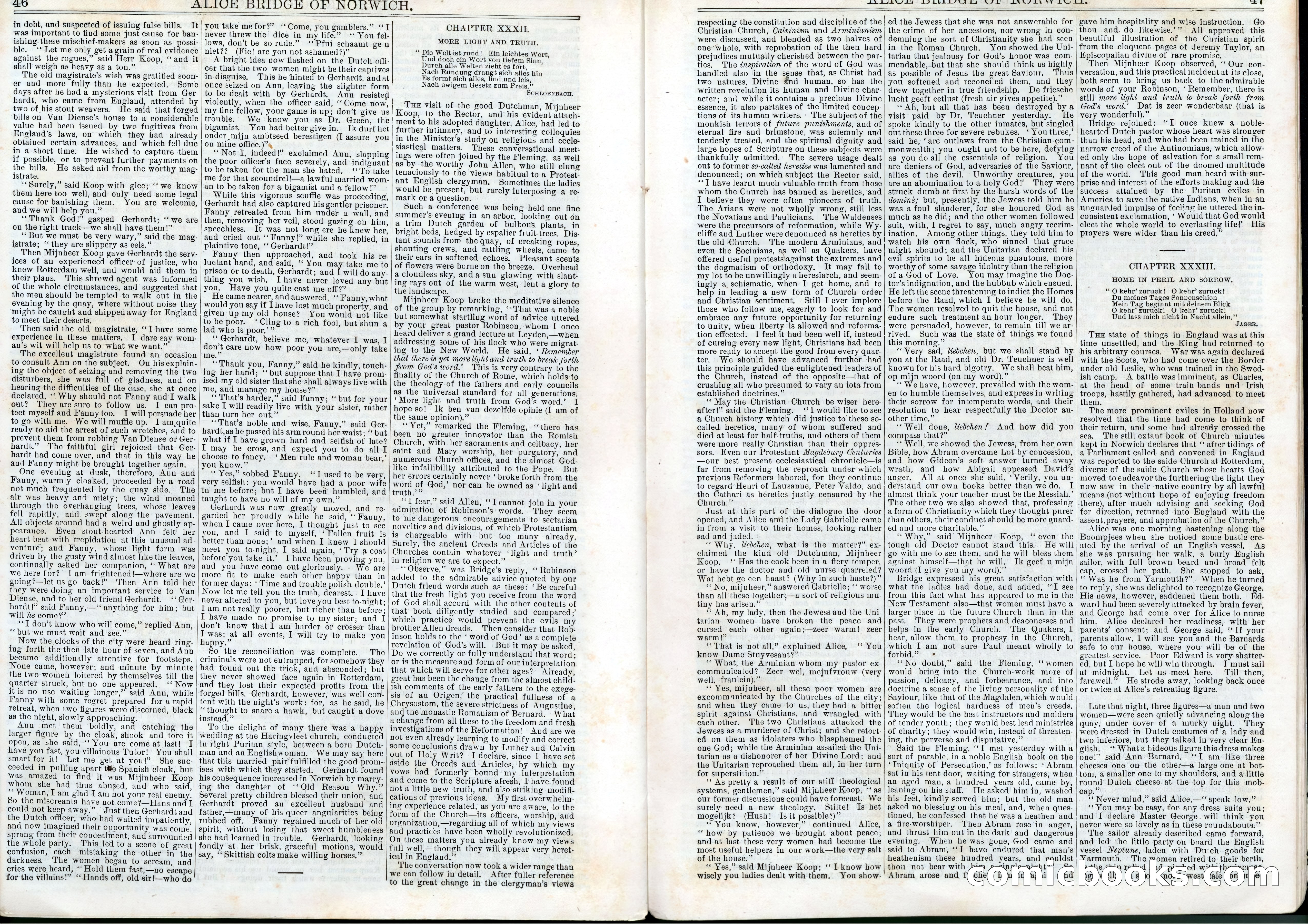
A restored page from Penny Dreadfuls, 1881. Page through the whole issue in the reader above.
📄 Transcribed text from this page (OCR, searchable)
Machine-transcribed from the original scan — historical spelling and the odd misread are preserved.
40 ALIUH bBALDUGH OF NORWICH, in debt, and suspected of issuing false bills. It was important to find some just cause for ban- ishing these mischief-makers as soon as possi- ble. ‘* Let me only get a grain of real evidence against the rogues,” said Herr Koop, “and it shall weigh as heavy as a ton.” The old magistrate’s wish was gratified soon- er and more fully than he expected. Some days after he had a mysterious visit from Ger- hardt, who came from England, attended by two of his stout weavers, He said that forged bills on Van Diense’s bouse to a considerable value had been issued by two fugitives from England’s laws, on which they had already obtained certain advances, and which fell due in a short time. He wished to capture them if possible, or to prevent further payments on the bills. He asked aid from the worthy mag- istrate. ‘“«Surely,” said Koop with glee; ‘‘we know them here too well, and only need some legal cause for banishing them. You are welcome, and we will help you.” “Thank God!” gasped Gerhardt; ‘we are on the right track—we shall have them!” ‘“‘But we must be very wary,” said the mag- istrate; ‘‘ they are slippery as eels.” Then Mijnheer Koop gave Gerhardt the serv- |’ ices of an experienced officer of justice, who knew Rotterdam well, and would aid them in their plans, This shrewd agent was informed of the whole circumstances, and suggested that the men should be tempted to walk out in the evening by the quay, where without noise they might be caught and shipped away for England to meet their deserts, Then said the old magistrate, ‘‘I have some experience in these matters, I dare say wom- an’s wit will help us to what we want.” The excellent magistrate found an occasion to consult Ann on the subject. On his explain- ing the object of seizing and removing the two disturbers, she was full of gladness, and on hearing the difficulties of the case, she at once declared, ‘‘ Why should not Fanny and I walk out? They are sure to follow us. I can pro- tect myself and Fannytoo. I will persuade her to go with me. We will muffle up. I amquite ready to aid the arrest of such wretches, and to prevent them from robbing Van Diense or Ger- hardt.” The faithful girl rejoiced that Ger- hardt had come over, and that in this way he aud Fanny might be brought together again. One evening at dusk, therefore, Ann and Fanny, warmly cloaked, proceeded by a road not much frequented by the quay side, The air was heavy and misty; the wind moaned through the overhanging trees, whose leaves fell rapidly, and swept along the pavement. All objects around had a weird and ghostly ap- pearance. Even stout-hearted Ann felt her heart beat with trepidation at this unusual ad- venture; and Fanny, whose light form was driven by the gusty wind almost like the leaves, continually asked ‘her companion, ‘‘ What are we here for? Iam frightened !—where are we going?—let us go back!” Then Ann told her they were doing an important service to Van Diense, and to her old friend Gerhardt. ‘‘ Ger- hardat!” said Fanny,—‘‘ anything for him; but will he come?” “*T don’t know who will come,” replied Ann, “but we must wait and see.” Now the clocks of the city were heard ring- ing forth the then late hour of seven, and Ann became additionally attentive for footsteps. None came, however; and minute by minute the two women loitered by themselves till the quarter struck, but no one appeared. ‘‘ Now itis no use waiting longer,’ said Ann, while Fanny with some regret prepared for a rapid retreat, when |.wo figures were discerned, black as the night, slowly approaching. Ann met them boldly, and catching the larger figure by the cloak, shook and tore it | Open, as she said, ‘‘ You are come at last! I have you fast, you villainous Tutor! You shall smart for it! Let me get at you!” She suc- ceeded in pulling apart tife Spanish cloak, but was amazed to find it was Mijinheer Koop whom she had thus abused, and who said, a.“ Woman, Tam eilad I am not your real enemy. So the miscreants have not come?—Hans and I could not keep away.” Just ther Gerhardt and the Dutch officer, who: had waited impatiently, and now imagined their opportunity was come, sprang from their concealment, and surrounded the whole party. This led to a scene of great confusion, each mistaking the other in the darkness. The women began to scream, and you take me for?” “Come, you gamblers,” ‘IT never threw the dice in my life.” ‘‘ You fel- lows, don’t be so rude.” ‘‘Pfui schaamt ge u niet?? (Fie! are you not ashamed?)” A bright idea now flashed on the Dutch offi- cer that the two women might be their captives in disguise. This he hinted to Gerhardt, andat once seized on Ann, leaving the slighter form to be dealt with by Gerhardt. Ann resisted violently, when the officer said, ‘Come now, my fine fellow, your game is up; don’t give us trouble. We know you as Dr. Green, the bigamist. You had better give in. Ik durf het onder mijn ambtseed berestigen (I assure you on mine office.)” “Not I, indeed!” exclaimed Ann, slapping the poor officer's face severely, and indignant to be taken for the man she hated. ‘To take me for that scoundrel !—a lawful married wom- an to be taken for a bigamist and a fellow!” While this vigorous scuffle was proceeding, Gerhardt had also captured his gentler prisoner. Fanny retreated from him under a wall, and then, removing her veil, stood gazing on him, speechless, It was not long ere he knew her, and cried out ‘‘ Fanny!” while she replied, in plaintive tone, ‘‘ Gerhardt!” Fanny then approached, and took his re- luctant hand, and said, ‘‘ You may take me to prison or to death, Gerhardt; and I will do any- thing you wish. Ihave never loved any but you. Have you quite cast me off?” He came nearer, and answered, ‘ Fanny, what would you say if I have lost much property, and given up my old house? You would not like to be poor. ‘Cling to a rich fool, but shun a lad who is poor,’ ” ‘Gerhardt, believe me, whatever I was, I don’t care now how poor you are,—only take me. “Thank you, Fanny,” said he kindly, touch- ing her hand; ‘but suppose that I have prom- ised my old sister that she shall always live with me, and manage my house?” “That's harder,” said Fanny; ‘but for your sake I will readily live with your sister, rather than turn her out,” “That’s noble and wise, Fanny,” said Ger- hardt,as he passed his arm round her waist; ‘but what if I have grown hard and selfish of late? I may be cross, and expect you to do all I choose to fancy, ‘Men rule and woman bear,’ you know.” “Yes,” sobbed Fanny. ‘‘I used to be very, very selfish: you would have had a poor wife in me before; but I have been humbled, and taught to have no will of my own.” Gerhardt was now greatly moved, and re. garded her proudly while he said, ‘‘ Fanny, when I came over here, I thought just to see you, and I said to myself, ‘ Fallen fruit is better than none;’ and when I knew I should meet you to-night, I said again, ‘Try a coat before you take it.” I have been proving you, and you have come out gloriously... We are more fit to make each other happy than in former days; ‘ Time and trouble polish double.’ Now let me tell you the truth, dearest. I have never altered to you, but love you best to-night; Tam not really poorer, but richer than before; I have made no promise to my sister; and I don’t know that I am harder or crosser than T was; at all events, I will try to make you happy.” So the reconciliation was complete. The criminals were not entrapped, for somehow they had found out the trick, and absconded; but they never showed face again in Rotterdam, and they lost their expected profits from the forged bills. Gerhardt, however, was well con- tent with the night’s work: for, as he said, he ‘thought to snare a hawk, but caught a dove instead.” To the delight of many there was a happy wedding at the Haringvleet church, conducted in right Puritan style, between a born Dutch- man and an Englishwoman, We may say here that this married pair fulfilled the good prom-: ises with which they started. Gerhardt found his consequence increased in Norwich by marry- ing the daughter of ‘‘Old Reason Why.” Several pretty children blessed their union, and Gerhardt proved an excellent husband and father,—many of his queer angularities being rubbed off. Fanny regained much of her old spirit, without losing that sweet humbleness she had learned in trouble. Gerhardt, looking fondly at her brisk, graceful motions, would say, ‘‘ Skittish colts make willing horses.” cries were heard, ‘‘ Hold them fast,—no escape for the villains!” ‘‘ Hands off, old sir!—who do | CHAPTER XXXIL. MORE LIGHT AND TRUTH, “ Die Weltist rund! Ein leichtes Wort, Und doch ein Wort von tietam Sinn, Durch alle Welten zieht es fort, Nach Rundung drangt sich alles hin Es formt sich alles, lind und leis, Nach ewigem Gesetz zum Preis.” ScHLOENBAOH. THE visit of the good Dutchman, Mijnheer ' Koop, to the Rector, and his evident attach- ' ment to his adopted daughter, Alice, had led to further intimacy, and to interesting colloquies in the Minister’s study on religious and eccle- | Siastical matters. These conversational meet- ings were often joined by the Fleming, as well as by the worthy John Allen, who still clung tenaciously to the views habitual to a Protest: ant English clergyman. Sometimes the ladies would be present, but rarely interposing a re- mark or a question. Such a conference was being held one fine summer’s evening in an arbor, looking out én a trim Dutch garden of bulbous plants, in bright beds, hedged by espalier fruit-trees, Dis- tant sounds from the quay, of creaking ropes, shouting crews, and rattling wheels, came to their ears in softened echoes, Pleasant scents of flowers were borne on the breeze. Overhead a cloudless sky, anda sun glowing with slant- ing rays out of the warm west, lent a glory to the landscape. Mijnheer Koop broke the meditative silence of the group by remarking, ‘‘ That was a noble but somewhat startling word of advice uttered by your great pastor Robinson, whom I once heard deliver a grand lecture at Leyden,—when addressing some of his flock who were migrat- ing to the New World. He said, ‘ Remember that there ts yet more light and truth to break forth from God's word.’ This is very contrary to the finality of the Church of Rome, which holds to the theology of the fathers and early councils as the universal standard for all generations, ‘More light and truth from God’s word,’ I hope so! Ik ben van dezelfde opinie (I am of the same opinion).” “Yet,” remarked the Fleming, ‘there has been no greater innovator than the Romish Church, with her sacraments and celibacy, her saint and Mary worship, her purgatory, and numerous Church offices, and the almost God- like infallibility attributed to the Pope. But her errors certainly never ‘broke forth from the word of God,’ nor can be owned as ‘light and truth.’” “JT fear,” said Allen, ‘‘I cannot join in your admiration of Robinson’s words. “They seem to me dangerous encouragements to sectarian novelties and divisions, of which Protestantism is chargeable with but too many already, Surely, the ancient Creeds and Articles of the Churches contain whatever ‘light and truth? in religion we are to expect.” “Observe,” was Bridge’s reply, ‘‘ Robinson added to the admirable advice quoted by our Dutch friend words such as these: ‘ Be careful that the fresh light you receive from the word of God shall accord with the other contents of that book diligently studied and compared; which practice would prevent the evils my brother Allen dreads. Then consider that Rob- inson holds to the ‘ word of God’ as a complete revelation of God’s will. But it may be asked, Do we correctly or fully understand that word; or is the measure and form of our interpretation that which will serve for other ages? Already, great has been the change from the almost child- ish comments of the early fathers to the exege- sis of an Origen, the practical fullness of a Chrysostom, the severe strictness of Augustine, and the monastic Romanism of Bernard. What achange from all these to the freedom and fresh investigations of the Reformation! And are we not even already learning to modify and correct some con¢lusions drawn by Luther and Oalvin out of Holy Writ? I declare, since I have set aside the Creeds and Articles, by which my vows had formerly bound my interpretation and come to the Scripture afresh, I have found not a little new truth, and also striking modifi- cations of previous ideas, My first overwhelm- ing experience related, as you are aware, to the form of the Church—its officers, worship, and organization, —regarding all of which my views and practices have been wholly revolutionized. On these matters you already know my views full well,—though they will appear very heret- ical in England.” The conversation now took a wider range than we can follow in detail. After fuller reference to the great change in the clergyman’s views J1444U 44 2920414 SG EE YE ANN AY twttie ze respecting the constitution and disciplire of the Christian Church, Calvinism and Arminianism were discussed, and blended as two halves of one~whole, with reprobation of the then hard prejudices mutually cherished between the par- ties, The inspiration of the word of God was handled also in the sense that, as Christ had two natures, Divine aod human, so has the written revelation its human and Divine char- acter; and while it contains a precious Divine essence, it also partakes of the limited concep- tions of its human writers. - The subject of the monkish terrors of future punishments, and of eternal fire and brimstone, was solemnly and tenderly treated, and the spiritual dignity and large hopes of Scripture on these subjects were thankfully admitted.. The severe usage dealt out to former so-called heretics was lamented and denounced; on which subject the Rector said, ‘*T have learnt much valuable truth from those whom the Church has banned as heretics, and I believe they were often pioneers of truth. The Arians were not wholly wrong, still less the Novatians and Paulicians. The Waldenses were the precursors of reformation, while Wy- cliffe and Luther were denounced as heretics by the old Church. The modern Arminians, and even the Socinians, as well as Quakers, have offered useful protestsiagainst the extremes and the dogmatism of orthodoxy. It may fall to my lot to be unwillingly a heresiarch, and seem- ingly a schismatic, when I get home, and to help in leading a new form of Church order and Christian sentiment. Still I ever implore those who follow me, eagerly to look for and embrace any future opportunity for returning to unity, when liberty is allowed and reforma- tion effected. I feel it had been well if, instead of cursing every new light, Christians had been more ready to accept the good from every quar- ter. We should have advanced further had this principle guided the enlightened leaders of the Church, instead of the opposite—that of crushing all who presumed to vary an iota from established doctrines.” “« May the Christian Church be wiser here- after!” said the Fleming. ‘‘I would like to see a Church history which did justice to these so- called heretics, many of whom suffered and died at least for half-truths, and others of them were more really Christian than their oppres- sors. Even our Protestant Magdeburg Centuries —our best present ecclesiastical chronicle—is far from removing the reproach under which previous Reformers labored, for they continue to regard Henri of Lausanne, Peter Valdo, and the Cathari as heretics justly censured by the Church.” Just at this part of the dialogue the door opened, and Alice and the Lady Gabrielle came in from a visit to their homes, looking rather sad and jaded. “Why, lebchen, what is the matter?” ex- claimed the kind old Dutchman, Mijnheer Koop. ‘ Has the cook been in 2 fiery temper, or have the doctor and old nurse quarreled? Wat hebt ge een haast? (Why in such haste?)” “No, mijoheer,” answered Gabrielle; ‘* worse than all these together;—a sort of religious mu- tiny has arisen.” i “Ab, my lady, then the Jewess and the Uni- tarian women have broken the peace and cursed each other again;—zeer warm! zeer warm!” “That is not all,” explained Alice, ‘‘ You know Dame Stuyvesant?” ‘© What, the Arminian whom my pastor ex- communicated? Zeer wel, mejufvrouw (very well, fraulein).” ‘« Yes, mijoheer, all these poor women are excommunicated by the Churches of the city; and when they came to us, they had a bitter spirit against Christians, and wrangled with each other, The two Christians attacked the Jewess as a murderer of Christ; and she retort- ed on them as idolaters who blasphemed the one God; while the Arminian assailed the Uni- tarian as a dishonorer of her Divine Lord; and the Unitarian reproached them all, in her turn for superstition.” : : ‘* Ag pretty a result of our stiff theological systems, gentlemen,” said Mijnoheer Koop, ‘‘as our former discussions could have forecast. We surely need a new theology. Stilte! Is het mogelijk? (Hush! Is it possible?)” : ‘““You know, however,” continued Alice, “how by patience we brought about peace; and at last these very women had become the most useful helpers in our work—the very salt of the house.” the crime of her ancestors, nor wrong in con- demning the sort of Christianity she had seen in the Roman Church. You showed the Uni- tarian that jealousy for God’s honor was com- mendable, but that she should think as highly as possible of Jesus the great Saviour, Thus you softened and reconciled them, and they drew together in true friendship. De friesche lucht geeft eetlust (fresh air gives appetite).” ‘Ah, but all that has been destroyed yA visit paid by Dr. Teuchner yesterday. e spoke kindly to the other inmates, but singled out these three for severe rebukes. ‘ You three,’ said he, ‘are outlaws from the Christian.com- monwealth; you ought not to be here, defying as you do all the essentials of religion. You are deniers of God, adversaries of the Saviour, allies of the devil. Unworthy creatures, you are an abomination to a holy God!’ They were struck dumb at first by the harsh words of the domine; but, presently, the Jewess told him he was afoul slanderer, for ste honored God as much as he did; and the other women followed suit, with, I regret to say, much angry recrim- ination. Among other things, they told him to watch his own flock, who sinned that grace might abound; and the Unitarian declared his evil spirits to be all hideous phantoms, more worthy of some savage idolatry than the religion of a God of Love. You may imagine the Doc- tor’s indignation, and the hubbub which ensued. He left the scene threatening to indict the Homes before the Raad, which I believe he will do. The women resolved to quit the house, and not endure such treatment an hour longer. They were persuaded, however, to remain til] we ar- rived. Such was the state of things we found this morning.” “Very sad, Webchen, but we shall stand by you at the Raad, and old Dr, Teuchner is well known for his hard bigotry. We shall beat him, op mijn woord (on my word).” “We have, however, prevailed with the wom- en to humble themselves, and express in wriling their sorrow for intemperate words, and their resolution to hear respectfully the Doctor an- other time.” “Well done, Webchen/ And how did you compass that?” “Well, we showed the Jewess, from her own Bible, how Abram overcame Lot by concession, and how Gideon’s soft answer turned away wrath, and how Abigail appeased David's anger. All at once she said, ‘ Verily, you un- derstand our own books better than we do. I almost think your teacher must be the Messiah.’ The other two we also showed that, professing aform of Christianity which they thought purer than others, their conduct should be more guard- ed and more charitable.” “Why,” said Mijoheer Koop, ‘‘even the tough old Doctor cannot stand this. He will go with me to see them, and he will bless them against himse