
Penny Dreadfuls, 1881 · page 22 of 38
Alice Bridge of Norwich — page 22: what you’re looking at
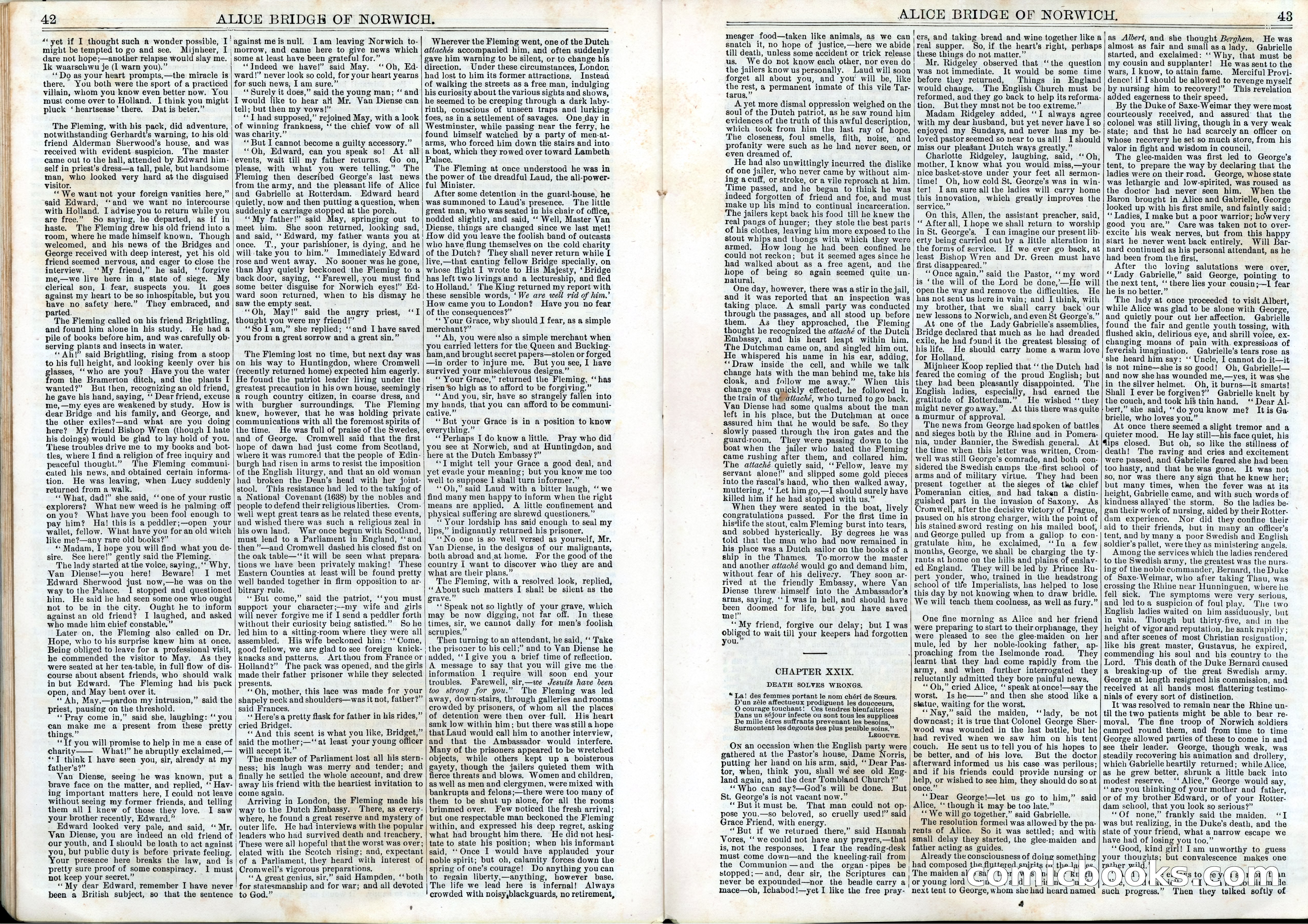
A restored page from Penny Dreadfuls, 1881. Page through the whole issue in the reader above.
📄 Transcribed text from this page (OCR, searchable)
Machine-transcribed from the original scan — historical spelling and the odd misread are preserved.
42 ALICE BRIDGE OF NORWICH. “yet if I thought such a wonder possible, I’ might be tempted to go and see. Mijnheer, I dare not hope;—another relapse would slay me. Ik waarschwu je (I warn you).” ‘‘Do as your heart prompts,—the miracle is there.” You both were the sport of a practiced villain, whom you know even better now. You must come over to Holland. I think you might pluck ‘heartsease’ there. Dat is beter.” The Fleming, with his pack, did adventure, notwithstanding Gerhardt’s warning, to his old friend Alderman Sherwood’s house, and was received with evident suspicion. The master came out to the hall, attended by Edward him- self in priest’s dress—a tall, pale, but handsome man, who looked very hard at the disguised visitor. ‘We want not your foreign vanities here,” said Edward; ‘‘and we want no intercourse with Holland. I advise you to return while you are free.” So saying, he departed, as if in haste. The Fleming drew his old friend into a room, where he made himself known. Though welcomed, and his news of the Bridges and George received with deep interest, yet his old friend seemed nervous, and eager to close the interview. ‘‘My friend,” he said, ‘‘ forgive me,—we live here in a state of siege. My clerical son, I fear, suspects you. It goes against my heart to be so inhospitable, but you have no safety here.” They embraced, and parted. ; The Fleming called on his friend Brightling, and found him alone in his study. He had a pile of books before him, and was carefully ob- serving plants and insects in water. “Ah!” said Brightling, rising from a stoop to his full height, and looking keenly over his glasses, ‘‘who are you? Have you the water from the Bramerton ditch, and the plants I wanted?” But then, recognizing an old friend, he gave his hand, saying, ‘‘ Dear friend, excuse me, —my eyes are weakened by study. How is dear Bridge and his family, and George, and the other exiles?—and what are you doing here? My friend Bishop Wren (though I hate his doings) would be glad to lay hold of you. These troubles drive me to my books and bot- tles, where I find a religion of free inquiry and peaceful thought.” The Fleming communi- cated his news, and obtained certain informa- tion. He was leaving, when Lucy suddenly returned from a walk. : “What, dad!” she said, ‘‘ one of your rustic explorers? What new weed is he palming off on you? What have you been fool enough to pay him? Ha! this is a peddler;—open your wallet, fellow. What have you for an old witch like me?—any rare old books?” ‘‘ Madam, I hope you will find what you de- sire. Sce here!” gently said the Fleming. The lady started at the voice, saying, ,‘‘ Why, Van Diense!—you here! Beware! I met Edward Sherwood just now,—he was on the way to the Palace. I stopped and questioned him. He said he had seen some one who ought not to be in the city. Ought he to inform against an old friend? I laughed, and asked who made him chief constable.” Later on, the Fleming also called on Dr. Hope, who to his surprise knew him at once. Being obliged to leave for a professional visit, he commended the visitor to May. As they were seated at her tea-table, in full flow of dis- course about absent friends, who should walk in but Edward. The Fleming had his pack open, and May bent over it. «Ah, May,—pardon my intrusion,” said the priest, pausing on the threshold. “Pray come in,” said she, laughing: ‘‘ you can make me a present from these pretty things.” ‘Tf you will promise to help in me a case of charity —— What!” he abruptly exclaimed,— **T think I have seen you, sir, already at my father’s?” Van Diense, seeing he was known, put a brave face on the matter, and replied, ‘* Hav- ing important matters here, I could not leave without seeing my former friends, and telling them all I knew of those they love. I saw your brother recently, Edward.” Edward looked very pale, and said, ‘“ Mr. Van Diense, you are indeed an old friend of our youth, and I should be loath to act against | ou, but public duty is before private feeling. Boul presence here breaks the law, and is pretty sure proof of some conspiracy. I must against meis null. Iam leaving Norwich to- morrow, and came here to give news which some at least have been grateful for.” ‘‘Indeed we have!” said May. ‘Oh, Ed- ward!” never look so cold, for your heart yearns for such news, I am sure.” “ Surely it does,” said the young man; “‘ and I would like to hear all Mr. Van Diense can tell; but then my vows!” ‘I had supposed,” rejoined May, with a look of winning frankness, ‘‘ the chief vow of all was charity.” ‘But I cannot become a guilty accessory.” “Oh, Edward, can you speak so! At all events, wait till my father returns. Go on, please, with what you were telling.” The Fleming then described George’s last news from the army, and the pleasant life of Alice and Gabrielle at Rotterdam. Edward heard quietly, now and then putting a question, when suddenly a carriage stopped at the porch. “«My father!” said May, springing out to meet him. She soon returned, looking sad, and said, ‘*‘ Edward, my father wants you at once. T., your parishioner, is dying, and he will take you to him.” Immediately Edward rose and went away. No sooner was he gone, than May quietly beckoned ‘the Fleming to a back door, saying, ‘‘ Farewell, you must find some better disguise for Norwich eyes!” Hd- ward soon returned, when to his dismay he saw the empty seat. . “Oh, May!” said the angry priest, ‘‘I thought you were my friend!” “So Iam,” she replied; ‘‘and I have saved you from a great sorrow and a great sin.” The Fleming lost no time, but next day was on his way to Huntingdon, where Cromwell (recently returned home) expected him eagerly. He found the patriot leader living under the greatest precaution in his own house, seemingly a rough country citizen, in coarse dress, and with burgher surroundings, The Fleming knew, however, that he was holding private communications with all the foremost spirits of the time. He was full of praise of the Swedes, and of George. Cromwell said that the first hope of dawn had just come from Scotland, where it was rumored that the people of Edin- burgh had risen in arms to resist the imposition of thé English liturgy, and that an old woman had broken the Dean’s head with her joint- stool. This resistance had led to the taking of a National Covenant (1638) by the nobles and people to defend their religious liberties. Crom- well wept great tears as he related these events, and wished there was such a religious zeal in his own land. War once begun with Scotland, must lead to a Parliament in England, ‘and then ’”’—and Cromwell dashed his closed fist on the oak table—‘‘it will be seen what prepara. tions we have been privately making! These Eastern Counties at least will be found pretty well banded together in firm opposition to ar- bitrary rule. ‘But come,” said the patriot, ‘‘you must support your character;—-my wife and girls will never forgive me if I send a peddler forth without their curiosity being satistied.” So he led him to a sitting-room where they were all assembled. His wife beckoned him: ‘t Come, good fellow, we are glad to see foreign knick- Knacks and patterns, Artthou from France or Holland?’ ‘The pack was opened, and the girls made their father prisoner while they selected presents, “Oh, mother, this lace was made for your shapely neck and shoulders—was it not, father?” said Frances. pies ‘‘Here’s a pretty flask for father in his rides, cried Bridget. : «* And this scent is what you like, Bridget,” said the mother;—‘‘at least your young officer will accept it.” = The member of Parliament lost all his stern- ness: his laugh was merry and tender; and finally he settled the whole account, and drew away his friend with the heartiest invitation to come again. : : Arriving in London, the Fleming made his way to the Dutch Embassy. There, as every- where, he found a great reserve and mystery of outer life. He had interviews with the popular leaders who had survived death and treachery, These were all hopeful that the worst was over; elated with the Scotch rising; and, expectant of a Parliament, they heard with interest of Cromwell’s vigorous preparations, ” Wherever the Fleming went, one of the Dutch attachés accompanied him, and often suddenly gave him warning to be silent, or to change his direction. Under these circumstances, London had lost to him its former attractions, Instead of walking the streets as a free man, indulging his curiosity about the various sights and shows, he seemed to be creeping through a dark laby- tinth, conscious of unseen traps and lurking foes, as in a settlement of savages. One day in Westminster, while passing near the ferry, he found himself watched by a party of men-at- arms, who forced him down the stairs and into a boat, which they rowed over toward Lambeth Palace. The Fleming at once understood he was in the power of the dreadful Laud, the all-power- ful Minister. After some detention in the guard-house, he was summoned to Laud’s presence. The little great man, who was seated in his chair of office, nodded slightly, and said, ‘‘ Well, Master Van Diense, things are changed since we last met! How did you leave the foolish band of outcasts who have flung themselves on the cold charity of the Dutch? They shall never return while [ live,—that canting fellow Bridge specially, on whose flight I wrote to His. Majesty, ‘ Bridge has left two livings and a lectureship, and fled to Holland.’ The King returned my report with these sensible words, ‘We are well rid of him.’ How came you to London? Have you no fear of the consequences?” “Your Grace, why should I fear, as a simple merchant?” ‘Ah, you were also « simple merchant when you carried letters for the Queen and Bucking- ham,and brought secret papers—stolen or forged —in order to injure me. But you see, I have survived your mischievous designs.” ‘Your Grace,” returned the Fleming, ‘has risen ‘So high as to afford to be forgiving.” “And you, sir, have so strangely fallen into my hands, that you can afford to be communi- cative.” “But your Grace is in a position to know everything.” ‘Perhaps I do know alittle. Pray who did you see at Norwich, and at Huntingdon, and here at the Dutch Embassy ?” “T might tell your Grace a good deal, and yet evade your meaning; but you know me too well to suppose I shall turn informer.” “Oh,” said Laud with a bitter laugh, ‘‘ we find many men happy to inform when the right means are applied. A little confinement and physical suffering are shrewd questioners,” “‘Your lordship has said enough to seal my lips,” indignantly returned his prisoner. “No one is so well versed as yourself, Mr. Van Diense, in the designs of our malignants, both abroad and.at home. For the good of the country 1 want to discover who they are and what are their plans.” The Fleming, with a resolved look, replied, “ About such matters I shal! be silent as the grave.” ‘Speak not so lightly of your grave, which may be now digging, not far off. In these times, sir, we cannot dally for men’s foolish scruples.” Then turning to an attendant, he said, ‘‘ Take the prisozer to bis cell;” and to Van Diense he added, ‘‘I give you a brief time of reflection. A message to say that you will give me the information I require will soon end your troubles. Farewell, sir,—we Jeswits have been too strong for you.” The Fleming was led away, down-stairs, through galleries androoms crowded by prisoners, of whom all the places of detention were then over full, His heart sank low within him; but there was still a hope that Laud would call him to another interview, and that the Ambassador would interfere, Many of the prisoners appeared to be wretched objects, while others kept up a boisterous gayety, though the jailers quieted them with fierce threats and blows. Women and children, as well as men and clergymen, were mixed with bankrupts and felons;—there were too many of them to be shut up alone, for all the rooms brimmed over. Few noticed the fresh arrival; but one respectable man beckoned the Fleming within, and expressed his deep regret, asking what had brought him there. He did not hesi- tate to state his position; when his informant said, ‘‘Once I would have applauded your noble spirit; but oh, calamity forces down the spring of one’s courage! Do anything you can not keep your secret.” ‘“My dear Edward, remember I have never been a British subject, so that the sentence “A great genius, sir,” said Hampden, ‘both ' for statesmanship and for war; and all devoted to God.” to regain liberty,—anything, however base. | Phe life we lead here is infernal! Always crowded with noisy,blackguards, no retirement, ALICE BRIDGE OF NORWICH. 3 438 meager food—taken like animals, as we can snatch it, no hope of justice,—here we abide till death, unless some accident or trick release us. We do not know each other, nor even do the jailers know us personally. Laud will soon forget all about you, and you' will be, like the rest, & permanent inmate of this vile Tar- tarus,’ A yet more dismal oppression weighed on the | tion. soul of the Dutch patriot, as he saw round him evidences of the truth of this awful description, which took from him the last ray of hope, The closeness, foul smells, filth, noise, and | loved pastor seemed so near to us all! profanity were such as he had never seen, or | miss our pleasant Dutch ways greatly.” even dreamed of. He had also unwittingly incurred the dislike of one jailer, who never came by without aim- ing acuff, or stroke, or a vile reproach at him. Time passed, and he began to think he was indeed forgotten of friend and foe, and must make up his mind to continual incarceration. The jailers kept back his food till he knew the real pangs of hunger; they stole the best parts of his clothes, leaving him more exposed to the stout whips and thongs with which they were armed. How long he had been confined he could not reckon; but it seemed ages since he had walked about as a free agent, and the hope of being so again seemed quile un- natural. One day, however, there was a stir in the jail, and it was reported that an inspection was taking place. A small party was conducted through the passages, and all stood up before them. As they approached, the Fleming thought he recognized the attaché of the Dutch Embassy, and his heart leapt within him. The Dutchman came on, and singled him out. He whispered his name in his ear, adding, “‘Draw inside the cell, and while we talk change hats with the man behind me, take his cloak, and follow me away.” When this change was quickly effected, he followed in the train of th¢ attaché, who turned to go back. Van Diense had some qualms about the man left in his place, but the Dutchman at once assured him that he would be safe. So they slowly passed through the iron gates and the guard-room, They were passing down to the boat when the jailer who hated the Fleming came rushing after them, and collared him. The attaché quietly said, ‘‘Fellow, leave my servant alone!” and slipped some gold pieces into the rascal’s hand, who then walked away, muttering, ‘‘ Let him go,—I should surely have killed him if he had stopped with us.” When they were seated in the boat, lively congratulations passed. For the first time in his*life the stout, calm Fleming burst into tears, and sobbed hysterically. By degrees he was told that the man who had now remained in his place was a Dutch sailor on the books of a ship in the Thames, To-morrow the master and another attaché would go and demand him, without fear of his delivery. They soon ar- rived at the friendly Embassy, where Van Diense threw-himself into the Ambassador’s arms, saying, ‘‘ I was in hell, and should have been doomed for life, but. you have saved me!” ‘‘My friend, forgive our delay; but I was obliged to wait tiJl your keepers had forgotten you.” CHAPTER XXIX. DEATH SOLVES WRONGS. “La! des femmes portant le nom ehéri de Scours. D’un zéle affectueux prodiguent les doucceurs, O courage touchant! Ces tendres bienfaitrices Dans un séjour infecte ou sont tous les supplices De mille étres suffrants prevenant les besoins, Surmontent les degouts des plus penible soins,” Leaovuveg. On an occasion when’the English party were gathered at the Pastor’s house, Dame Norris, putting her hand on his arm, said, ‘‘ Dear Pas- tor, when, think you, shall we see old Eng- land again, and the dear Tombland Church?” ““Who can say?—God’s will be done. But St. George’s is not vacant now.” “But it must be. That man could not op- pose you,—so beloved, so cruelly used!” said Grace Friend, with energy. «But if we returned there,” said Hannah Vores, “‘ we could not have any prayers,—that is, not the responses. I fear the reading-desk must come down—and the kneeling-rail from the Communion—and the organ-pipes be stopped;—and, dear sir, the Scriptures can | proaching from the Iselmonde road. | ers, and taking bread and wine together like a real supper. So, if the heart’s right, perhaps these things do not matter.” Mr. Ridgeley observed that ‘‘the question was not immediate. It would be some time before they returned, Things in England would change. The English Church must be reformed, and they go back to help its reforma- But they must not be too extreme.” Madam Ridgeley added, ‘‘I always agree with my dear husband, but yet never have I so Charlotte Ridgeley, laughing, said, ‘Oh, nice basket-stove under your feet all sermon- time! Oh, how cold St..George’s was in win- ter! Iam sure all the ladies will carry home this innovation, which greatly improves the service.” d Qn this, Allen, the assistant preacher, said, ‘* After all, I hope we shall return to worship in St. George’s. I can imagine our present lib- erty being carried out by a little alteration in the forms of service. If we ever go back, at least Bishop Wren and Dr. Green must have first disappeared.” “Once again,” said the Pastor, ‘‘my word is ‘the will of the Lord be done,-—He will open the way and remove the difficulties. He has not sent us herein vain; and I think, with my brother, that we shall carry back our new lessons to Norwich, and even St George's.” At one of the Lady Gabrielle's assemblies, Bridge declared that much as he had dreaded exile, he had found it the greatest blessing of his life. He should carry home a warm love for Holland. . Mijnheer Koop replied that ‘‘ the Dutch had feared the coming of the proud English; but they had been pleasantly disappointed. The English ladies, especially, had earned the gratitude of Rotterdam.” He wished “ they might never goaway.” At this there was quite a murmur of approval. The news from George had spoken of battles and sieges both by the Rhine and in Pomera- nia, under Bannier, the Swedish general. At the time when this letter was written, Crom- well was still George’s comrade, and both con- sidered the Swedish camps the -first school of arms and of military virtue. They had been present together at the sieges of the chief Pomeranian cities, and had taken a distin- guished part in the invasion of Saxony. As Cromwell, after the decisive victory of Prague, paused on his strong charger, with the point of his stained.sword resting on his mailed boot, and George pulled up from a gallop to con- gratulate him, he exclaimed, ‘“‘In a few months, George, we shall be charging the ty- rants at home on the hills and plains of enslav- ed England, They will be led by Prince Ru- pert yonder, who, trained in the headstrong school of the Imperialists, has helped to lose this day by not knowing when to draw bridle. We will teach them coolness, as well as fury.” One fine morning as Alice and her friend were preparing to start to their orphanage, they were pleased to see the glee-maiden on her mule, led by her noble-looking father, ap- They learnt that they had come rapidly from the army, and when further interrogated they reluctantly admitted they bore painful news, “Oh,” cried Alice, ‘‘ speak at once!—say the worst. Is he——” and then she stood like