
Penny Dreadfuls, 1881 · page 20 of 38
Alice Bridge of Norwich — page 20: what you’re looking at
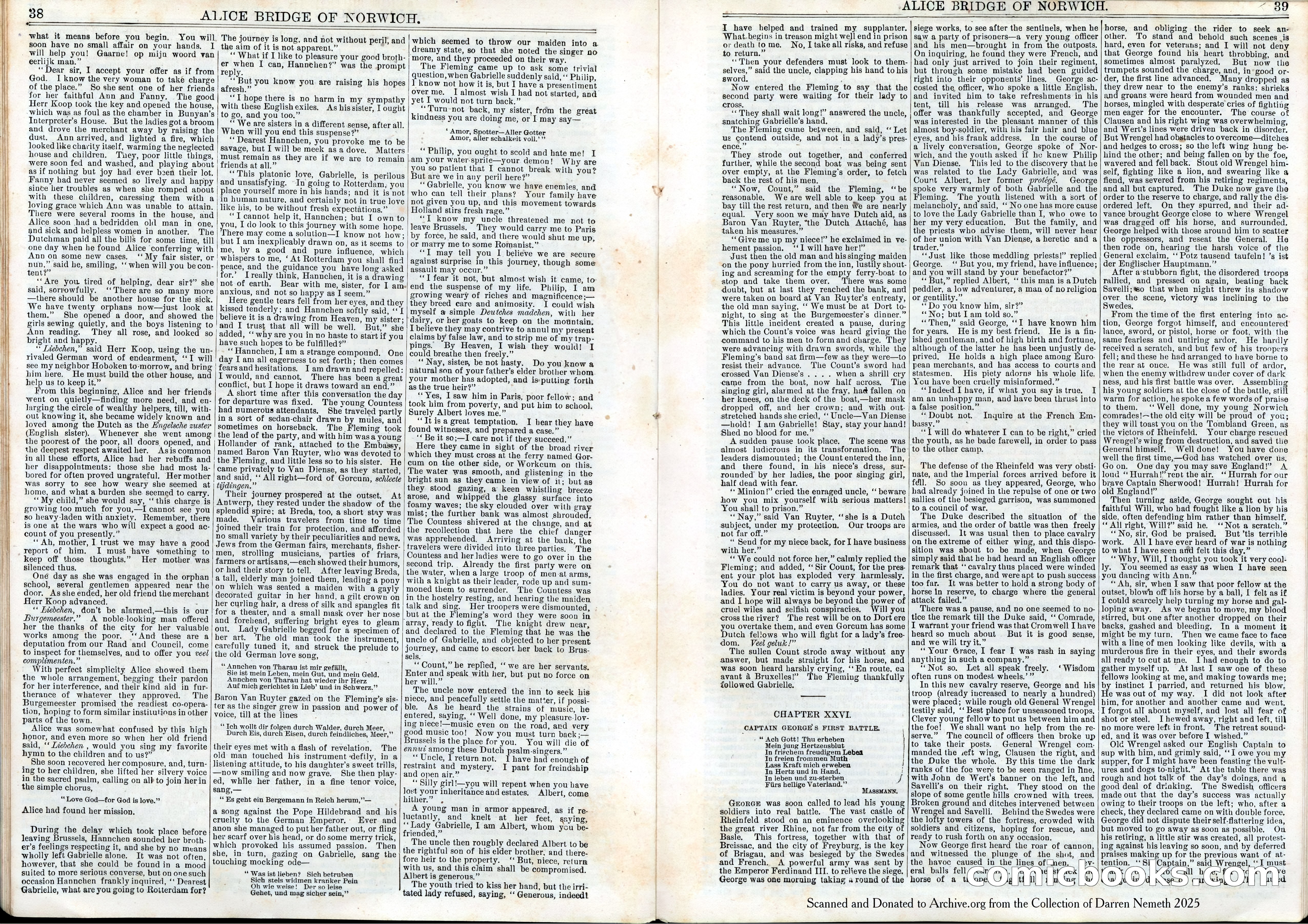
A restored page from Penny Dreadfuls, 1881. Page through the whole issue in the reader above.
📄 Transcribed text from this page (OCR, searchable)
Machine-transcribed from the original scan — historical spelling and the odd misread are preserved.
38 ALICE BRIDGE OF NORWICH. « what it means before you begin. You will soon have no small affair on your hands. I will help you! Gaarne! op mijn woord van eerlijk man.” “Dear sir, I accept your offer as if from God. I know the very woman to take charge of the place.” §o she sent one of her friends for her faithful Ann and Fanny, The good Herr Koop took the key and opened the house, which was as foul as the chamber in Bunyan’s Interpreter’s House. But the ladies got a broom and drove the merchant away by raising the dust. Ann arrived, and lighted a fire, which looked like charity itself, warming the neglected house and children, They, poor little things, | were soon fed and washed, and playing about as if nothing but joy had ever b2eti their lot. Fanny had never seemed so lively and happy since her troubles as when she romped apout with these children, caressing them with a loving grace which Ann was unable to attain. | There were several rooms in the house, and Alice soon had a bedridden old man in one, and sick and helpless women in another. The Dutchman paid all the bills for some time, till one day when he found Alice ‘conferring with Anp on some new cases. ‘*My fair sister, or nun,” said he, smiling, ‘‘ when will you becon- tent?” ‘‘Are you tired of helping, dear sir?” she said, sorrowfully, ‘‘There are so many more —there should be another house for the sick. ‘We have twenty orphans now—just look at them,” She opened a door, and showed the girls sewing quietly, and the boys listening to Ann reading. They all rose, and looked so bright and happy. “ Inebchen,” said Herr Koop, using the un- rivaled German word of endearment, ‘I will see my neighbor Hoboken to-morrow, and bring | him here, He must build the other house, and help us to keep it.” From this beginning, Alice and her friends went on quietly—finding more need, and en- larging the circle of wealthy helpers, till, with- out knowing it, she became widely known and loved among the Dutch as the Hngelsche custer (English sister). Whenever she went among the poorest of the poor, all doors opened, and | the deepest respect awaited her. Asis common in all these efforts, Alice had her rebuffs and her disappointments: those she had most la- bored for often proved ungrateful. Her mother was sorry to see how weary she seemed at home, and what a burden she. seemed to carry. “My child,” she would say, ‘‘this charge is growing too much for you,—I cannot see you so heavy-laden with anxiety. Remember, there is one at the wars who will expect a good ac- count of you presently.” “Ah, mother, I trust we may have a good report of him. I must have something to Keep off those thoughts.” Her mother was silenced thus, Oné day as she was engaged in the orphan school, several gentlemen appeared near the door. As she ended, her old friend the merchant Herr Koop advanced. : “ Fiebchen, don't be alarmed,—this is our Burgemeester.”” A noble-looking man offered her the thanks of the city for her valuable works among the poor. ‘‘And these are a deputation from our Raad and Council, come to inspect for themselves, and to offer you veel complimenten.” With perfect simplicity Alice showed them the whole arrangement, begging their pardon for her interference, and their kind aid in fur- therance of whatever they approved. The Burgemeester promised the readiest co-opera- tion, hoping to form similar institutions in other parts of the town. Alice was somewhat confused by this high honor, and even more so when her old friend said, ‘‘ [vehchen , would you sing my favorite hymn to the children and to us?” She soon recovered her composure, and, turn- The journey is long, and not without peril; and the aim of it is not apparent.” “What if I like to pleasure your good broth- er when I can, Hannchen?” was the prompt reply. ‘But you know you are raising his hopes afresh.” “‘T hope there is no harm in my sympathy with these English exiles. As his sister, I ought to go, and you too.” “We are sisters in a different.sense, after all. When will you end this suspense?” ‘‘ Dearest Hannchen, you provoke me to be savage, but I will be meek asa dove, Matters must remain as they are if we are to remain friends at all.” ‘This platonic love, Gabrielle, is perilous and unsatisfying. “In going to Rotterdam, you place yourself more in his hands; and it is not in human nature, and certainly not in true love like his, to be without fresh expectations,” *‘T cannot help it, Hannchen; but I own to you, I do look to this journey with some hope. There may come a solution—I know not how; but I am inexplicably drawn on, as it seems to me, by a good and pure influence, which whispers to me, ‘ At Rotterdam you shall find peace, and the guidance you have long asked for.’ [really think, Hannchen, it is a drawing anxious, and not so happy as I seem.” Here gentle tears fell from her eyes, and they kissed tenderly; and Hannchen softly said, ‘‘ I believe it is a drawing from Heaven, my sister; and I trust that all will be well. But,” she added, “why are you in no haste to start if you have such hopes to be fulfilled?” ‘‘Hannchen, I am a strange compound. One day I am all eagerness to set forth; then comes fears and hesitations. I am drawn and repelled: I would, and cannot, There has been a great conflict, but I hope it draws toward an end.” A short time after this conversation the day for departure was fixed. The young Countess had numerous attendants. She traveled partly in a sort of sedan-chair drawn by mules, and sometimes on horseback. The Fleming took the lead of the party, and with him wasa young Hollander of rank, attached to the Embassy, named Baron Van Ruyter, who was devoted to the Fleming, and little less so to his sister. He came a to Van Diense, as they started, and said, ‘‘ All right—ford of Gorcum, schlecte ijdingen,” Their journey prospered at the outset. At Antwerp, they rested under the shadow of the splendid spire; at Breda, too, a short stay was made. Various travelers from time to time joined their train for protection, and afforded no small variety by their peculiarities and news, Jews from the German fairs, merchants, fisher- men, strolling musicians, parties of friars, farmers or artisans,—each showed their humors, or had their story to tell. After leaving Breda, a tall, elderly man joined them, leading a pony on which was sented a maiden with a gayly decorated guitar in her hand, a gilt crown on her curling hair, a dress of silk and spangles fit for a theater, and a small mask over her nose and forehead, suffering bright eyes to gleam out. Lady Gabrielle begged for a specimen of her art. The old man took the instrument, carefully tuned it, and struck the prelude to the old German love song, “ Annchen von Tharau ist mir gefillt, Sie ist mein Leben, mein Gut, und mein Geld. Annchen von Tharau hat wieder ihr Herz Auf mich gerichtet in Lieb’ und in Schwerz.” Baron Van Ruyter gazed on the Fleming’s sis- ter as the singer grew in passion and power of voice, till at the lines “Ich wollt dir folgen durch Walder, durch Meer, Durch Eis, durch Kisen, durch feindliches, Meer,” their eyes met with a flash of revelation. The old man touched his instrument <defily, in a listening attitude, to his daughter’s sweet trills, ing to her children, she lifted her silvery voice |—now smiling and now grave. She then play- in the sacred psalm, calling on alb to join herin the simple chorus, “Love God—for God is love.” Alice had found her mission. During the delay which took place before leaving Brussels, Hannchen sounded her broth- er’s feelings respecting it, and she by no means wholly left Gabrielle alone. It was not often, ed, while her father, in a fine tenor voice, sang’,— “Es geht ein Bergemann in Reich herum,’’— a song against the Pope Hildebrand and his cruelty to the German Emperor. Ever and anon she managed to put her father out, or fling her scarf over his head, or dosome merry trick, which provoked his assumed passion. Then she, in turn, gazing on Gabrielle, sang the touching mocking ode— however, that she could be found in a mood suited to more serious converse, but on one such occasion Hannchen frankly inquired, ‘‘ Dearest Gabrielle, what are you going to Rotterdam for? “Was ist lieben? Sich betruben Sich stels widmen kranker Pein Oh wie weise! Der so leise Gehet, und mag sicher sein,” not of earth. Bear with me, sister, for I am= dreamy state, so that she noted the singer no more, and they proceeded on their way. The Fleming came up to ask some trivial question, when Gabrielle suddenly said, ‘« Philip, 1 know not how it is, but I have a presentiment over me. TI almost wish I had not started, and yet I would not turn back.” _* Turn not back, my sister, from the great kindness you are doing me, or I may say— * Amor, S otter—Aller Gotter Amor, aller schalkeit voll.’ ” ‘‘ Philip, you ought to scold and hate me! I am your water-sprite—your demon! Why are you so patient that I cannot break with you? But are we in any peril here?” ‘Gabrielle, you know we have enemies, and who can tell their plans? Your family have not given you up, and this movement towards Holland stirs fresh rage.” “I know my uncle threatened me not to leave Brussels. They would carry me to Paris by force, he said, and there would shut me up, or marry me to some Romanist.” “‘I may tell you I believe we are secure against surprise in this journey, though some assault may occur.” “‘T fear it not, but almost wish it came, to end the suspense of my life, Philip, I am growing weary of riches and magnificence :-— they breed care and animosity. I could wish myself a simple Deutches madchen, with her dairy, or her goats to keep on the motntain, I believe they may contrive to annul my present claims by false law, and to strip me of my trap- pings. By Heaven, I wish they would! I could breathe then freely.” ‘‘ Nay, sister, be not hasty. Do you know a natural son of your father’s elder brother whom your mother has adopted, and is»putting forth as the true heir?” ‘Yes, I saw him in Paris, poor fellow; and took him from poverty, and put him to school. Surely Albert loves me.” “It isa great temptation. I hear they have found witnesses, and prepared a case.” ‘* Be it so;—I care not if they succeed,” Here they came in sight of the broad river which they must cross at the ferry named Gor- cum on the otber side, or Workcum on this. The water was smooth, and glistening in the bright sun as they came in view of it; but ag they stood gazing, a’ keen whistling breeze arose, and whipped the glassy surface into foamy waves; the sky clouded over with gray mist; the further bank was almost shrouded. The Countess shivered at the change, and at the recollection that here the chief danger was apprehended. Arriving at the bank, the travelers were divided into three parties. The Countess and her ladies were to go over in the second trip. Already the first party were on the water, when a large troop of men-at arms, wilh a knight as their leader, rode up and sum- moned them to surrender. The Countess was in the hostelry resting, and hearing the maiden talk and sing. Her troopers were dismounted, but at the Fleming’s word they were soon in farray, ready to fight. The knight drew near, and declared to the Fleming that he was the uncle of Gabrielle, and objected to her present journey, and came to escort her back to Brus- sels. “Count,” he replied, ‘‘ we are her servants, Enter and speak with her, but put no force on her will.” The uncle now entered the inn to seek his niece, and peacefully settle the matter, if possi- ble. As he heard the strains of music, he entered, saying, ‘‘ Well done, my pleasure-lov- ing niece!—music even on the road, and very good music too! Now you must turn back ;— Brussels is the place for you. You will die of ennui among these Dutch psalm-singers.” ss Uncle, Treturn not. Ihave had enough of restraint and mystery. I pant for freindship and open air.” “ Silly girl!—you will repent when you have loxt your inheritance and estates, Albert, come hither.” A young man in armor appeared, as if re- luctantly, and knelt at her feet, saying, ‘‘Lady Gabrielle, I am Albert, whom you be- friended,” The uncle then rougbly declared Albert to be the rightful son of his elder brother, and there- fore heir to the property. ‘‘ But, niece, return with us, and this claim shall be compromised. Albert is generous.” The youth tried to kiss her hand, but the irri- tated lady refused, saying, ‘‘ Generous, indeed! which seemed to throw our maiden into a ALICE BRIDGE OF NORWICH. | “ao I have helped and trained my supplanter. What-begins in treason might well end in prison or death to me. No, I take all risks, and refuse to return.” “Then your defenders must look to them- selves,” said the uncle, clapping his hand to his sword. : Now entered the Fleming to say that the second party were waiting for their lady to cross. ‘«They shall wait long!” answered the uncle, snatching Gabrielle’s hand, The Fleming came between, and said, ‘“ Let us contend outside, and not in a lady’s pres- ence.” = They strode out together, and conferred further, while the second boat was being sent over empty, at the Fleming's order, to fetch back the rest of his men. “Now, Count,” said the Fleming, ‘be reasonable. We are well able to keep you at bay till the rest return, and then We are nearly equal. Very soon we may have Dutch aid, as Baron Van Ruyter, “the Dutch Attaché, has taken his measures.” ‘*Give me up my niece!” he exclaimed in ve- hement passion. ‘‘I will have her!” Just then the old man and hissinging maiden on the pony hurried from the inn, lustily shout- ing and screaming for the empty ferry-boat to stop and take them over. here was some doubt, but at last they reached the bank, and were taken on board at Van Ruyter’s entreaty, the old man saying, ‘‘ We must be at Dort to- night, to sing at the Burgemeester’s dinner.” This little incident created a pause, during which the Count’s voice was heard giving the command to his men to formand charge. They were advancing with drawn swords, while the Fleming's band sat firm—few as they were—to resist their advauce. The Count’s sword had erossed Van Diense’s . . . . when a shrill cry came from the boat, now half across, The singing girl, alarmed at the fray, had fallen on her knees, on the deck of the boat,—her mask dropped off, and her crown; and with out- stretched hands she cried, ‘‘ Uncle—Van Diense —hold! Iam Gabrielle! Stay, stay your hand! Shed no blood for me.” A sudden pause took place. The scene was almost ludicrous in its transformation. The leaders dismounted; the Count entered the inn, and there found, in his niece’s dress, sur- rounded by her ladies, the poor singing girl, half dead with fear. “ Minion!” cried the enraged uncle, ‘‘ beware how you mix yourself with serious matters! You shall to prison.” ‘Nay,’ said Van Ruyter, ‘‘she is a Dutch subject, under my protection. Our troops are not far off.” “‘ Send for my niece back, for I have business with her.” ““We could not force her,” calmly replied the Fleming; and added, ‘‘ Sir Count, for the pres- ent your plot has exploded very harmlessly. ‘You do not want to carry us away, or these ladies. Your real victim is beyond your power, and I hope will always be beyond the power of cruel wiles and selfish conspiracies. Will you cross the river? The rest will be on to Dort ere ou overtake them, and even Gorcum has some Dutch fel!ows who will fight for a lady’s free- dom. Veel geluk!” The sullen Count strode away without any answer, but made straight for his horse, and was soon heard harshly crying, ‘‘ En route, ea avant a Bruxelles!” The Fleming thankfully followed Gabrielle. ; CHAPTER XXVI. CAPTAIN GEORGES FIRST BATTLE. \ - “ Ach Gott! Thu erheben Mein jung Hertzensblut In frischem freudigem Lebea In freien frommen Muth - Lass Kraft mich erweben In Hertz und in Hand, In leben und zu-sterben J Firs heilige Vaterland.” MassmMann, GxrorGE was soon called to lead his young soldiers into real battle. The vast castle of Rheinfeld stood on an eminence overlooking the great river Rhine, not far from the city of Basle. This fortress, together with that of Breissac, and the city of Freyburg, is the key of Brisgau, and was besieged by the Swedes and French. A powerful army was sent by the Emperor Ferdinand III. to relieve the siege. George was one morning taking a round of the siege works, to see after the sentinels, when he saw a party of prisoners—a very young officer and his men—brought in from the outposts. On inquiring, he found they were French, and had only just arrived to join their regiment, but through some mistake had been guided right into their opponents’ lines. George ac- costed the officer, who spoke a little English, and invited him to take refreshments in his tent, till his release was arranged. The offer was thankfully accepted, and George was interested in the pleasant manner of this almost boy-soldier, with his fair hair and blue eyes, and his frank address, In the course of a lively conversation, George spoke of Nor- wich, and the youth asked if he knew Philip Van Diense. This led to the discovery that he was related to the Lady Gabrielle, and was Count Albert, her former protégé. George spoke very warmly of both Gabrielle and the Fleming. The youth listened with a sort of melancholy, and said, ‘‘ No one has more cause to love the Lady Gabrielle than I, who owe to her my very education. But the family, and the priests who advise them, will never hear of her union with Van Diense, a heretic and a trader.” “Just like those meddling priests!” replied George. ‘‘ But you, my friend, have influence; and you will stand by your benefactor?” ‘«But,” replied Albert, ‘‘ this man is a Dutch peddler, a low adventurer, 4 man of noreligion or gentility.” ‘*Do you know him, sir?” “No; but I am told so.” “Then,” said George, ‘‘I have known him for years. He is my best friend. He is a fin- ished gentleman, and of high birth and fortune, although of the latter he has been unjustly de- prived. He holds a high place among Euro. pean merchants, and has access to courts and statesmen. His piety adorns his whole life. You have been cruelly misinformed.” “Indeed I have, if what you say istrue. I }am an unhappy man, and have been thrust into a false position.” ‘Doubt not. Inyuire at the French Em- bassy.” ‘*T will do whatever I can to be right,” cried the youth, as he bade farewell, in order to pass to the other camp. The defense of the Rheinfeld was very obsti- nate, and the Imperial forces arrived before it fdll. So soon as they appeared, George, who had already joined in the repulse of one or two sallies of the besieged garrison, was summoned to a council of war. The Duke described the situation of the armies, and the order of battle was then freely discussed. It was usual then to place cavalry on the extreme of either wing, and this dispo- sition was about to be made, when George simply said that he had heard an English officer remark that ‘‘ cavalry thus placed were winded in the first charge, and were apt to push success too far. It was better to hold a strong body of horse in reserve, to charge where the general attack failed.” There was a pause, and no one seemed to no- tice the remark till the Duke said, ‘‘ Comrade, I warrant your friend was that Cromwell I have heard so much about But it is good sense, and we will try it.” *“Your Grace, I fear I was rash in saying anything in such a company.” “Not so. Let all speak freely. ‘Wisdom often runs on modest wheels,’ ” In this new cavalry reserve, George and his troop (already increased to nearly a hundred) were placed; while rough old General Wrengel testily said, ‘‘ Best place for unseasoned troops, Clever young fellow to put us between him and the foe!, We shall want no help from the re- serve.” The council of officers then broke up to take their posts. General Wrengel com. manded the .eft wing, Clausen the right, and the Duke the whole. By this time the dark ranks o