
Penny Dreadfuls, 1881 · page 11 of 38
Alice Bridge of Norwich — page 11: what you’re looking at
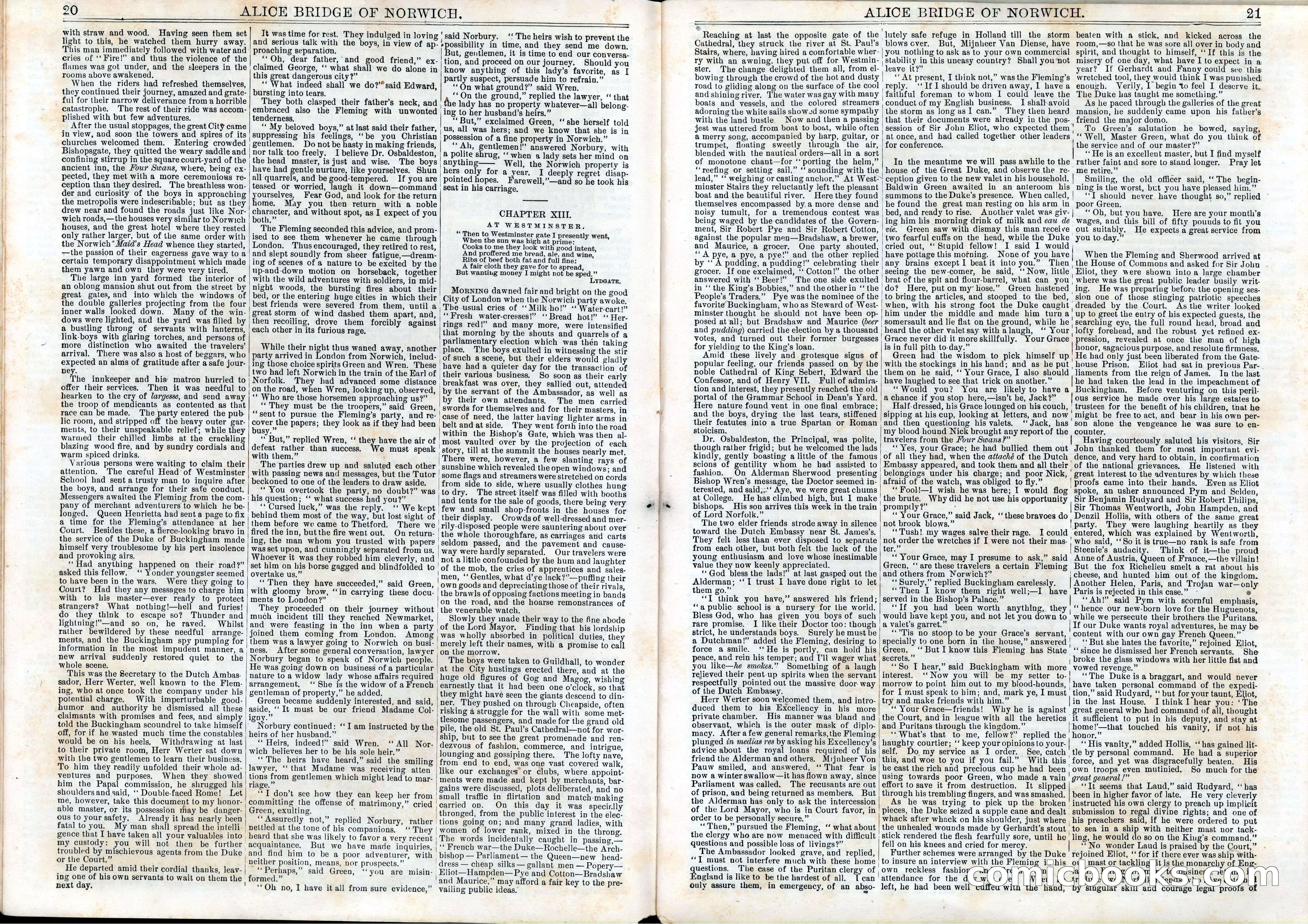
A restored page from Penny Dreadfuls, 1881. Page through the whole issue in the reader above.
📄 Transcribed text from this page (OCR, searchable)
Machine-transcribed from the original scan — historical spelling and the odd misread are preserved.
20 ALICE BRIDGE OF NORWICH. with straw and wood. Having seen them set light to this, he watched them hurry away. This man immediately followed with water and cries of ‘‘ Fire!” and thus the violence of the flames was got under, and the sleepers in the rooms above awakened. ‘When the riders had refreshed themselves, they continued their journey, amazed and grate- ful for their narrow deliverance from a horrible catastrophe. The rest of their ride was accom- plished with but few adventures, After the usual stoppages, the great Cit? came in view, and soon the towers and spires of its churches welcomed them. Entering crowded Bishopsgate, they quitted the weary saddle and confining stirrup in the square court-yard of the | ancient inn, the Your Swans, where, being ex- pected, they met with a more ceremonious re- ception than they desired. The breathless won- der and curiosity of the boys in approaching the metropolis were indescribable; but as they drew near and found the roads just like Nor- wich roads, —the houses very similar to Norwich houses, and the great hotel where they rested only rather larger, but of the same order with the Norwich ° Maid’s Head whence they started, —the passion of their eagerness gave way to a certain temporary disappointment which made them yawn and own they were very tired. The large inn yard formed the interior of an oblong mansion shut out from the street by great gates, and into which the windows of the double galleries projecting from the four inner walls looked down. Many of the win- dows were lighted, and the yard was filled by a bustling throng of servants with lanterns, link-boys with glaring torches, and persons of more distinction who awaited the travelers’ arrival. There was also a host of beggars, who expected an alms of gratitude after a safe jour- ney. The innkeeper and his) matron hurried to offer their services. Then it was needful to hearken to the cry of largesse, and send away the troop of mendicants as contented as that race can be made. The party entered the pub. lic room, and stripped off the heavy outer gar- ments, to their unspeakable relief; while they warmed their chilled limbs at the crackling blazing wood fire, and by sundry cordials and warm spiced drinks. Various persons were waiting to claim their attention, The careful Head of Westminster School had sent a trusty man to inquire after the boys, and arrange for their safe conduct. Messengers awaited the Fleming from the com- pany of merchant adventurers to which he be- longed. a time for the Fleming’s attendance at her Court. Besides these, a fierce-looking bravo in the service of the Duke of Buckingham made himself very troublesome by his pert insolence and provoking airs. ‘‘Had anything happened on their road?” asked this fellow. ‘‘ Yonder youngster seemed to have been in the wars. Were they going to Court? Had they any messages to charge him with to his master—ever ready to protect strangers? What nothing!—hell and furies! do they think to escape so? Thunder and lightning!”—and so on, he raved. Whilst rather bewildered by these needful arrange- ments, and the Buckingham spy pumping for information in the most impudent manner, a new arrival suddenly restored quiet to the whole scene. This was the Secretary to the Dutch Ambas. sador, Herr Werter, well known to the Flem- ing, who at once took the company under his potential charge. With imperturbable good- humor and authority he dismissed all these claimants with promises and fees, and simpl off, for if he wasted much time the constables would be on his heels, Withdrawing at last to their private room, Herr Werter sat down with the two gentlemen to learn their busincss. To him they readily unfolded their whole ad- ventures and purposes. When they showed him the Papal commission, he shrugged his shoulders and said, ‘‘ Double-faced Rome! Let me, however, take this document to my honor- able master, or its possession thay be danger- ous to your safety, Already it has nearly been fatal to you. gence that I have taken all your valuables into my custody: you will not then be further ( My man shall spread the intelli. | troubled by mischievous agents from the Duke | or the Court.” He departed amid their cordial thanks, leav- ing one of his own servants to wait on them the next day. Queen Henrietta had sent a page to fix | It was time for rest. They indulged in loving and serious talk with the proaching separation. “Oh, dear father,’and good friend,” ex- claimed George, ‘‘ what shall we do alone in this great dangerous city?” ‘What indeed shall we do?’said Edward, bursting into tears. They both clasped their father’s neck, and embraced also the Fleming with unwonted tenderness, “« My beloved boys,” at last said their father, suppressing his feelings, ‘‘be you Christian gentlemen. Do not be hasty in making friends, nor talk too freely. I believe Dr. Osbaldeston, the head master, is just and wise. The boys have had gentle nurture, like yourselves. Shun all quarrels, and be good-tempered. If you are teased or worried, laugh it down—command yourselves, Fear God, and look for the return home, ay you then return with a noble ak Spal and without spot, as I expect of you oth,” The Fleming seconded this advice, and prom- ised to see them whenever he came through London. Thus encouraged, they retired to rest, and slept soundly from sheer fatigue,—dream- ing of scenes of a nature to be excited by the up-and-down motion on horseback, together with the wild adventures with soldiers, in mid- night woods, the bursting fires about their bed, or the entering huge cities in which their best friends were severed from them, until a great storm of wind dashed them apart, and, then recoiling, drove them forcibly against each other in its furious rage. While their night thus waned away, another party arrived in Aisador from Norwich, includ- ing those choice spirits Green and Wren. These two had left Norwich in the train of the Earl of Norfolk. They had advanced some distance on the road, when Wren, looking up, observed, ‘‘ Who are those horsemen approaching us?” ‘‘They must be the troopers,” said Green, “sent to pursue the Fleming’s party, and re- cover the papers; they look as if they had been busy.” ‘* But,” replied Wren, ‘‘ they have the air of defeat rather than success. We must speak with them,” ''The parties drew up and saluted each other with passing news and messages, but the Tutor beckoned to one of the leaders to draw aside. “You overtook the party, no doubt?” was his question; ‘‘ what success had you?” ‘* Cursed luck,” was the reply. ‘' We kept behind them most of the way, but lost sight of them before we came to Thetford. There we fired the inn, but the fire went out. On return- ing, the man whom you trusted with papers was set upon, and cunningly separated from us, Whoever it was they robbed him cleverly, and set him on his horse gagged and blindfolded to | overtake us.” “Then they have succeeded,” said Green, with gloomy brow, ‘‘in carrying these docu- ments to London?” They proceeded on their journey without much incident till they reached Newmarket, and were feasting in the inn when a party joined them coming from London. Among them was a lawyer going to Norwich on busi- ness, After some general conversation, lawyer Norbury began to speak of Norwich people. He was going down on business of a particular nature to a widow lady whose affairs required arrangement, ‘‘ She is the widow of a French gentleman of property,” he added, Green became suddenly interested, and said, aside, ‘‘ It must be our friend Madame Col- I simply igny.” told the Buckingham scoundrel to take himself |’ Norbury continued: “I am instructed by the heirs of her husband.” “Heirs, indeed!” said Wren. ‘All Nor- wich believes her to be his sole heir.” “The heirs have heard,” said the smiling lawyer, ‘‘ that Madame was receiving atten tions from gentlemen which might lead to mar- riage.” “I don’t see how they can keep her from committing the offense of matrimony,” cried Green, exulting, : ‘* Assuredly not,” replied Norbury, rather | “They | nettled at the tone of his companions, heard that she was likely to favor a very recent acquaintance. But we have made inquiries, and find him to be a poor adventurer, with neither position, means, nor prospects.” “Perhaps,” said Green, ‘you are misin- _ formed.” ‘Oh no, I have it all from sure evidence,” boys, in view of ap- » ‘‘ The heirs wish to prevent the ossibility in time, and they send me down. ut, gentlemen, it is time to end our conversa- tion, and proceed on our journey. Should you know anything of this lady’s favorite, as I partly suspect, persuade him to refrain.” “‘On what ground?” said Wren. ‘On the ground,” replied the lawyer, “ that e lady has no property whatever—all belong. ing to her husband’s heirs.” “But,” exclaimed Green, ‘she herself told us, all was hers; and we know that she is in | possession of a fine property in Norwich.” “Ah, gentlemen!” answered Norbury, with 4 polite shrug, ‘‘ when a lady sets her mind on anything—— Well, the Norwich property is hers only for a year. I deep] regret disap- pointed hopes. Farewell,”—and so he took his seat in his carriage, ‘said Norbury. CHAPTER XIII. AT WESTMINSTER. “Then to Westminster gate I presently went, When the sun was high at prime: Cooks to me they look with good intent, And proffered me bread, ale, and wine, Ribs of beef both fat and full fine: A fair cloth they gave for to spread, But wanting money I might not be sped,” Lyp@aTE. Mornine dawned fair and bright on the good City of London when the Norwich party awoke. Tbe usual cries of ‘‘ Milk-ho!” ‘* Water-cart!” “Fresh water-cresses!” ‘‘Bread hot!” ‘ Her- rings red!” and many more, were intensified that morning by the shouts and quarrels of a pkg oat election which was thén taking ‘place. The boys exulted in wilnessing the stir jof such a scene, but their elders would gladly have had a quieter day for the transaction of | their various business. So soon as their early breakfast was over, they sallied out, attended by the servant of the Ambassador, as well as by their own attendants. The men carried swords for themselves and for their masters, in ,case of need, the latter having lighter arms in | belt and at side. They went forth into the road | within the Bishop’s Gate, which was then al- most vaulted over by the projection of each | Story, till at the summit the houses nearly met. | There were, however, a few slanting rays of sunshine which revealed the open windows; and some flags and streamers were stretched on cords from side to side, where usually clothes hung to dry. The street itself was filled with booths and tents for the sale of goods, there being very |few and small shop-fronts in the houses for their display. Crowds of well-dressed and mer- rily-disposed people were sauntering about over ;the whole thoroughfare, as carriages and carts seldom passed, and the pavement and cause- way were hardly separated. Our travelers were not a little confounded by the hum and laughter of the mob, the cries of apprentices and sales- men, ‘‘ Gentles, what d’ye lack?”—puffing their own goods and depreciating those of their rivals, the brawls of opposing factions meeting in bands on the road, and the hoarse remonstrances of the venerable watch. Slowly they made their way to the fine abode of the Lord Mayor. Finding that bis lordship was wholly absorbed in political duties, they merely left their names, with a promise to call on the morrow. The boys were taken to Guildhall, to wonder at the City hustings erected there, and at the huge old figures of Gog and Magog, wishing earnestly that it had been one o’clock, so that they might have seen the giants descend to din- ner. They pushed on through Cheapside, often | risking a struggle for the wall with some met- tlesome passengers, and made for the grand old pile, the old St. Paul’s Cathedral—not for wor- ship, but to see the great promenade and ren- dezvous of fashion, commerce, and intrigue, lounging and gossiping there. The lofty nave, from end to end, was one vast covered walk, like our exchanges’ or clubs, where appoint- ments were made and kept by merchants, bar- gains were discussed, plots deliberated, and no small traffic in flirtation and match-making carried on. On this day it was specislly thronged, from the public interest in the elec- tions going on; and many grand ladies, with women of lower rank, mixed in the throng. |The words incidentally caught in passing,— ‘* French war—the Duke—Rochelle—the Arch- bishop — Parliament — the Queen—new _ head- dress — cheap silks— gallant men — Popery— Eliot—Hampden—Pye and Cotton—Bradshaw and Maurice,” may afford a fair key to the pre- vailing public ideas, ee aE treat e ae =e WICH. 21 ALICE BRIDGE OF NOR r Reaching at last the opposite gate of the | lutely safe refuge in Holland till the storm Cathedral, they struck the river at St. Paul’s Stairs, where, having hired a comfortable wher- ry with an awning. they put off for Westmin- ster. The change delighted them all, from el- bowing through the crowd of the hot and dusty road to gliding along on the surface of the cool and shining river. The water was gay with many boats and vessels, and the colored streamers adorning the white sails showed some sympathy with the land bustle. Now and then a passing jest was uttered from boat to boat, while often a merry song, accompanied by harp, guitar, or | trumpet, floating sweetly through the air, blended with the nautical orders—all in a sort of monotone chant—for ‘' porting the helm,” “reefing or setting sail,” ‘‘ sounding with the lead,” ‘‘ weighing or casting anchor.” At West minster Stairs they reluctantly left the pleasant boat and the beautiful river. Here they found themselves encompassed by,a more dense and noisy tumult, for a tremendous contest was being waged by the candidates of the Govern- ment, Sir Robert Pye and Sir Robert Cotton, against the popular men—Bradshaw, a brewer, and Maurice, a grocer. One party shouted, “A pye, a pye, a pye:” and the other replied by ‘‘ A pudding, a pudding!” celebrating their grocer. If one exclaimed, ‘‘ Cotton!” the other answered with ‘‘ Beer!” The one side exulted in ‘‘ the King’s Bobbies,” and the other in ‘the People's Traders.” Pye was the nominee of the favorite Buckingham, who as Steward of West- minster thought he should not have been op- posed at‘all; but Bradshaw and Maurice (eer and pudding) carried the election by a thousand votes, and turned out their former burgesses for yielding to the King’s loan. Amid these lively and grotesque signs of popular feeling, our friends passed on by the noble Cathedral of King Sebert, Edward the Confessor, and of Henry VII. Full of admira- tion and interest, they presently reached the old portal of the Grammar School in Dean’s Yard. Here nature found vent in one final embrace; and the boys, drying the last tears, stiffened their featutes into a true Spartan or Roman stoicism. Dr. Osbaldeston, the Principal, was polite, though rather frigid; but he welcomed the lads kindly, gently boasting a little of the famous scions of gentility whom he had assisted to | fashion. On Alderman Sherwood presenting Bishop Wren’s message, the Doctor seemed in- terested, and said,;‘‘ Aye, we were great chums at College. He has climbed high, but I make bishops. His son arrives this week in the train of Lord Norfolk.” The two elder friends strode away in silence toward the Dutch Embassy near St. James’s. They felt less than ever disposed to separate from each other, but both felt the lack of the young enthusiasm and love whose inestimable value they now keenly appreciated. “God bless the lads!’’ at last gasped out the Alderman; ‘‘I trust I have done right to let them go.” “T think you have,” answered his friend; “‘a public. school is a nursery for the world. Bless God, who has given you boys of such rare promise. - I like their Doctor too: though strict, he understands boys. Surely he must be a Dutchman!” added the Fleming, desiring to force a smile. ‘‘He is portly, can hold his peace, and rein his temper; and [’ll wager what you like—he smokes.” Something of a laugh relieved their pent-up spirits when the servant respectfully pointed out the massive door. way of the Dutch Embassy. Herr Werter soon welcomed them, and intro- duced them to his Excellency in his more private chamber. His manner was bland and observant, which is the outer mask of diplo- macy. After a few general remarks, the Fleming plunged in medias res by asking his Excellency’s advice about the royal loans required of his friend the Alderman and others. Mijnheer Von Pauw smiled, and answered, ‘‘ That fear is now a winter swallow—it has flown away, since Parliament was called. The recusants are out of prison, and being returned as members. But the Alderman has only to ask the intercession of the Lord Mayor, who is in Court favor, in oréer to be personally secure.” “Then,” pursued the Fleming, ‘“ what about the clergy who are now menaced with difficult questions and possible loss of livings?” The Ambassador looked grave, and replied, “I must not interfere much with these home questions. The case of the Puritan clergy of England is like to be the hardest of all. T can ouly assure them, in emergency, of an abso- blows cver. But, Mijnheer Van Diense, have you nothing to ask as to your own commercial | Stability in this uneasy country? Shall you ‘not leave it?” ‘At present, I think not,” was the Fleming’s reply. ‘‘If I should be driven away, I have a faithful foreman to whom I could leave the conduct of my English business, I shalhavoid the storm as long asI can.” They then heard that their documents were already in the pos- session of Sir John Eliot, who expected them at once, and had called together other leaders for conference. In the meantime we will pass awhile to the house of the Great Duke, and observe the re- ception given to the new valet in his household, Baldwin Green awaited in an anteroom his summons to the Duke’s presence. When called, he found the great man resting on his arm in bed, and ready to rise. Another valet was giv- ing him his morning drink of milk and eau de ove. Green saw with dismay this man receive two fearful cuffs on the head, while the Duke cried out, ‘‘ Stupid fellow! I said I would have pottage this morning. None of you have any brains except I beat it into you.” T! seeing the new-comer, he said, ‘' Now, little brat of the spit and flour-barrel, what can you do? Here, put on my hose.” Green hastened Then , beaten with a stick, and kicked across the room,—so that he was sore all over in body and spirit, and thought to himself, ‘If this is the. misery of one day, what have I to expect in a year? If Gerhardt and. Fanny could see this: wretched tool, they wouid think I was punished} enough, Verily, I begin ‘to feel I deserve it.. The Duke has taught me something.” As he paced through the galleries of the great mansion, he suddenly came upon his father’s friend the major domo, To Green’s salutation he bowed, saying, “Well, Master Green, what do you think of the service and of our master?” ‘‘He is an excellent master, but I find myself rather faint and sore to stand longer. Pray let me retire.” : Smiling, the old officer said, ‘‘ The begin- ning is the worst, but you have pleased him,” “TI should never have thought so,” replied poor Green, “Oh, but you have. Here are your month’s wages, and this bill of fifty pounds to fit you out suitably. He expects a great service from ‘you to-day.” 4 When the Fleming and Sherwood arrived at the House of Commons and asked for Sir Johu Eliot, they were shown into a large chamber , Where was the great public leader busily writ- ing. He was preparing before the opening ses- to bring the articles, and stooped to the bed, | sion one of those stinging patriotic speeches when, with his strong foot the Duke caught dreaded by the Court, As the writer looked him under the middle and made him