
Penny Dreadfuls, 1844 · page 210 of 278
Alfred; or, The Adventures of a French Gentleman — page 210: what you’re looking at
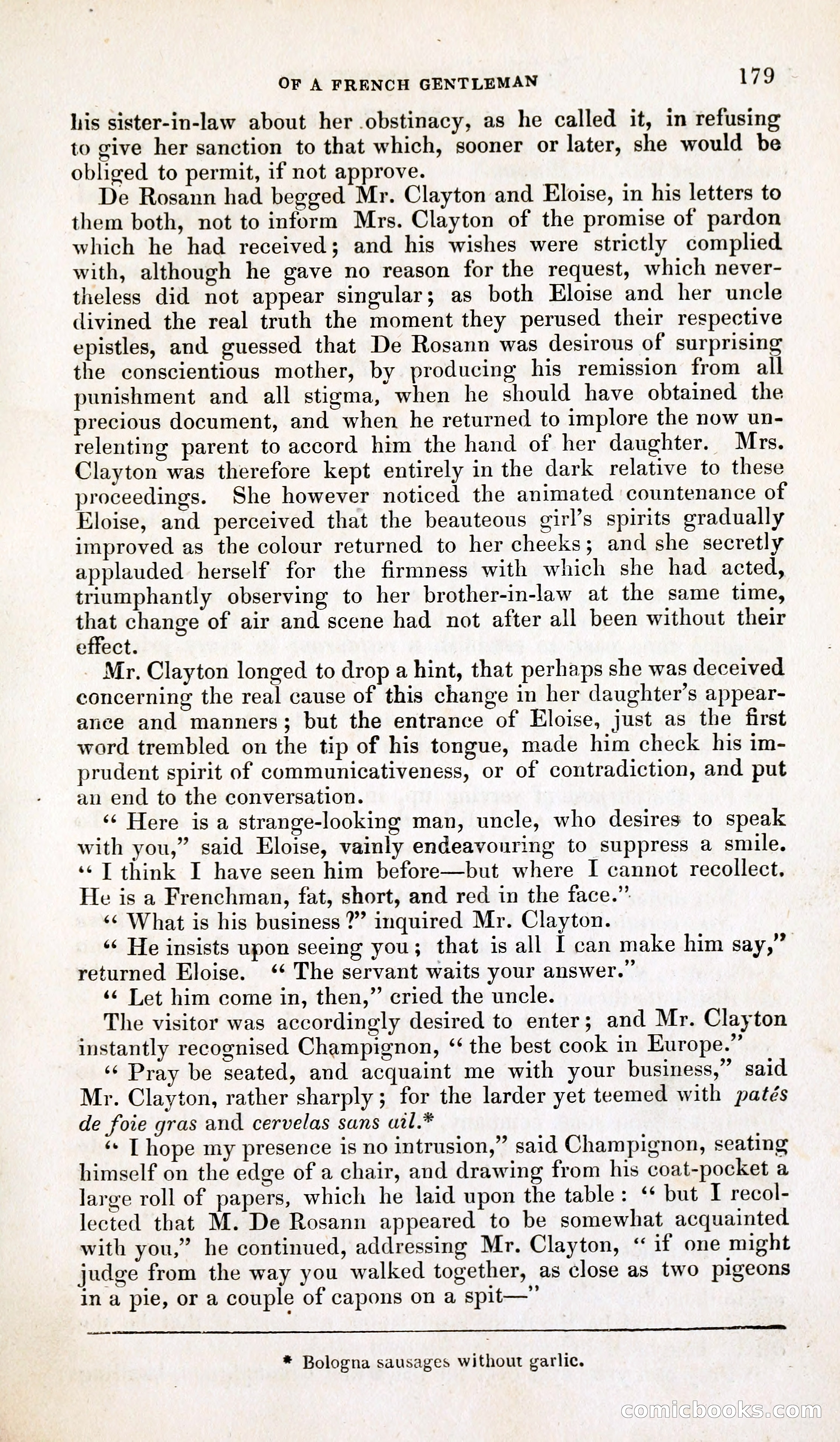
A restored page from Penny Dreadfuls, 1844. Page through the whole issue in the reader above.
📄 Transcribed text from this page (OCR, searchable)
Machine-transcribed from the original scan — historical spelling and the odd misread are preserved.
OF A FRENCH GENTLEMAN 179 his sister-in-law about her obstinacy, as he called it, in refusing to give her sanction to that which, sooner or later, she would be obliged to permit, if not approve. | De Rosann had begged Mr. Clayton and Eloise, in his letters to them both, not to inform Mrs. Clayton of the promise of pardon which he had received; and his wishes were strictly complied with, although he gave no reason for the request, which never- theless did not appear singular; as both Eloise and her uncle divined the real truth the moment they perused their respective epistles, and guessed that De Rosann was desirous of surprising the conscientious mother, by producing his remission from all punishment and all stigma, when he should have obtained the precious document, and when he returned to implore the now un- relenting parent to accord him the hand of her daughter. Mrs. Clayton was therefore kept entirely in the dark relative to these proceedings. She however noticed the animated countenance of Eloise, and perceived that the beauteous girl’s spirits gradually improved as the colour returned to her cheeks; and she secretly applauded herself for the firmness with which she had acted, triumphantly observing to her brother-in-law at the same time, that change of air and scene had not after all been without their effect. Mr. Clayton longed to drop a hint, that perhaps she was deceived concerning the real cause of this change in her daughter’s appear- ance and manners; but the entrance of Eloise, just as the first word trembled on the tip of his tongue, made him check his im- prudent spirit of communicativeness, or of contradiction, and put an end to the conversation. ‘¢ Here is a strange-looking man, uncle, who desires to speak with you,” said Eloise, vainly endeavouring to suppress a smile. ‘¢ T think I have seen him before—but where I cannot recollect, He is a Frenchman, fat, short, and red in the face.” ‘¢ What is his business?” inquired Mr. Clayton. ‘‘ He insists upon seeing you; that is all I can make him say,” returned Eloise. ‘‘ The servant waits your answer.” ‘¢ Let him come in, then,” cried the uncle. The visitor was accordingly desired to enter; and Mr. Clayton instantly recognised Champignon, “ the best cook in Europe.” ‘‘ Pray be seated, and acquaint me with your business,” said Mr. Clayton, rather sharply; for the larder yet teemed with patés de foie gras and cervelas sans utl.* ‘« [ hope my presence is no intrusion,” said Champignon, seating himself on the edge of a chair, and drawing from his coat-pocket a large roll of papers, which he laid upon the table: ‘* but I recol- lected that M. De Rosann appeared to be somewhat acquainted with you,” he continued, addressing Mr. Clayton, “if one might judge from the way you walked together, as close as two pigeons in a pie, or a couple of capons on a spit—” * Bologna sausages without garlic. GomicdooksnGeo