
Penny Dreadfuls, 1844 · page 134 of 278
Alfred; or, The Adventures of a French Gentleman — page 134: what you’re looking at
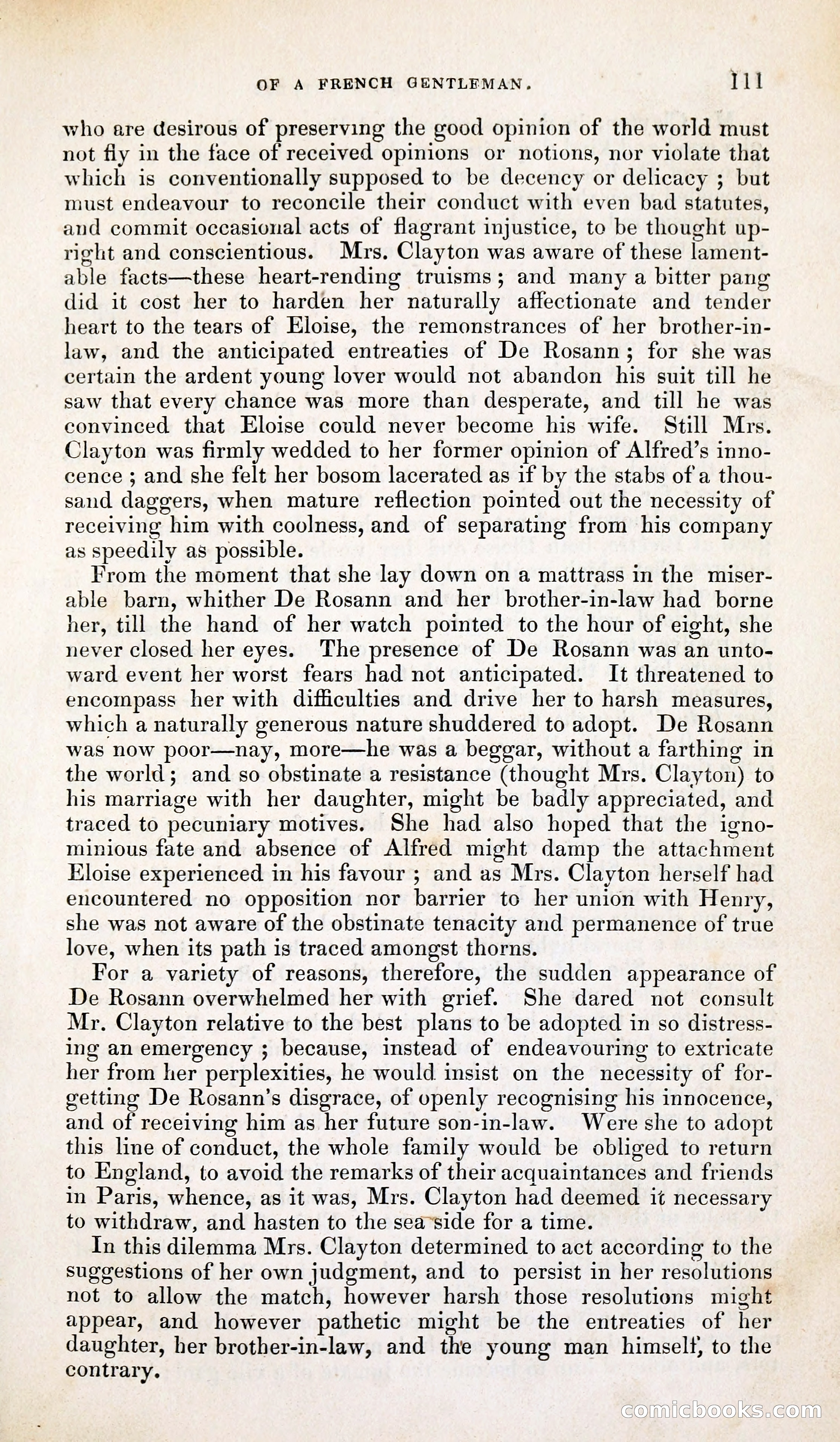
A restored page from Penny Dreadfuls, 1844. Page through the whole issue in the reader above.
📄 Transcribed text from this page (OCR, searchable)
Machine-transcribed from the original scan — historical spelling and the odd misread are preserved.
OF A FRENCH GENTLEMAN. 111 who are desirous of preserving the good opinion of the world must not fiy in the face of received opinions or notions, nor violate that which is conventionally supposed to be decency or delicacy ; but must endeavour to reconcile their conduct with even bad statutes, and commit occasional acts of flagrant injustice, to be thought up- right and conscientious. Mrs. Clayton was aware of these lament- able facts—these heart-rending truisms; and many a bitter pang did it cost her to harden her naturally affectionate and tender heart to the tears of Eloise, the remonstrances of her brother-in- law, and the anticipated entreaties of De Rosann; for she was certain the ardent young lover would not abandon his suit till he saw that every chance was more than desperate, and till he was convinced that Eloise could never become his wife. Still Mrs. Clayton was firmly wedded to her former opinion of Alfred’s inno- cence ; and she felt her bosom lacerated as if by the stabs of a thou- sand daggers, when mature reflection pointed out the necessity of receiving him with coolness, and of separating from his company as speedily as possible. From the moment that she lay down on a mattrass in the miser- able barn, whither De Rosann and her brother-in-law had borne her, till the hand of her watch pointed to the hour of eight, she never closed her eyes. The presence of De Rosann was an unto- ward event her worst fears had not anticipated. It threatened to encompass her with difficulties and drive her to harsh measures, which a naturally generous nature shuddered to adopt. De Rosann was now poor—nay, more—he was a beggar, without a farthing in the world; and so obstinate a resistance (thought Mrs. Clayton) to his marriage with her daughter, might be badly appreciated, and traced to pecuniary motives. She had also hoped that the igno- minious fate and absence of Alfred might damp the attachment Eloise experienced in his favour ; and as Mrs. Clayton herself had encountered no opposition nor barrier to her union with Henry, she was not aware of the obstinate tenacity and permanence of true love, when its path 1s traced amongst thorns. For a variety of reasons, therefore, the sudden appearance of De Rosann overwhelmed her with grief. She dared not consult Mr. Clayton relative to the best plans to be adopted in so distress- ing an emergency ; because, instead of endeavouring to extricate her from her perplexities, he would insist on the necessity of for- getting De Rosann’s disgrace, of openly recognising his innocence, and of receiving him as her future son-in-law. Were she to adopt this line of conduct, the whole family would be obliged to return to England, to avoid the remarks of their acquaintances and friends in Paris, whence, as it was, Mrs. Clayton had deemed 1¢ necessary to withdraw, and hasten to the sea‘side for a time. In this dilemma Mrs. Clayton determined to act according to the suggestions of her own judgment, and to persist in her resolutions not to allow the match, however harsh those resolutions might appear, and however pathetic might be the entreaties of her daughter, her brother-in-law, and the young man himselt, to the contrary. CORNICLOOOKS»CO