
Penny Dreadfuls, 1839 · page 263 of 273
Alfred de Rosann by G.W.M. Reynolds — page 263: what you’re looking at
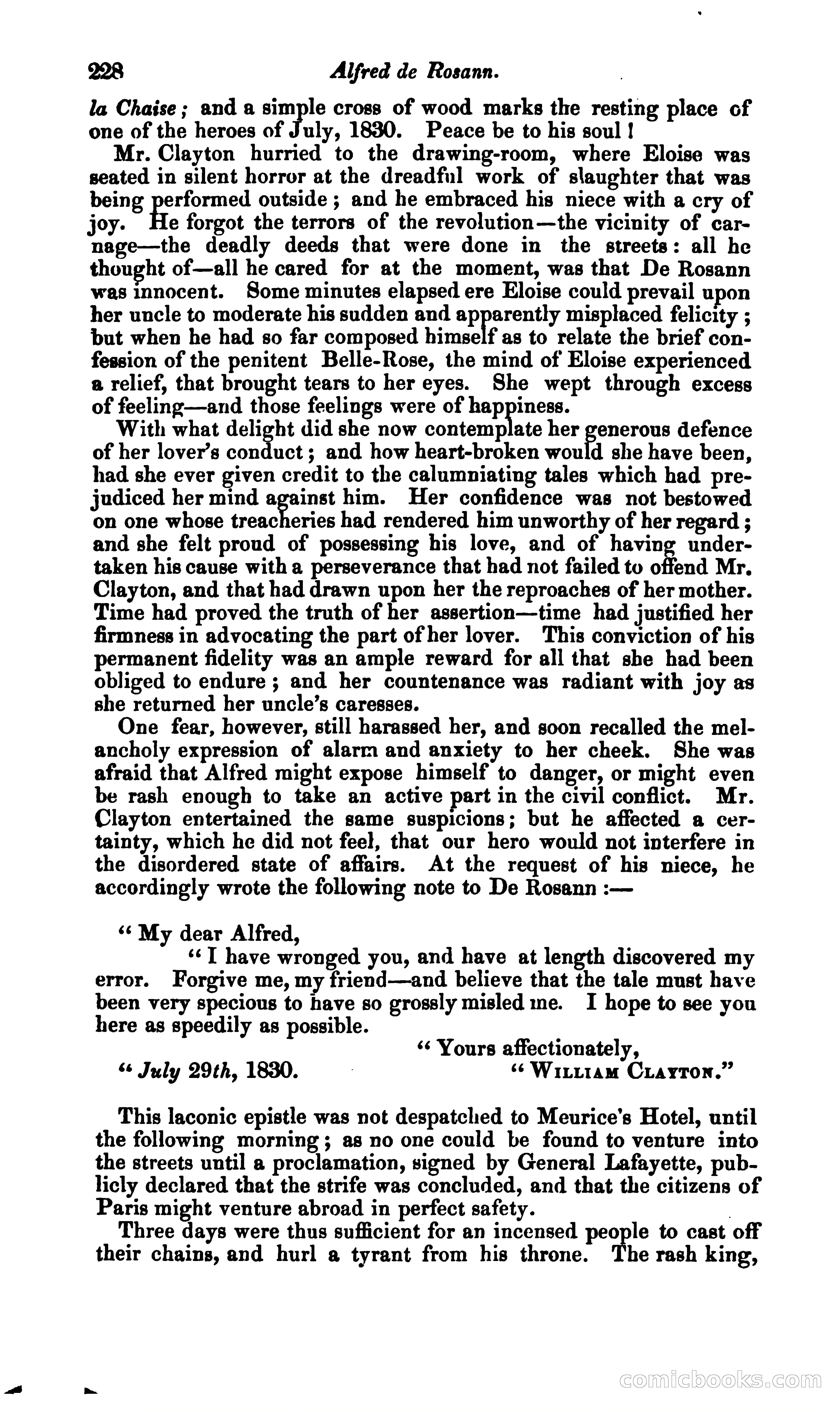
A restored page from Penny Dreadfuls, 1839. Page through the whole issue in the reader above.
📄 Transcribed text from this page (OCR, searchable)
Machine-transcribed from the original scan — historical spelling and the odd misread are preserved.
228 Alfred de Rosann. la Chaise; and a simple cross of wood marks the resting place of one of the heroes of July, 1880. Peace be to his soul ! Mr. Clayton hurried to the drawing-room, where Eloise was seated in silent horror at the dreadful work of slaughter that was being performed outside ; and he embraced his niece with a cry of joy. e forgot the terrors of the revolution—the vicinity of car- nage—the deadly deeds that were done in the streets: all he thought of—all he cared for at the moment, was that De Rosann was innocent. Some minutes elapsed ere Eloise could prevail upon her uncle to moderate his sudden and apparently misplaced felicity ; but when he had so far composed himself as to relate the brief con- fession of the penitent Belle-Rose, the mind of Eloise experienced. a relief, that brought tears to her eyes. She wept through excess of feeling—and those feelings were of happiness. With what delight did she now contemplate her generous defence of her lover’s conduct; and how heart-broken would she have been, had she ever given credit to the calumniating tales which had pre- judiced her mind against him. Her confidence was not bestowed on one whose treacheries had rendered him unworthy of her regard ; and she felt proud of possessing his love, and of having under- taken his cause with a perseverance that had not failed to offend Mr. Clayton, and that had drawn upon her the reproaches of her mother. Time had proved the truth of her assertion—time had justified her firmness in advocating the part of her lover. This conviction of his permanent fidelity was an ample reward for all that she had been obliged to endure ; and her countenance was radiant with joy as she returned her uncle’s caresses. One fear, however, still harassed her, and soon recalled the mel- ancholy expression of alarm and anxiety to her cheek. She was afraid that Alfred might expose himself to danger, or might even be rash enough to take an active part in the civil conflict. Mr. Clayton entertained the same suspicions; but he affected a cer- tainty, which he did not feel, that our hero would not interfere in the disordered state of affairs. At the request of his niece, he accordingly wrote the following note to De Rosann :— ‘¢ My dear Alfred, ‘¢T have wronged you, and have at length discovered my error. Forgive me, my friend—and believe that the tale must have been very specious to have so grossly misled me. I hope to see you here as speedily as possible. ‘¢ Yours affectionately, “‘ July 29th, 1830. ; ‘¢Wittiam Crayton.” This laconic epistle was not despatched to Meurice’s Hotel, until the following morning; as no one could be found to venture into the streets until a proclamation, signed by General Lafayette, pub- licly declared that the strife was concluded, and that the citizens of Paris might venture abroad in perfect safety. | Three days were thus sufficient for an incensed people to cast off their chains, and hurl a tyrant from his throne. The rash king, ~ COnicbooolks (GO)