
Penny Dreadfuls, 1839 · page 257 of 273
Alfred de Rosann by G.W.M. Reynolds — page 257: what you’re looking at
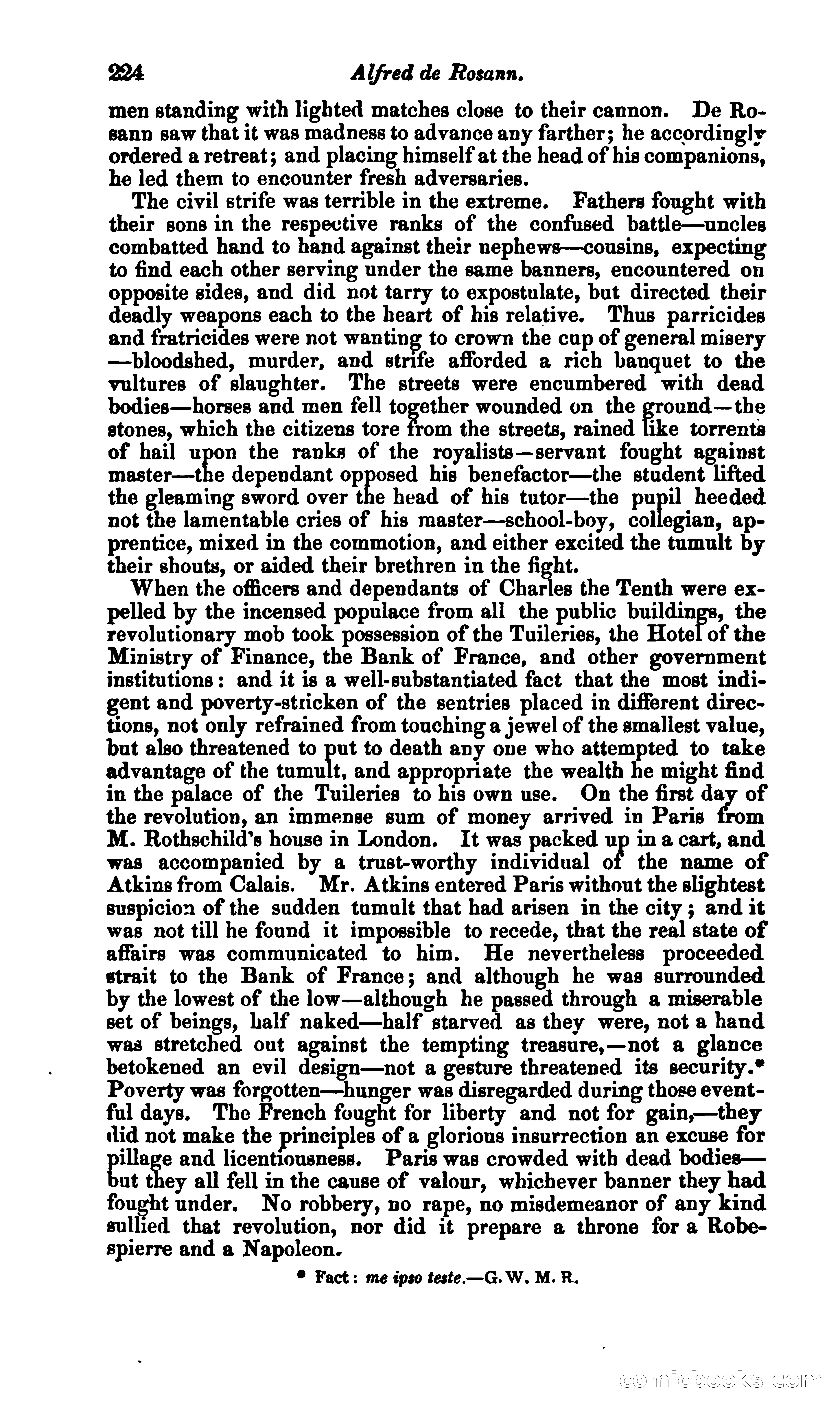
A restored page from Penny Dreadfuls, 1839. Page through the whole issue in the reader above.
📄 Transcribed text from this page (OCR, searchable)
Machine-transcribed from the original scan — historical spelling and the odd misread are preserved.
224 Alfred de Rosann. men standing with lighted matches close to their cannon. De Ro- sann saw that it was madness to advance any farther; he accordingly ordered a retreat; and placing himself at the head of his companions, he led them to encounter fresh adversaries. The civil strife was terrible in the extreme. Fathers fought with their sons in the respective ranks of the confused battle—uncles combatted hand to hand against their nephews—cousins, expecting to find each other serving under the same banners, encountered on Opposite sides, and did not tarry to expostulate, but directed their deadly weapons each to the heart of his relative. Thus parricides and fratricides were not wanting to crown the cup of general misery —bloodshed, murder, and strife afforded a rich banquet to the vultures of slaughter. The streets were encumbered with dead bodies—horses and men fell together wounded on the ground—the stones, which the citizens tore from the streets, rained like torrents of hail upon the ranks of the royalists—servant fought against master—the dependant opposed his benefactor—the student lifted the gleaming sword over the head of his tutor—the pupil heeded not the lamentable cries of his master—school-boy, collegian, ap- prentice, mixed in the commotion, and either excited the tumult by their shouts, or aided their brethren in the fight. When the officers and dependants of Charles the Tenth were ex- pelled by the incensed populace from all the public buildings, the revolutionary mob took possession of the Tuileries, the Hotel of the Ministry of Finance, the Bank of France, and other government institutions: and it is a well-substantiated fact that the most indi- gent and poverty-stricken of the sentries placed in different direc- tions, not only refrained from touching a jewel of the smallest value, but also threatened to put to death any one who attempted to take advantage of the tumult, and appropriate the wealth he might find in the palace of the Tuileries to his own use. On the first day of the revolution, an immense sum of money arrived in Paris from M. Rothschild’s house in London. It was packed up in a cart, and was accompanied by a trust-worthy individual of the name of Atkins from Calais. Mr. Atkins entered Paris without the slightest suspicion of the sudden tumult that had arisen in the city ; and it was not till he found it impossible to recede, that the real state of affairs was communicated to him. He nevertheless proceeded strait to the Bank of France; and although he was surrounded by the lowest of the low—although he passed through a miserable set of beings, half naked—half starved as they were, not a hand was stretched out against the tempting treasure,—not a glance betokened an evil design—not a gesture threatened its security.* Poverty was forgotten—hunger was disregarded during those event- ful days. The French fought for liberty and not for gain,—they did not make the principles of a glorious insurrection an excuse for puia e and licentiousness. Paris was crowded with dead bodies— ut they all fell in the cause of valour, whichever banner they had fought under. No robbery, no rape, no misdemeanor of any kind sullied that revolution, nor did it prepare a throne for a Robe- spierre and a Napoleon. © Fact: me ipso teste.—G. W. M. R. COnicbooolks (GO)