
Penny Dreadfuls, 1839 · page 17 of 273
Alfred de Rosann by G.W.M. Reynolds — page 17: what you’re looking at
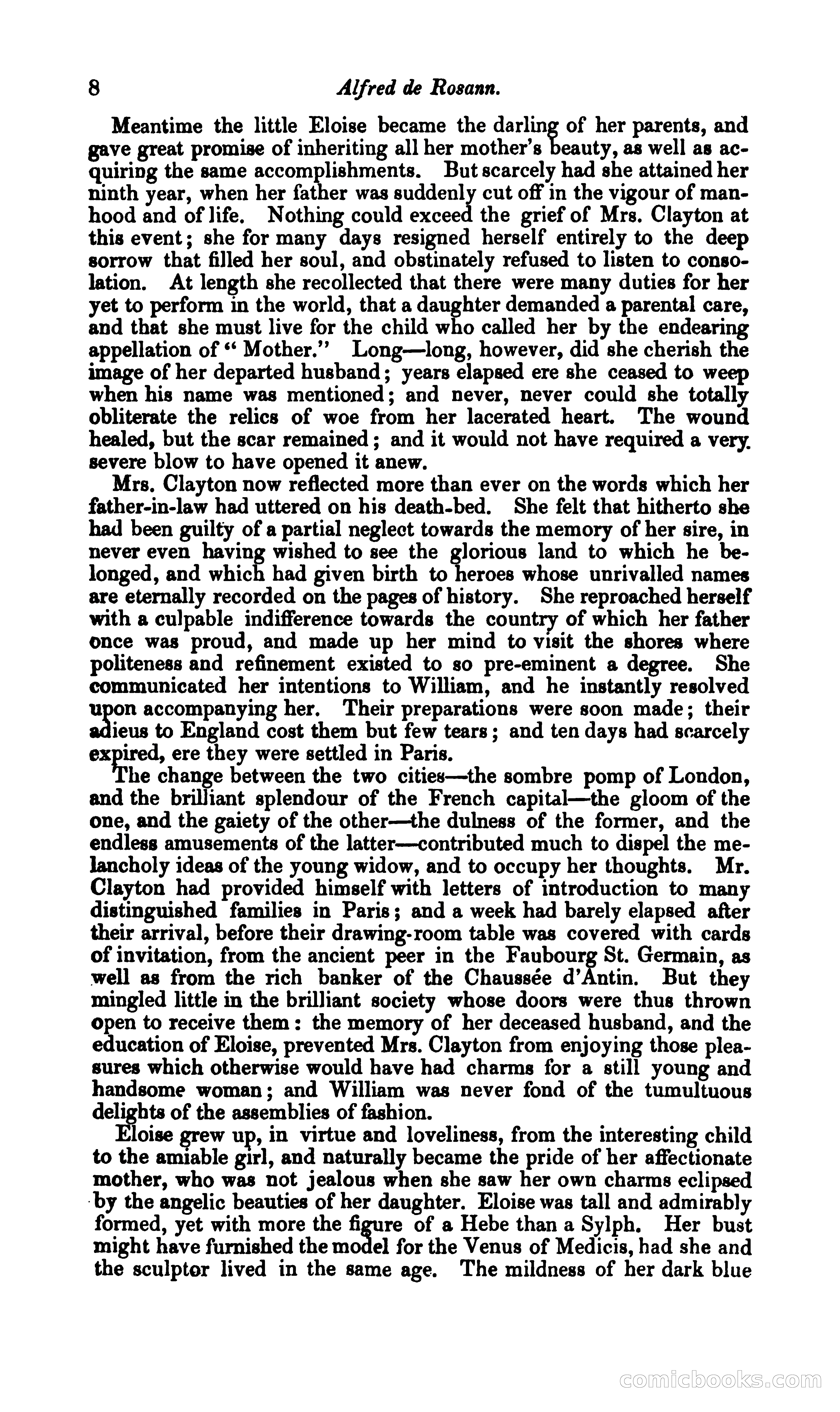
A restored page from Penny Dreadfuls, 1839. Page through the whole issue in the reader above.
📄 Transcribed text from this page (OCR, searchable)
Machine-transcribed from the original scan — historical spelling and the odd misread are preserved.
8 Alfred de Rosann. Meantime the little Eloise became the darling of her parents, and gave great promise of inheriting all her mother’s beauty, as well as ac- quiring the same accomplishments. But scarcely had she attained her ninth year, when her father was suddenly cut off in the vigour of man- hood and of life. Nothing could exceed the grief of Mrs. Clayton at this event; she for many days resigned herself entirely to the deep sorrow that filled her soul, and obstinately refused to listen to conso- lation. At length she recollected that there were many duties for her yet to perform in the world, that a daughter demanded a parental care, and that she must live for the child who called her by the endearing appellation of ‘‘ Mother.” Long—long, however, did she cherish the image of her departed husband; years elapsed ere she ceased to w when his name was mentioned; and never, never could she totally obliterate the relics of woe from her lacerated heart. The wound healed, but the scar remained; and it would not have required a very. severe blow to have opened it anew. Mrs, Clayton now reflected more than ever on the words which her father-in-law had uttered on his death-bed. She felt that hitherto she had been guilty of a partial neglect towards the memory of her sire, in never even having wished to see the glorious land to which he be- longed, and which had given birth to heroes whose unrivalled names are eternally recorded on the pages of history. She reproached herself with a culpable indifference towards the country of which her father once was proud, and made up her mind to visit the shores where politeness and refinement existed to so pre-eminent a degree. She communicated her intentions to William, and he instantly resolved upon accompanying her. Their preparations were soon made; their ileus to England cost them but few tears; and ten days had scarcely expired, ere they were settled in Paris. he change between the two cities—the sombre pomp of London, and the brilliant splendour of the French capital—the gloom of the one, and the gaiety of the other—the dulness of the former, and the endless amusements of the latter—contributed much to dispel the me- lancholy ideas of the young widow, and to occupy her thoughts. Mr. Clayton had provided himself with letters of introduction to many distinguished families in Paris; and a week had barely elapsed after their arrival, before their drawing-room table was covered with cards of invitation, from the ancient peer in the Faubourg St. Germain, as well as from the rich banker of the Chaussee d’Antin. But they mingled little m the brilliant society whose doors were thus thrown Open to receive them: the memory of her deceased husband, and the education of Eloise, prevented Mrs. Clayton from enjoying those plea- sures which otherwise would have had charms for a still young and handsome woman; and William was never fond of the tumultuous delights of the assemblies of fashion. loise grew up, In virtue and loveliness, from the interesting child to the amiable girl, and naturally became the pride of her affectionate mother, who was not jealous when she saw her own charms eclipsed by the angelic beauties of her daughter. Eloise was tall and admirably formed, yet with more the figure of a Hebe than a Sylph. Her bust might have furnished the model for the Venus of Medicis, had she and the sculptor lived in the same age. The mildness of her dark blue COnicbooolks (GO)