
Penny Dreadfuls, 1839 · page 15 of 273
Alfred de Rosann by G.W.M. Reynolds — page 15: what you’re looking at
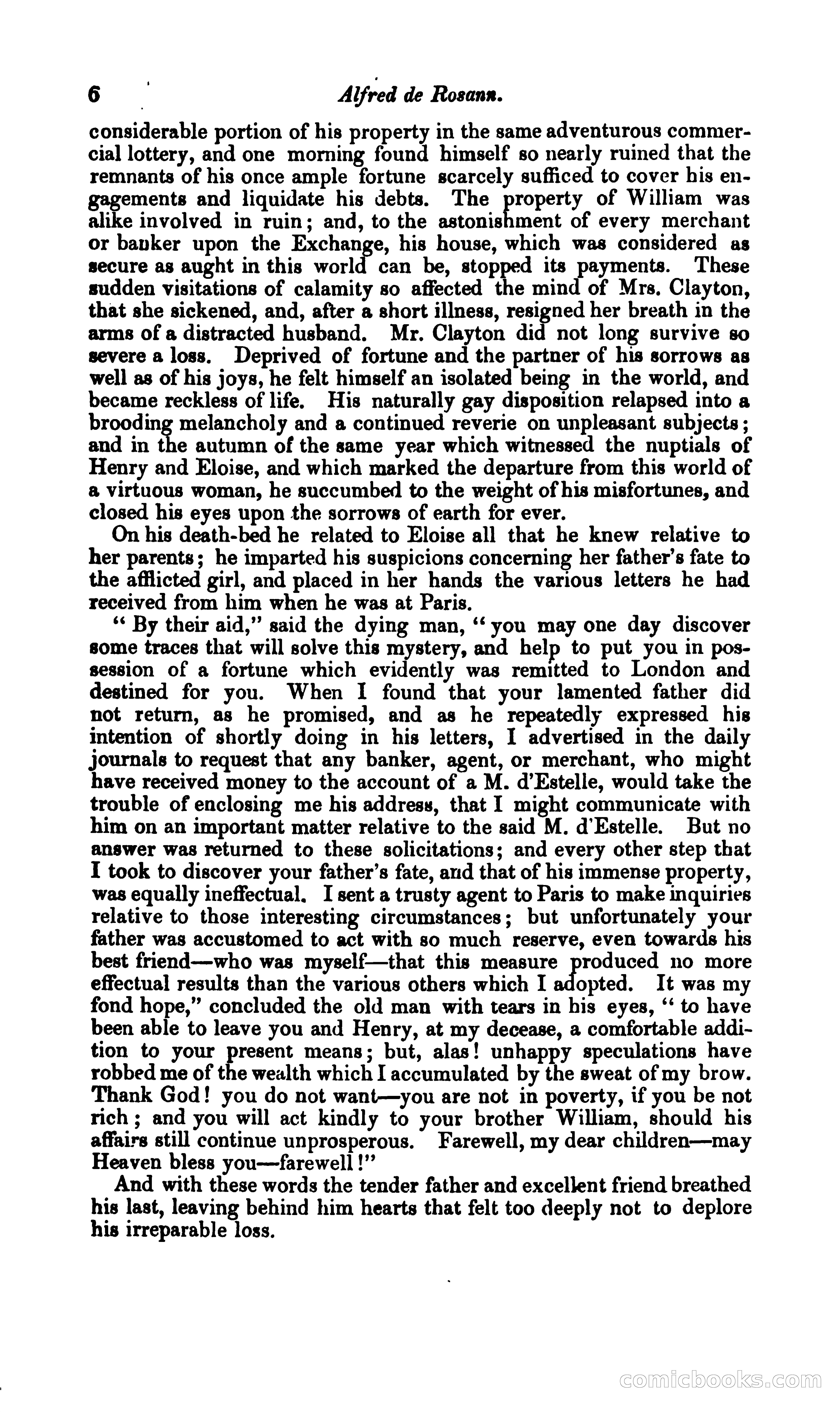
A restored page from Penny Dreadfuls, 1839. Page through the whole issue in the reader above.
📄 Transcribed text from this page (OCR, searchable)
Machine-transcribed from the original scan — historical spelling and the odd misread are preserved.
6 | Alfred de Flosann. considerable portion of his property in the same adventurous commer- cial lottery, and one morning found himself so nearly ruined that the remnants of his once ample fortune scarcely sufficed to cover his en- gagements and liquidate his debts. The property of William was alike involved in ruin; and, to the astonishment of every merchant or banker upon the Exchange, his house, which was considered as secure as aught in this world can be, stopped its payments. These sudden visitations of calamity so affected the mind of Mrs, Clayton, that she sickened, and, after a short illness, resigned her breath in the arms of a distracted husband. Mr. Clayton did not long survive so severe a loss. Deprived of fortune and the partner of his sorrows as well as of his joys, he felt himself an isolated being in the world, and became reckless of life. His naturally gay disposition relapsed into a brooding melancholy and a continued reverie on unpleasant subjects ; and in the autumn of the same year which witnessed the nuptials of Henry and Eloise, and which marked the departure from this world of @ virtuous woman, he succumbed to the weight of his misfortunes, and closed his eyes upon the sorrows of earth for ever. On his death-bed he related to Eloise all that he knew relative to her parents; he imparted his suspicions concerning her father’s fate to the afflicted girl, and placed in her hands the various letters he had received from him when he was at Paris. ‘* By their aid,” said the dying man, ‘‘ you may one day discover some traces that will solve this mystery, and help to put you in pos- session of a fortune which evidently was remitted to London and destined for you. When I found that your lamented father did not return, as he promised, and as he repeatedly expressed his intention of shortly doing in his letters, I advertised in the daily journals to request that any banker, agent, or merchant, who might have received money to the account of a M. d’Estelle, would take the trouble of enclosing me his address, that I might communicate with him on an important matter relative to the said M. d’Estelle. But no answer was returned to these solicitations; and every other step that I took to discover your father’s fate, and that of his immense property, was equally ineffectual. I sent a trusty agent to Paris to make inquiries relative to those interesting circumstances; but unfortunately your father was accustomed to act with so much reserve, even towards his best friend—who was myself—that this measure produced no more effectual results than the various others which I adopted. It was my fond hope,” concluded the old man with tears in his eyes, ‘‘ to have been able to leave you and Henry, at my decease, a comfortable addi- tion to your present means; but, alas! unhappy speculations have robbed me of the wealth which I accumulated by the sweat of my brow. Thank God! you do not want—you are not in poverty, if you be not rich ; and you will act kindly to your brother William, should his affairs still continue unprosperous. Farewell, my dear children—may Heaven bless you—farewell !” And with these words the tender father and excellent friend breathed his last, leaving behind him hearts that felt too deeply not to deplore his irreparable loss. COnicbooolks (GO)