
Penny Dreadfuls, 1839 · page 88 of 190
Penny Blood Serial Cover — page 88: what you’re looking at
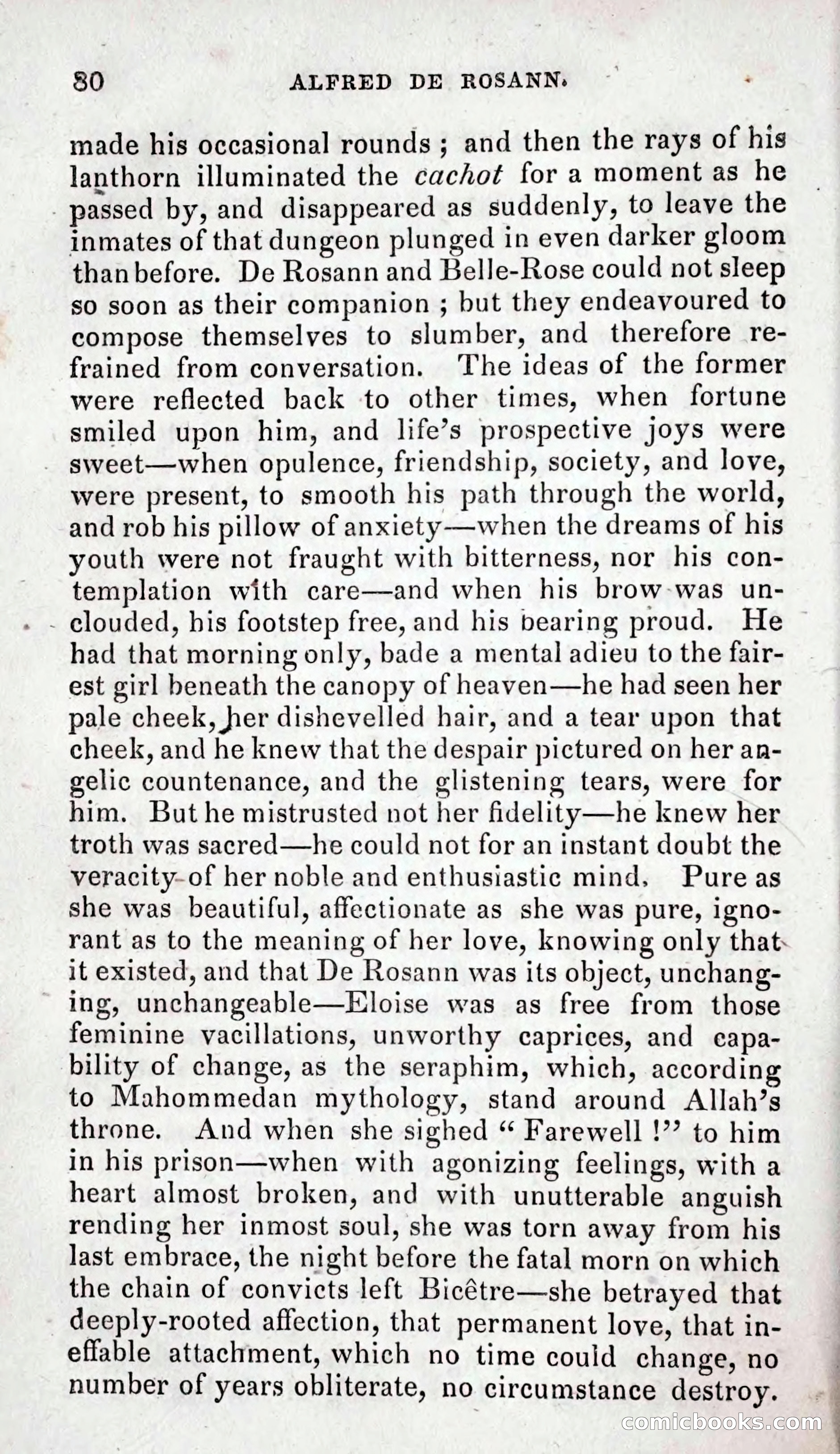
A restored page from Penny Dreadfuls, 1839. Page through the whole issue in the reader above.
📄 Transcribed text from this page (OCR, searchable)
Machine-transcribed from the original scan — historical spelling and the odd misread are preserved.
80 ALFRED DE ROSANN:, made his occasional rounds; and then the rays of his lanthorn illuminated the cachot for a moment as he _passed by, and disappeared as suddenly, to leave the inmates of that dungeon plunged in even darker gloom thanbefore. De Rosann and Belle-Rose could not sleep so soon as their companion ; but they endeavoured to compose themselyes to slumber, and therefore re- frained from conversation. The ideas of the former were reflected back to other times, when fortune smiled upon him, and life’s prospective Joys were _ sweet—when opulence, friendship, society, and love, were present, to smooth his path through the world, and rob his pillow of anxiety—when the dreams of his youth were not fraught with bitterness, nor his con- templation with care—and when his brow-was un- - clouded, his footstep free, and his bearing proud. He had that morning only, bade a mental adieu to the fair- est girl beneath the canopy of heaven—he had seen her pale cheek, her dishevelled hair, and a tear upon that cheek, and he knew that the despair pictured on her an- gelic countenance, and the glistening tears, were for him. But he mistrusted not her fidelity—he knew her troth was sacred—he could not for an instant doubt the veracity-of her noble and enthusiastic mind. Pureas she was beautiful, affectionate as she was pure, igno- rant as to the meaning of her love, knowing only that: it existed, and that De Rosann was its object, unchang- ing, unchangeable—Eloise was as free from those feminine vacillations, unworthy caprices, and ecapa- bility of change, as the seraphim, which, according to Mahommedan mythology, stand around Allah’s throne. And when she sighed “ Farewell !”? to him in his prison—when with agonizing feelings, with a heart almost broken, and with unutterable anguish rending her inmost soul, she was torn away from his last embrace, the night before the fatal morn on which the chain of convicts left Bicétre—she betrayed that deeply-rooted affection, that permanent love, that in- efflable attachment, which no time could change, no number of years obliterate, no circumstance destroy. CORNICE OO KS CO) m