
Penny Dreadfuls, 1839 · page 45 of 190
Penny Blood Serial Cover — page 45: what you’re looking at
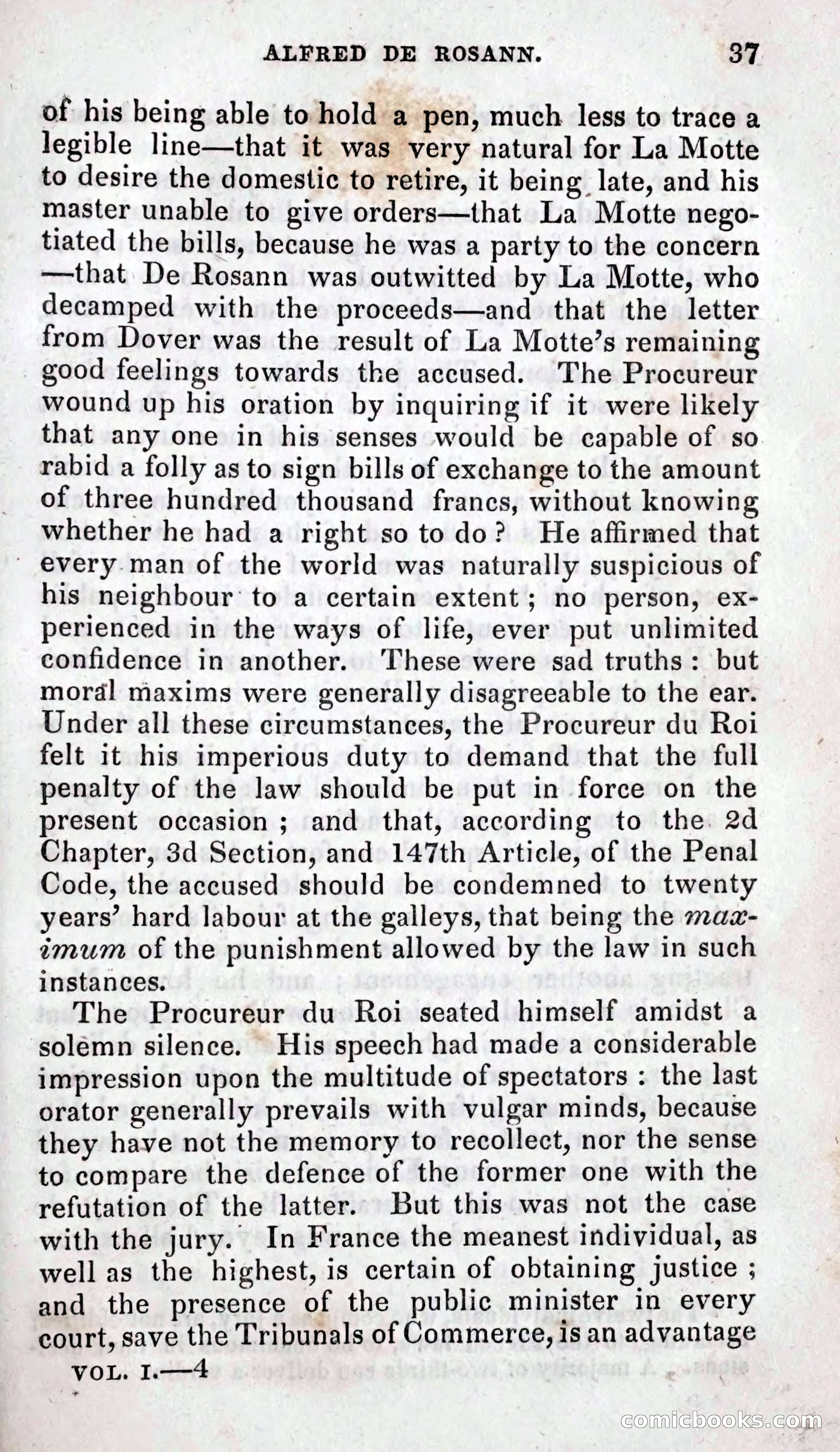
A restored page from Penny Dreadfuls, 1839. Page through the whole issue in the reader above.
📄 Transcribed text from this page (OCR, searchable)
Machine-transcribed from the original scan — historical spelling and the odd misread are preserved.
ALFRED DE ROSANN. 37 of his being able to hold a pen, much less to trace a legible line—that it was very natural for La Motte to desire the domestic to retire, it being late, and his master unable to give orders—that La Motte nego- tiated the bills, because he was a party to the concern —that De Rosann was outwitted by La Motte, who decamped with the proceeds—and that the letter from Dover was the result of La Motte’s remaining good feelings towards the accused. The Procureur wound up his oration by inquiring if it were likely that any one in his senses would be capable of so rabid a folly as to sign bills of exchange to the amount of three hundred thousand francs, without knowing whether he had a right so todo? He affirmed that _ everyman of the world was naturally suspicious of his neighbour’ to a certain extent; no person, ex- perienced in the ways of life, ever put unlimited confidence in another. ‘These were sad truths: but moral maxims were generally disagreeable to the ear. Under all these circumstances, the Procureur du Roi felt it his imperious duty to demand that the full penalty of the law should be put in force on the present occasion; and that, according to the. 2d Chapter, 3d Section, and 147th Article, of the Penal Code, the accused should be condemned to twenty years’ hard labour at the galleys, that being the maz- imum of the punishment allowed by the law in such instances. The Procureur du Roi seated himself amidst a solemn silence. His speech had made a considerable impression upon the multitude of spectators : the last orator generally prevails with vulgar minds, because they have not the memory to recollect, nor the sense to compare the defence of the former one with the refutation of the latter. But this was not the case with the jury. In France the meanest individual, as well as the highest, is certain of obtaining justice ; and the presence of the public minister in every court, save the Tribunals of Commerce, is an advantage COmicooolks