
Penny Dreadfuls, 1839 · page 39 of 201
Alfred de Rosann — page 39: what you’re looking at
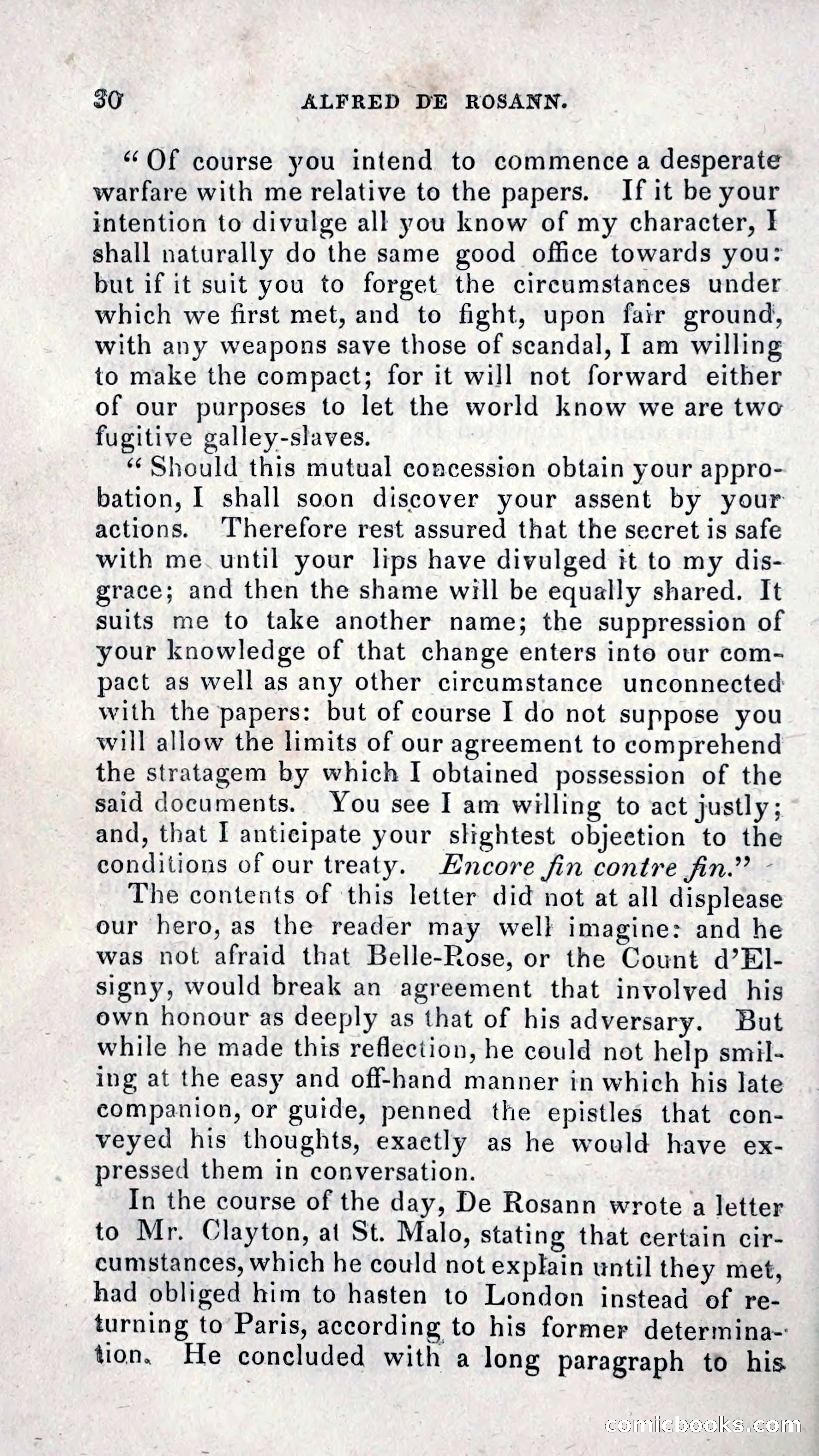
A restored page from Penny Dreadfuls, 1839. Page through the whole issue in the reader above.
📄 Transcribed text from this page (OCR, searchable)
Machine-transcribed from the original scan — historical spelling and the odd misread are preserved.
30 ALFRED DE ROSANN. ‘Of course you intend to commence a desperate warfare with me relative to the papers. If it be your intention to divulge all you know of my character, I shall naturally do the same good office towards you? but if it suit you to forget the circumstances under which we first met, and to fight, upon fair ground, with any weapons save those of scandal, I am willing to make the compact; for it will not forward either of our purposes to let the world know we are two fugitive galley-slaves. ‘Should this mutual concession obtain your appro- bation, I shall soon discover your assent by your actions. Therefore rest assured that the secret is safe with me.until your lips have divulged it to my dis- grace; and then the shame will be equally shared. It suits me to take another name; the suppression of your knowledge of that change enters inte our com- pact as well as any other circumstance unconnected with the papers: but of course I do not suppose you will allow the limits of our agreement to comprehend the stratagem by which I obtained possession of the said documents. You see I am willing to act justly; and, that I anticipate your slightest objeetion to the conditions of our treaty. Encore fin contre fin.” The contents of this letter did not at all displease our hero, as the reader may well imagine: and he was not afraid that Belle-Rose, or the Count d’El- signy, would break an agreement that involyed his own honour as deeply as that of his adversary. But while he made this reflection, he could not help smil- ing at the easy and off-hand manner in which his late companion, or guide, penned the epistles that con- veyed his thoughts, exactly as he would have ex- pressed them in conversation. In the course of the day, De Rosann wrote a letter to Mr. Clayton, at St. Malo, stating that certain cir- cumstances, which he could not explain until they met, had obliged him to hasten to London instead of re- turning to Paris, according to his former determina- tion. He concluded with a long paragraph to his COMMICLOOOKSsCOnNn