
Penny Dreadfuls, 1857 · page 64 of 394
Agnes, or, Beauty and Pleasure — page 64: what you’re looking at
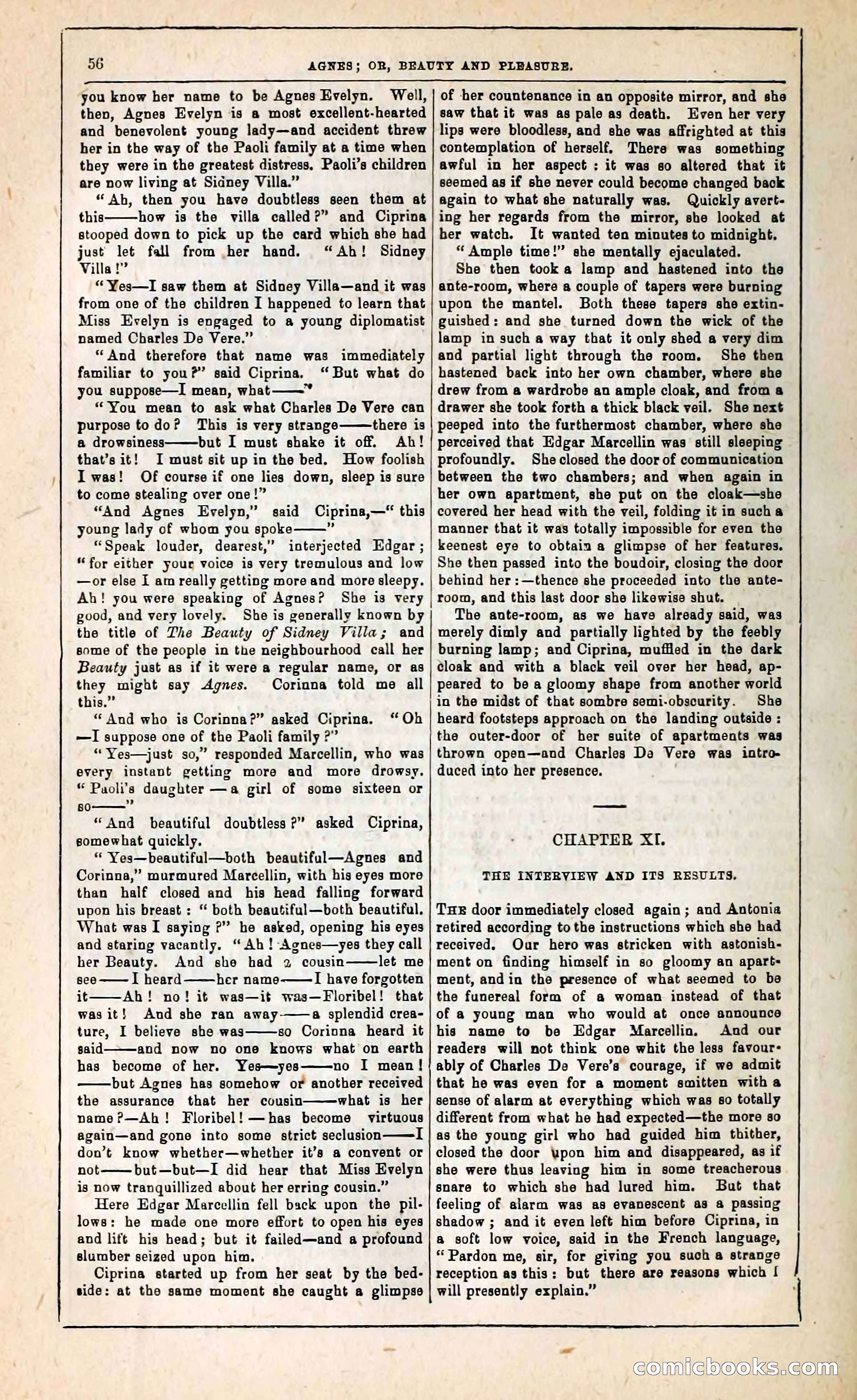
A restored page from Penny Dreadfuls, 1857. Page through the whole issue in the reader above.
📄 Transcribed text from this page (OCR, searchable)
Machine-transcribed from the original scan — historical spelling and the odd misread are preserved.
56 AGNES; OR, BEAUTY AND PLEASURE. you know her name to be Agnes Evelyn. Well, then, Agnes Evelyn is a most excellent-hearted and benevolent young lady—and accident threw her in the way of the Paoli family at a time when they were in the greatest distress, Paoli’s children are now living at Sidney Villa.” “Ab, then you have doubtless seen them at this how is the villa called?” and Ciprina stooped down to pick up the card which she had just let fall from her hand. “Ah! Sidney Villa!” “‘'Yes—lI saw them at Sidney Villa—and it was from one of the children I happened to learn that Miss Evelyn is engaged to a young diplomatist named Charles De Vere.” “And therefore that name was immediately familiar to you?” said Ciprina. “ But what do you suppose—I mean, what “You mean to ask what Charles De Vere can purpose todo? This is very strange there is a drowsiness but I must shake it off. Ah! that’s it! I must sit up in the bed. How foolish I was! Of course if one lies down, sleep is sure to come stealing over one!” “And Agnes Evelyn,” said Ciprina,— this young lady of whom you spoke 4 “Speak louder, dearest,” interjected Edgar ; “for either your voice is very tremulous and low —or else I am really getting more and more sleepy. Ab! you were speaking of Agnes? She is very good, and very lovely. She is generally known by the title of The Beauty of Sidney Villa; and some of the people in the neighbourhood call her Beauty just as if it were a regular name, or as they might say Agnes. Corinna told me all this.” “And who is Corinna?” asked Ciprina. —I suppose one of the Paoli family ?” “Yes—just so,” responded Marcellin, who was every instant getting more and more drowsy. “ Paoli’s daughter —a girl of some sixteen or 80 . ~~ cc Oh “And beautiful doubtless?” asked Ciprina, somewhat quickly, “ Yes—beautiful—both beautiful—Agnes and Corinna,” murmured Marcellin, with his eyes more than half closed and his head falling forward upon his breast: “ both beautiful—both beautiful. What was I saying ?” he asked, opening his eyes and staring vacantly. “Ah! Agnes—yes they call her Beauty. And she had 2 cousin let me see —— I heard her name I have forgotten it Ah! no! it was—it was—Floribel! that was it! And she ran away-——a splendid crea- ture, I believe she was so Corinna heard it said and now no one knows what on earth has become of her. Yes—yes no I mean! but Agnes has somehow or another received the assurance that her cousin what is her name?—Ah! Floribel! —has become virtuous again—and gone into some strict seclusion I don’t know whether—whether it’s a convent or not but—but—I did hear that Miss Evelyn is now tranquillized about her erring cousin.” Here Edgar Marcellin fell back upon the pil- lows: he made one more effort to open his eyes and lift his head; but it failed—and a profound slumber seized upon him. Ciprina started up from her seat by the bed- side: at the same moment she caught a glimpse of her countenance in an opposite mirror, and she saw that it was as pale as death. Even her very lips were bloodless, and she was affrighted at this contemplation of herself. There was something awful in her aspect : it was so altered that it seemed as if she never could become changed back again to what she naturally was. Quickly avert- ing her regards from the mirror, she looked at ber watch. It wanted ten minutes to midnight, “Ample time!” she mentally ejaculated. She then took a lamp and hastened into the ante-room, where a couple of tapers were burning upon the mantel. Both these tapers she extin- guished: and she turned down the wick of the lamp in such a way that it only shed a very dim and partial light through the room. She then hastened back into her own chamber, where she drew from a wardrobe an ample cloak, and from a drawer she took forth a thick black veil. She next peeped into the furthermost chamber, where she perceived that Edgar Marcellin was still sleeping profoundly. Sheclosed the door of communication between the two chambers; and when again in her own apartment, she put on the cloak—she covered her head with the veil, folding it in sucha manner that it was totally impossible for even the keenest eye to obtain a glimpse of her features. She then passed into the boudoir, closing the door behind her :—thence she proceeded into the ante- room, and this last door she likewise shut. The ante-room, as we have already said, was merely dimly and partially lighted by the feebly burning lamp; and Ciprina, muffled in the dark cloak and with a black veil over her head, ap- peared to bea gloomy shape from another world in the midst of that sombre semi-obscurity. She heard footsteps approach on the landing outside : the outer-door of her suite of apartments was thrown open—and Charles Da Vere was intro- duced into her presence. CHAPTER XI. THE INTERVIEW AND ITS RESULTS. THE door immediately closed again; and Antonia retired according tothe instructions which she had received. Our hero was stricken with astonish- ment on finding himself in so gloomy an apart= ment, andin the presence of what seemed to be the funereal form of a woman instead of that of a young man who would at once announce his name to be Edgar Marcellin. And our readers will not think one whit the less favour- ably of Charles De Vere’s courage, if we admit that he was even for a moment smitten with a sense of alarm at everything which was so totally different from what he had expected—the more so as the young girl who had guided him thither, closed the door wpon him and disappeared, as if she were thus leaving him in some treacherous snare to which she had lured him. SBut that feeling of alarm was as evanescent as a passing shadow ; and it even left him before Ciprina, in a soft low voice, said in the French language, “Pardon me, sir, for giving you such a strange reception as this: but there are reasons which [| will presently explain.” | | 3 boo