
Penny Dreadfuls, 1857 · page 60 of 394
Agnes, or, Beauty and Pleasure — page 60: what you’re looking at
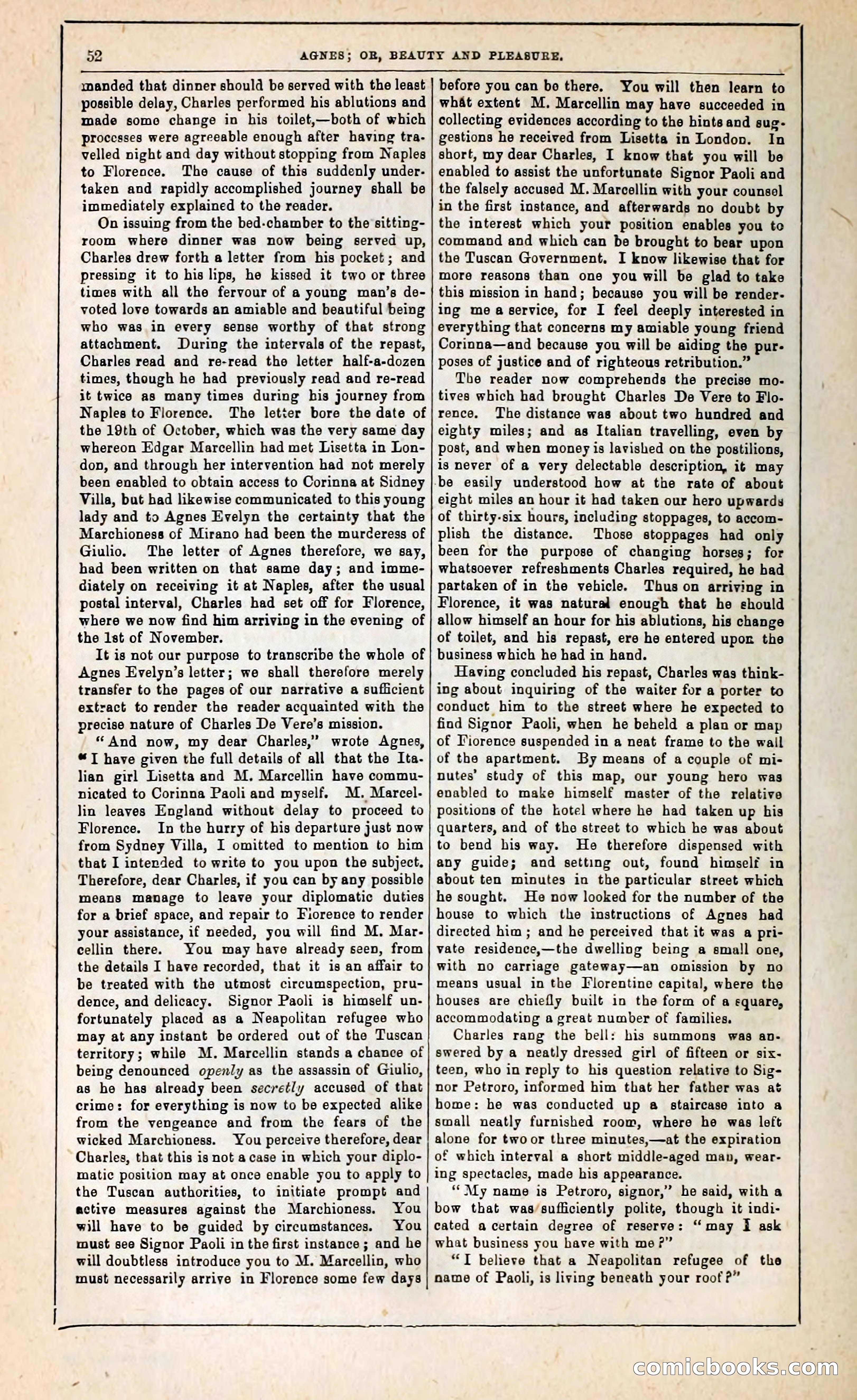
A restored page from Penny Dreadfuls, 1857. Page through the whole issue in the reader above.
📄 Transcribed text from this page (OCR, searchable)
Machine-transcribed from the original scan — historical spelling and the odd misread are preserved.
LL ’ o2 manded that dinner should be served with the least possible delay, Charles performed his ablutions and made some change in his toilet,—both of which processes were agreeable enough after having tra- velled night and day without stopping from Naples to Florence. The cause of this suddenly under- taken and rapidly accomplished journey shall be immediately explained to the reader. On issuing from the bed-chamber to the sitting- room where dinner was now being served up, Charles drew forth a letter from his pocket; and pressing it to his lips, he kissed it two or three times with all the fervour of a young man’s de- voted love towards an amiable and beautiful being who was in every sense worthy of that strong attachment. During the intervals of the repast, Charles read and re-read tho letter half-a-dozen times, though he had previously read and re-read it twice as many times during his journey from Naples to Florence. The letter bore the date of the 19th of October, which was the very same day whereon Edgar Marcellin bad met Lisetta in Lon- don, and through her intervention had not merely been enabled to obtain access to Corinna at Sidney Villa, but bad likewise communicated to this young lady and to Agnes Evelyn the certainty that the Marchioness of Mirano had been the murderess of Giulio. The letter of Agnes therefore, we say, had been written on that same day; and imme- diately on receiving it at Naples, after the usual postal interval, Charles had set off for Florence, where we now find him arriving in the evening of the 1st of November. It is not our purpose to transcribe the whole of Agnes Evelyn’s letter; we shall therefore merely transfer to the pages of our narrative a sufficient extract to render the reader acquainted with the precise nature of Charles De Vere’s mission. “ And now, my dear Charles,” wrote Agnes, “T have given the full details of all that the Ita- lian girl Lisetta and M. Marcellin have commu- nicated to Corinna Paoli and myself. M. Marcel- lin leaves England without delay to proceed to Florence. In the hurry of his departure just now from Sydney Villa, I omitted to mention to him that I intended to write to you upon the subject. Therefore, dear Charles, if you can by any possible means manage to leave your diplomatic duties for a brief space, and repair to Fiorence to render your assistance, if needed, you will find M. Mar- cellin there. You may have already seen, from the details I have recorded, that it is an affair to be treated with the utmost circumspection, pru- dence, and delicacy. Signor Paoli is himself un- fortunately placed as a Neapolitan refugee who may at any instant be ordered out of the Tuscan territory; while M. Marcellin stands a chance of being denounced openly as the assassin of Giulio, as he has already been secretly accused of that crime: for everything is now to be expected alike from the vengeance and from the fears of the wicked Marchioness. You perceive therefore, dear Charles, tbat this is not a case in which your diplo- matic position may at once enable you to apply to the Tuscan authorities, to initiate prompt and active measures against the Marchioness. You will have to be guided by circumstances. You must see Signor Paoli in the first instance; and he will doubtless introduce you to M. Marcellin, who must necessarily arrive in Florence some few days AGNES; OR, BEAUTY AND PLEASURE, before you can be there. You will then learn to what extent M. Marcellin may have succeeded in collecting evidences according to the hints and sug- gestions he received from Lisetta in London. In short, my dear Charles, I know that you will be enabled to assist the unfortunate Signor Paoli and the falsely accused M. Marcellin with your counsel in the first instance, and afterwards no doubt by the interest which your position enables you te command and which can be brought to bear upon the Tuscan Government. I know likewise that for more reasons than one you will be glad to take this mission in hand; because you will be render- ing mea-service, for I feel deeply interested in everything that concerns my amiable young friend Corinna—and because you will be aiding the pur- poses of justice and of righteous retribution.” The reader now comprehends the precise mo- tives which had brought Charles De Vere to Flo- rence. The distance was about two hundred and eighty miles; and as Italian travelling, even by post, and when money is lavished on the postilions, is never of a very delectable description, i¢ may -be easily understood how at the rate of about eight miles an hour it had taken our hero upwards of thirty-six hours, including stoppages, to accom- plish the distance. Those stoppages had only been for the purpose of changing horses; for whatsoever refreshments Charles required, he had partaken of in the vehicle. Thus on arriving in Florence, it was natural enough that he should allow himself an hour for his ablutions, his change of toilet, and his repast, ere he entered upor the business which he had in hand. Having concluded his repast, Charles was think- ing about inquiring of the waiter for a porter to conduct him to the street where he expected to find Signor Paoli, when he beheld a plan or map of Iiorence suspended in a neat frame to the wall of the apartment. By means of a couple of mi- nutes’ study of this map, our young hero was enabled to make himself master of the relative positions of the hotel where he had taken up his quarters, and of the street to which he was about to bend his way. He therefore dispensed with any guide; and setting out, found himself in about ten minutes in the particular street which he sought. He now looked for the number of the house to which the instructions of Agnes had directed him ; and he perceived that it was a pri- vate residence,—the dwelling being a small one, with no carriage gateway—an omission by no means usual in the Florentine capital, where the houses are chiefly built in the form of a square, accommodating a great number of families, Charles rang the bell: his summons was an- swered by a neatly dressed girl of fifteen or six- teen, who in reply to his question relative to Sig- nor Petroro, informed him that her father was a& home: he was conducted up a@ staircase into a small neatly furnished room, where he was left alone for twoor three minutes,—at the expiration of which interval a short middle-aged man, wear- ing spectacles, made his appearance. “My name is Petroro, signor,’’ he said, with a bow that was/sufficiently polite, though it indi- cated acertain degree of reserve: “may i ask what business you have with me?” “T believe that a Neapolitan refugee of the name of Paoli, is living beneath your roof ?” book (E@) 3