
Penny Dreadfuls, 1857 · page 40 of 394
Agnes, or, Beauty and Pleasure — page 40: what you’re looking at
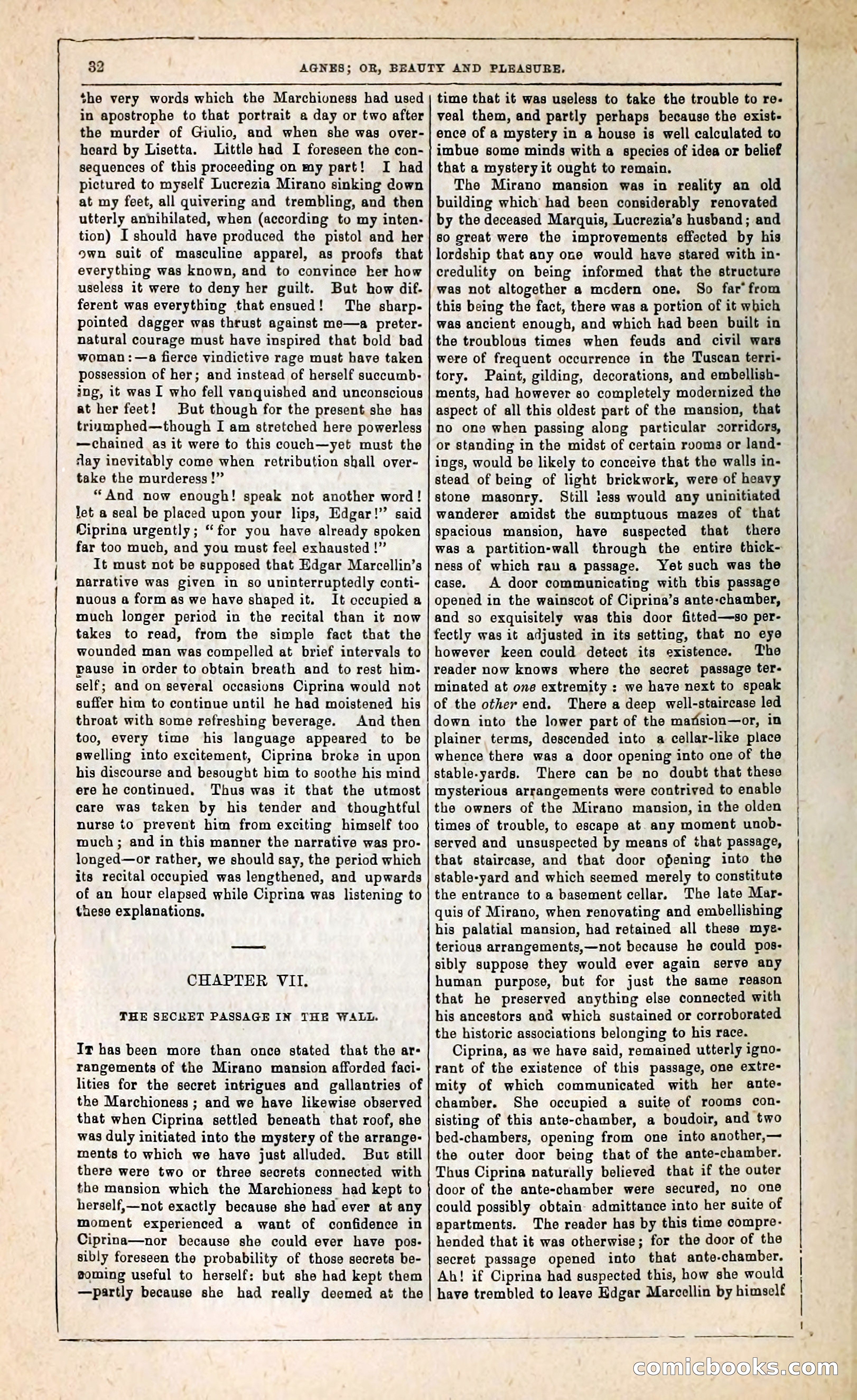
A restored page from Penny Dreadfuls, 1857. Page through the whole issue in the reader above.
📄 Transcribed text from this page (OCR, searchable)
Machine-transcribed from the original scan — historical spelling and the odd misread are preserved.
32 AGNES; OR, BEAUTY AND PLEASURE, she very words which the Marchioness had used in apostrophe to that portrait a day or two after the murder of Giulio, and when she was over- heard by Lisetta. Little had I foreseen the con- sequences of this proceeding on my part! I had pictured to myself Lucrezia Mirano sinking down at my feet, all quivering and trembling, and then utterly annihilated, when (according to my inten- tion) I should have produced the pistol and her own suit of masculine apparel, as proofs that everything was known, and to convince ker how useless it were to deny her guilt. But how dif- ferent was everything that ensued! The sharp- pointed dagger was thrust against me—a preter- natural courage must have inspired that bold bad woman :—a fierce vindictive rage must have taken possession of her; and instead of herself succumb- ing, it was I who fell vanquished and unconscious at her feet! But though for the present she has triumphed—though I am stretched here powerless —chained as it were to this couch—yet must the day inevitably come when retribution shall over- take the murderess !” “And now enough! speak not another word! Jet a seal be placed upon your lips, Hdgar!” said Ciprina urgently; “for you have already spoken far too much, and you must feel exhausted !” It must not be supposed that Edgar Marcellin’s narrative was given in so uninterruptedly conti- nuous a form as we have shaped it. It cccupied a much longer period in the recital than it now takes to read, from the simple fact that the wounded man was compelled at brief intervals to pause in order to obtain breath and to rest him- self; and on several occasions Ciprina would not suffer him to continue until he had moistened his throat with some refreshing beverage. And then too, every time his language appeared to be swelling into excitement, Ciprina broke in upon his discourse and besought him to soothe his mind ere he continued. Thus was it that the utmost care was taken by his tender and thoughtful nurse to prevent him from exciting himself too much ; and in this manner the narrative was pro- longed—or rather, we should say, the period which its recital occupied was lengthened, and upwards of an hour elapsed while Ciprina was listening to these explanations. CHAPTER VII. THE SECRET PASSAGE IN THE WALL. Ir has been more than once stated that the ar- rangements of the Mirano mansion afforded faci- lities for the secret intrigues and gallantries of the Marchioness ; and we have likewise observed that when Ciprina settled beneath that roof, she was duly initiated into the mystery of the arrange- ments to which we have just alluded. But still there were two or three secrets connected with the mansion which the Marchioness had kept to herself,—not exactly because she had ever at any moment experienced a want of confidence in Ciprina—nor because she could ever have pos- sibly foreseen the probability of those secrets be- goming useful to herself: but she had kept them —partly because she had really deemed at the time that it was useless to take the trouble to re- veal them, and partly perhaps because the exist- ence of a mystery in a house is well calculated to imbue some minds with a species of idea or belief that a mystery it ought to remain. The Mirano mansion was in reality an old building which had been considerably renovated by the deceased Marquis, Lucrezia’s husband; and so great were the improvements effected by his lordship that any one would have stared with in- credulity on being informed that the structure was not altogether a mcdern one, So far from this being the fact, there was a portion of it which was ancient enough, and which had been built in the troublous times when feuds and civil wars were of frequent occurrence in the Tuscan terri- tory. Paint, gilding, decorations, and embellish- ments, had however so completely modernized tho aspect of all this oldest part of the mansion, that no one when passing along particular corridors, or standing in the mids¢ of certain rooms or land- ings, would be likely to conceive that the walls in- stead of being of light brickwork, were of heavy stone masonry. Still iess would any uninitiated wanderer amidst the sumptuous mazes of that spacious mansion, have suspected that there was a partition-wall through the entire thick- ness of which rau a passage. Yet such was the ease. A door communicating with this passage opened in the wainscot of Ciprina’s ante-chamber, and so exquisitely was this door fitted—so per- fectly was it adjusted in its setting, that no eye however keen could detect its existence. Tho reader now knows where the secret passage ter- minated at one extremity : we have next to speak of the other end. There a deep well-staircase led down into the lower part of the mafision—or, in plainer terms, descended into a cellar-like place whence there was a door opening into one of the stable-yards. There can be no doubt that these mysterious arrangements were contrived to enable the owners of the Mirano mansion, in the olden times of trouble, to escape at any moment unob- served and unsuspected by means of that passage, that staircase, and that door opening into the stable-yard and which seemed merely to constitute the entrance to a basement cellar. The late Mar- quis of Mirano, when renovating and embellishing his palatial mansion, had retained all these mye- terious arrangements,—not because he could pos- sibly suppose they would ever again serve any human purpose, but for just the same reason that he preserved anything else connected with his ancestors and which sustained or corroborated the historic associations belonging to his race. Ciprina, as we have said, remained utterly igno- rant of the existence of this passage, one extre- mity of which communicated with her ante- chamber. She occupied a suite of rooms con- sisting of this ante-chamber, a boudoir, and two bed-chambers, opening from one into another,— the outer door being that of the ante-chamber. Thus Ciprina naturally believed that if the outer door of the ante-chamber were secured, no one could possibly obtain admittance into her suite of apartments. The reader has by this time compre- hended that it was otherwise; for the door of the secret passage opened into that ante-chamber. Ah! if Ciprina had suspected this, how she would have trembled to leave Hdgar Marcellin by himself Ghboo