
Penny Dreadfuls, 1857 · page 386 of 394
Agnes, or, Beauty and Pleasure — page 386: what you’re looking at
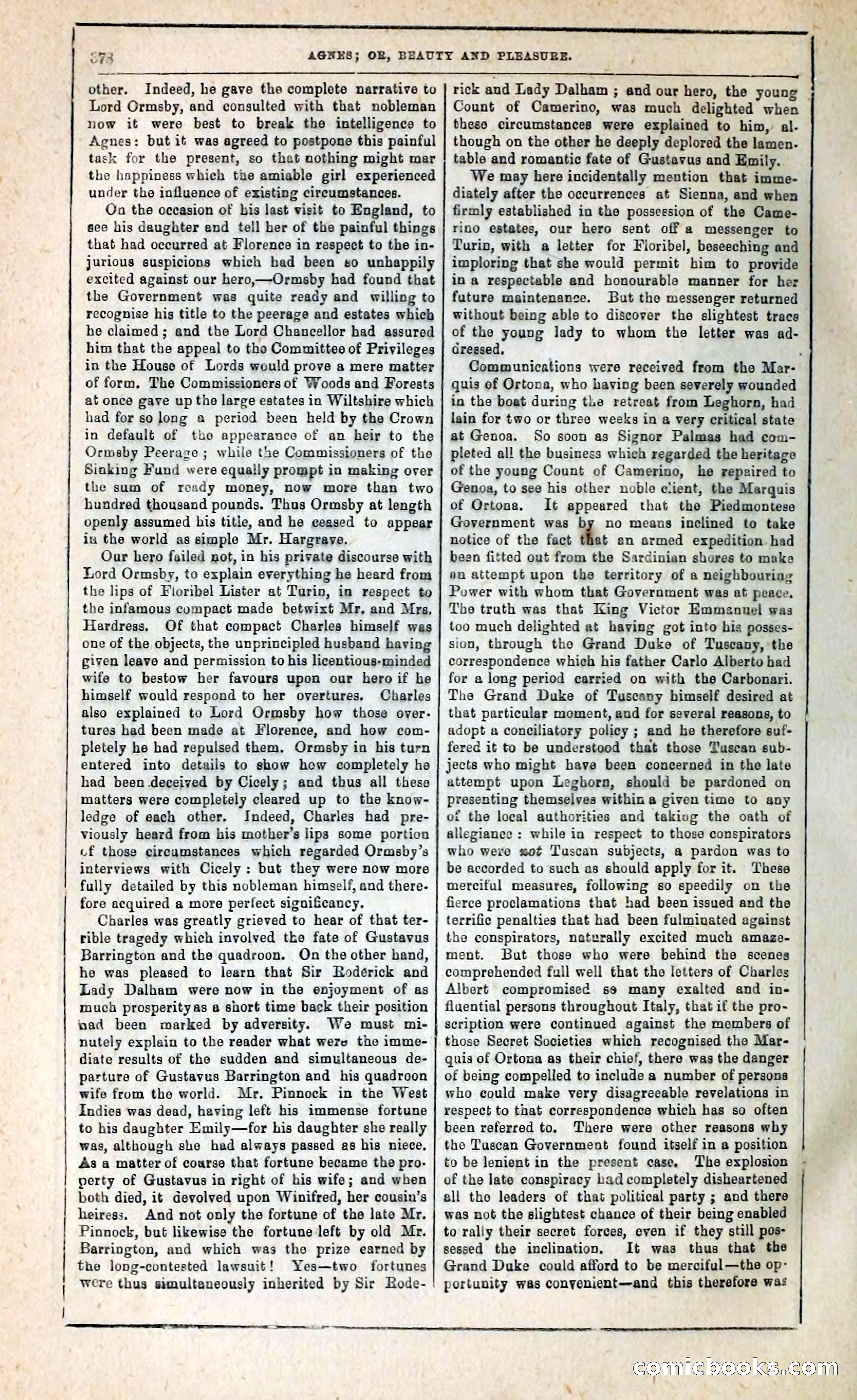
A restored page from Penny Dreadfuls, 1857. Page through the whole issue in the reader above.
📄 Transcribed text from this page (OCR, searchable)
Machine-transcribed from the original scan — historical spelling and the odd misread are preserved.
other. Indeed, he gave the complete narrative to Lord Ormsby, and consulted with that nobleman now it were best to break the intelligence to Agnes: but it was agreed to postpone this painful task for the present, so that nothing might mar the happiness whieh the amiable girl experienced under the influence of existing circumstances. On the occasion of his last visit to England, to see his daughter end tell her of the painful things that had occurred at Florence in respect to the in- jurious suspicions which had been so unhappily excited against our hero,—Ormsby had found that the Government was quite ready and willing to recognise his title to the peerage and estates which he claimed ; and the Lord Chancellor had assured him that the appeal to tho Committee of Privileges in the House of Lords would prove a mere matter of form, The Commissioners of Woods and Forests at once gave up the large estates in Wiltshire which had for so long a period been held by the Crown in default of tho appearance of an heir to the Ormsby Peerage ; while the Commissioners of the Sinking Fund were equally prompt in making over the sum of ready money, now more than two hundred thousand pounds. Thus Ormsby at length openly assumed his title, and he eegsed to appear in the world as simple Mr. Hargrave. Our hero failed not, in his private discourse with Lord Ormsby, to explain everything he heard from the lips of Floribel Lister at Turin, in respect to the infamous compact made betwixt Mr, and Mrs, Hardress, Of that compact Charles himself was one of the objects, the unprincipled husband having given leave and permission to his licentious-minded wife to bestow her favours upon our hero if he himself would respond to her overtures. Charles also explained to Lord Ormsby how those over- tures had been made at Florence, and how com- pletely he had repulsed them, Ormsby in his turn entered into details to show how completely he had been deceived by Cicely; and thus all these matters were completely cleared up to the know- ledge of each other. Indeed, Charles had pre- viously heard from his mother’s lips some portion vf those circumstances which regarded Ormsby’s interviews with Cicely: but they were now more | fully detailed by this nobleman himself, and there- fore acquired a more perfect significancy. Charles was greatly grieved to hear of that ter- rible tragedy which involved tke fate of Gustavus Barrington and the quadroon. On the other hand, he was pleased to learn that Sir Rodérick and Lady Dalham were now in the enjoyment of as rmouch prosperity as a short time back their position nad been marked by adversity. We must mi- nutely explain to the reader what were the imme- diate results of the sudden and simultaneous de- parture of Gustavus Barrington and his quadroon wife from the world. Mr. Pinnock in the West Indies was dead, having left his immense fortune to his daughter Emily—for his daughter she really was, although she had always passed as his niece, As a matter of course that fortune became the pro- perty of Gustavus in right of his wife; and when | both died, it devolved upon Winifred, her cousin’s heiress, And not only the fortune of the late Mr. | Pinnock, but likewise the fortune left by old Mr. Barrington, and which was the prize earned by | the long-contested lawsuit! Yes—two fortunes were thus simultaneously inherited by Sir Rode- | te AGNES; OR, BEAUTY AND PLEASURE. : rick and Lady Dalham ; and our hero, the young Count of Camerino, was much delighted when these circumstances were explained to him, al- though on the other he deeply deplored the lamen- table and romantic fate of Gustavus and Enily.. We may here incidentally mention that imme- diately after the occurrences at Sienna, and when firmly established in the possession of the Came- rino estates, our hero sent off a messenger to Turin, with a letter for Floribel, beseeching and imploring that she would permit him to provide in a respectable and honourable manner for her future maintenance. But the messenger returned without being able to discover the slightest trace of the young lady to whom the letter was ad- Gregsed, Communications were received from the Mar- quis ef Ortora, who having been severely wounded in the boat during the retreat from Leghorn, had lain for two or three weeks in a very critical state at Genoa. So soon as Signor Palmas had com- pleted al! the business whieh regarded the heritage of the young Count of Camerino, he repaired to Genoa, to see his other noble elient, the Marquis of Ortone. It appeared that the Piedmontese Government was by no means inclined to take notice of the fact thot en armed expedition had been fitted out from the Sardinian shores to make an attempt upon the territory of a neighbouriag Power with whom that Government was at peace. The truth was that King Victor Emmsnuel was too much delighted at haying got into his posses- sion, through tho Grand Duke of Tuscany, the correspondence which his father Carlo Alberto had for a long period carried on with the Carbonari. The Grand Duke of Tuscany himself desired at that particular moment, and for several reasons, to adopt a conciliatory policy ; and he therefore suf- fered it to be understood that those Tuscan sub- jects who might have been concerned in the late attempt upon Leghorn, should be pardoned on presenting themselves within a given time to any of the local authorities and takiug the oath of allegiance : while in respect to those conspirators who weve sof Tuscan subjects, a pardon was to be accorded to such as should apply for it. These merciful measures, following so speedily on the fierce proclamations that had been issued and the terrific penalties that had been fulmiuated against the conspirators, natvrally excited much amage- ment. But those who were behind the scenes comprehended full well that tho letters of Charles Albert compromised se many exalted and in- fluential persons throughout Italy, that if the pro- scription were continued against the members of those Secret Societies which recognised the Mar- guis of Ortona as their chief, there was the danger of being compelled to include a number of persons who could make very disagreeable revelations in respect to that correspondence which has so often been referred to. There were other reasons why the Tuscan Government found itself in a position to be lenient in the present case. The explosion of the late conspiracy had completely disheartened all the leaders of that political party ; and there was not the slightest chance of their being enabled to rally their secret forces, even if they still pos- sessed the inclination. It was thus that the Grand Duke could afford to be merciful—the op- portunity was conyenient—and this therefore waz chook =) 5}