
Penny Dreadfuls, 1857 · page 367 of 394
Agnes, or, Beauty and Pleasure — page 367: what you’re looking at
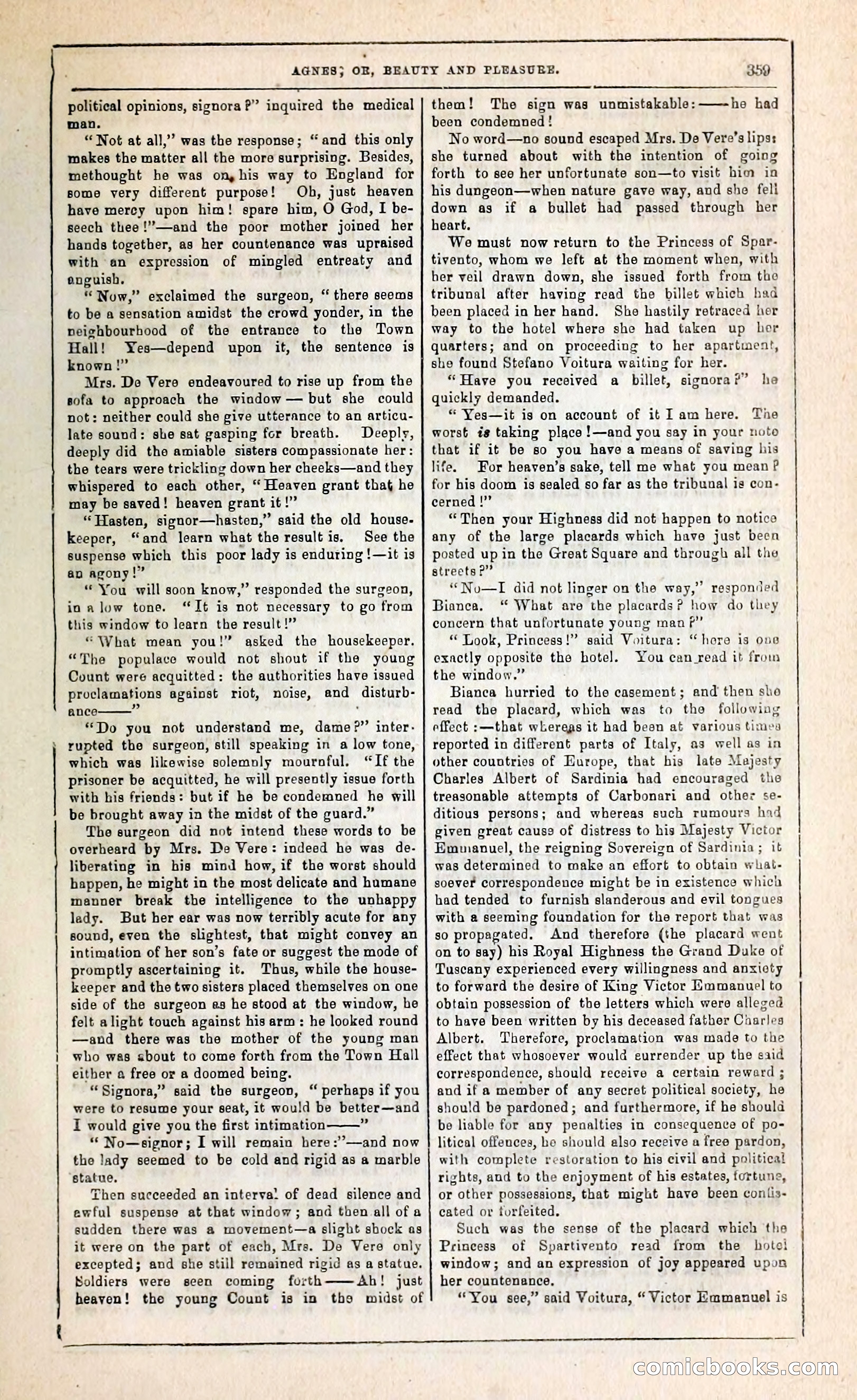
A restored page from Penny Dreadfuls, 1857. Page through the whole issue in the reader above.
📄 Transcribed text from this page (OCR, searchable)
Machine-transcribed from the original scan — historical spelling and the odd misread are preserved.
meee ee —s —_a SS ee a political opinions, signora ?” inquired the medical man. “ Not at all,’ was the response; “and this only makes the matter all the more surprising. Besides, methought he was on, his way to England for some very different purpose! Oh, just heaven have mercy upon him! spare him, O God, I be- seech thee!”—and the poor mother joined her hands together, as her countenance was upraised with an expression of mingled entreaty and foguish. “Now,” exclaimed the surgeon, “ there seems to be a sensation amidst the crowd yonder, in the neighbourhood of the entrance to the Town Hall! Yes—depend upon it, the sentence is known !” Mrs. De Vere endeavoured to rise up from the sofa to approach the window — but she could not: neither could she give utterance to an articu- late sound: she sat gasping for breath. Deeply, deeply did the amiable sisters compassionate her: the tears were trickling down her cheeks—and they whispered to each other, “ Heaven grant that he may be saved! heaven grant it!” “‘Hasten, signor—hasten,” said the old house- keeper, “and learn what the result is. See the suspense which this poor lady is enduring !—it is an agony!” “You will soon know,” responded the surgeon, in alow tone. “It is not necessary to go from this window to learn the result!” “What mean you!” asked the housekeeper. “The populace would not shout if the young Count were acquitted: the authorities have issued proclamations against riot, noise, and disturb- ance % “Do you not understand me, dame?” inter- rupted the surgeon, still speaking in a low fone, which was likewise solemnly mouroful. “If the prisoner be acquitted, he will presently issue forth with his friends: but if he be condemned he will be brought away in the midst of the guard.” The surgeon did not intend these words to be overheard by Mrs. De Vere: indeed he was de- liberating in his mind how, if the worst should happen, he might in the most delicate and humane manner break the intelligence to the unhappy lady. But her ear was now terribly acute for any sound, even the slightest, that might convey an intimation of her son’s fate or suggest the mode of promptly ascertaining it. Thus, while the house- keeper and the two sisters placed themselves on one side of the surgeon es he stood at the window, he felt alight touch against his arm: he looked round —and there was the mother of the young man who was sbout to come forth from the Town Hall either a free or a doomed being. “Signora,” said the surgeon, “ perhaps if you were to resume your seat, it would be better—and I would give you the first intimation F “ No—signor; I will remain here:’—and now the lady seemed to be cold and rigid as a marble statue. Then succeeded an interva: of dead silence and ewful suspense at that window; and then all ofa sudden there was a movement—a slight shock as it were on the part of each, Mrs. De Vere only excepted; and she still remained rigid as a statue. Soldiers were seen coming forth Ah! just heaven! the young Count is in tho midst of AGNES; OR, BEAUTY AND PLEASUBE. he had them! The sign was unmistakable: been condemned! No word—no sound escaped Mrs. De Vere’s lips: she turned about with the intention of going forth to see her unfortunate son—to visit him in his dungeon—when nature gave way, aud she feli down as if a bullet had passed through her heart. We must now return to the Princess of Spar- tivento, whom we left at the moment when, with her veil drawn down, she issued forth from tho tribunal after having read the billet which had been placed in her hand. She hastily retraced her way to the hotel where she had taken up her quarters; and on proceeding to her apartment, she found Stefano Voitura waiting for her. “Have you received a billet, signora?’ he quickly demanded. * Yes—it is on account of it Tam here. The worst ts taking place !—and you say in your noto that if it be so you have a means of saving his life. For heaven’s sake, tell me what you mean P for his doom is sealed so far as the tribunal is con- cerned !” “Then your Highness did not happen to notice any of the large placards which have just been posted up in the Great Square and through all the streets Pp” ‘“Nu—I did not linger on the way,” responded Bianca. ‘“ What are the placards? how do they concern that unfortunate young man?” “ Look, Princess!” said Voitura: “hore is ove exactly opposite the hotel. You can_read it froim the window,” Bianca hurried to the casement; and then she read the placard, which was to the following effect :—that whereas it had been at various times reported in different parts of Italy, as well as in other countries of Europe, that his late Majesty Charles Albert of Sardinia had encouraged tle treasonable attempts of Carbonari and other se- ditious persons; and whereas such rumours had given great causa of distress to his Majesty Victor Emmanuel, the reigning Sovereign of Sardinia; it was determined to make an effort to obtain what- soever correspondence might be in existence which had tended to furnish slanderous and evil tongues with a seeming foundation for the report that was so propagated. And therefore (the placard went on to say) his Royal Highness the Grand Duke of Tuscany experienced every willingness and anxiety to forward the desire of King Victor Emmanuel to obtain possession of the letters which were alleged to have been written by his deceased father Caarles Albert. Therefore, proclamation was made to the effect that whosoever would eurrender up the eaid correspondence, should receive a certain reward ; and if a member of any secret political society, he should be pardoned; and furthermore, if he should be liable for any penalties in consequente of po- litical offences, be should also receive a free pardon, with complete restoration to his civil and political rights, and to the enjoyment of his estates, fortune, or other possessions, that might have been corilis- cated or forfeited. Such was the sense of the placard which the Princess of Spartivento read from the hotei window; and an expression of joy appeared upon her countenance, “You see,” said Voitura, “ Victor Emmanuel is COmiclook 5}