
Penny Dreadfuls, 1857 · page 350 of 394
Agnes, or, Beauty and Pleasure — page 350: what you’re looking at
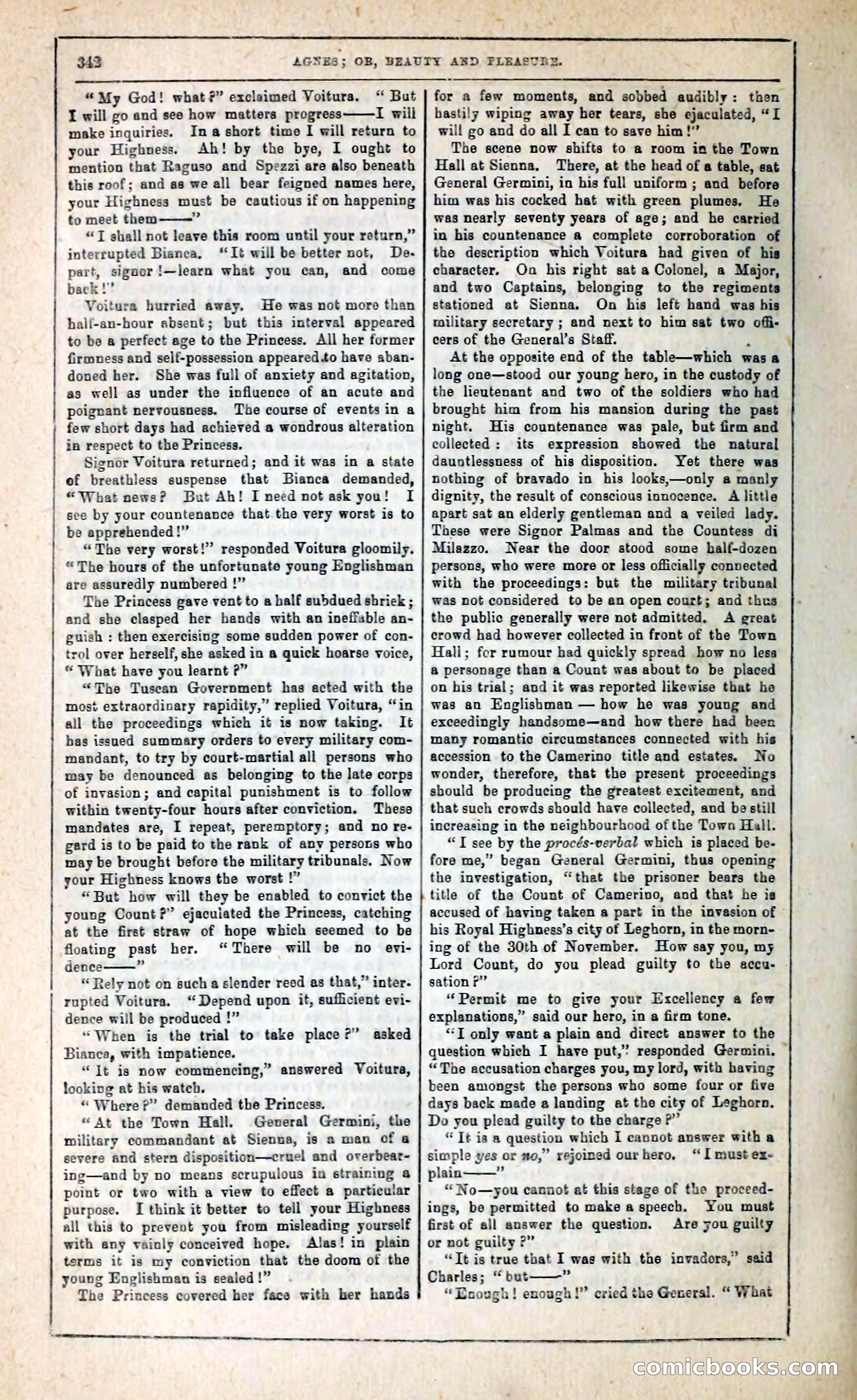
A restored page from Penny Dreadfuls, 1857. Page through the whole issue in the reader above.
📄 Transcribed text from this page (OCR, searchable)
Machine-transcribed from the original scan — historical spelling and the odd misread are preserved.
rr LT ieee eee 342 “My God! what?” exclaimed Voitura. “ But I will go and see how matters progress I will make inquiries. Ina short time I will return to your Highness. Ah! by the bye, I ought to mention that Raguso and Spezzi are also beneath this roof; and as we all bear feigned names here, your Highness must be cautious if on happening to meet them e “T shall not leave this room until your return,” interrupted Bianca, “It will be better not, De- part, sigaor!—learn what you can, and come back!” Voitura hurried away, He was not more than half-an-hour absent; but this interval appeared to be a perfect age to the Princess. All her former firmness and self-possession appeared.to have aban- doned her. She was full of anxiety and agitation, as well as under the influence of an acute and poignant nervousness. The course of eventsin a few short days had achieved a wondrous alteration in respect to the Princess. Signor Voitura returned; and it was in a state of breathless suspense that Bianca demanded, “What news? But Ah! I need notask you! I see by your countenance that.the very worst is to be apprehended!” “The very worst!” responded Voitura gloomily. “The hours of the unfortunate young Englishman are assuredly numbered !” The Princess gave vent to a half subdued shriek ; and she clasped her hands with an ineffable an- guish : then exercising some sudden power of con- trol over herself, she asked in a quick hoarse voice, “ What have you learnt ?” “The Tuscan Government has acted with the most extraordinary rapidity,” replied Voitura, “in all the proceedings which it is now taking. It bas issued summary orders to every military com- mandant, to try by court-martial all persons who may be denounced as belonging to the late corps of invasion; and capital punishment is to follow within twenty-four hours after conviction. These mandates are, I repeat, peremptory; and no re- gard is to be paid to the rank of any persons who may be brought before the military tribunals. Now your Highness knows the worst !” “But how will they be enabled to convict the young Count?” ejacuiated the Princess, catching at the first straw of hope which seemed to be floating past her. “There will be no evi- dence ” “Rely not on such a slender reed as that,” inter- rupted Voitura. “Depend upon it, sufficient evi- dence will be produced !” “When is the trial to take place?” asked Bianca, with impatience. “It is now commencing,” answered Voitura, looking at his watch. “ Where ?” demanded the Princess. * At the Town Hall. General Germini, the military commandant at Sienna, is a man of a severe and stern disposition—cruel and overbear- ing—and by no means scrupulous in straining a point or two with a view to effect a particular purpose. [I think it better to tell your Highness all this to prevent you from misleading yourself with any vainly conceived hope. Alas! in plain terms it is my conviction that the doom of the young Englishman is sealed !” The Princess covered her face with her hands 1? . _ ——— — AGNES; OB, BEAUTY AND PLEASURE. for a few moments, and sobbed audibly: then hastily wiping away her tears, she ejaculated, “I will go and do all I can to save him!” The scene now shifts to a room in the Town Hall at Sienna. There, at the head of a table, sat General Germini, in his full uniform ; and before him was his cocked hat with green plumes. He was nearly seventy years of age; and he carried in his countenance a complete corroboration of the description which Voitura had given of his character. Oa his right sat a Colonel, a Major, and two Captains, belonging to the regiments stationed at Sienna. On his left hand was his toilitary secretary ; and next to him sat two offi- cers of the General’s Staff. y At the opposite end of the table—which was a long one—stood our young hero, in the custody of the lieutenant and two of the soldiers who had brought him from his mansion during the past night. His countenance was pale, but firm and collected: its expression showed the natural dauntlessness of his disposition. Yet there was nothing of bravado in his looks,—only a manly dignity, the result of conscious innocence. A little apart sat an elderly gentleman and a veiled lady. These were Signor Palmas and the Countess di Milazzo. Near the door stood some half-dozen persons, who were more or less officially connected with the proceedings: but the military tribunal was not considered to be an open court; and thus the public generally were not admitted. A great crowd had however collected in front of the Town Hali; for rumour had quickly spread how no less @ personage than a Count was about to be placed on his trial; and it was reported likewise that he was an Englishman — how he was young and exceedingly handsome—and how there had been many romantic circumstances connected with his accession to the Camerino title and estates. No wonder, therefore, that the present proceedings should be producing the greatest excitement, and that such crowds should have collected, and ba still increasing in the neighbourhood of the Town Hall. “T see by the procés-verbal which is placed be- fore me,” began General Germini, thus opening the investigation, “thet the prisoner bears the title of the Count of Camerino, and that he ie accused of having taken a part in the invasion of © his Royal Highness’s city of Leghorn, in the morn- ing of the 30th of November. How say you, my Lord Count, do you plead guilty to the accu- sation P”’ “Permit me to give your Excellency a few explanations,” said our hero, in a firm tone. “T only want a plain and direct answer to the question which I have put,”? responded Germini. “The accusation charges you, my lord, with having been amongst the persons who some four or five days back made a landing at the city of Leghorn. Do you plead guilty to the charge ?” “Tt is a question which I cannot answer with a simple yes or no,” rejoined ourhero, “I must ex- plain om “ No—you cannot at this stage of the proceed- ings, be permitted to make a speech. You must first of all answer the question. Are you guilty or not guilty ?” “Tt is true that I was with the invadors,” said Charles; “ but x : “Enough! enough!” cried the General. “ What choo