
Penny Dreadfuls, 1857 · page 28 of 394
Agnes, or, Beauty and Pleasure — page 28: what you’re looking at
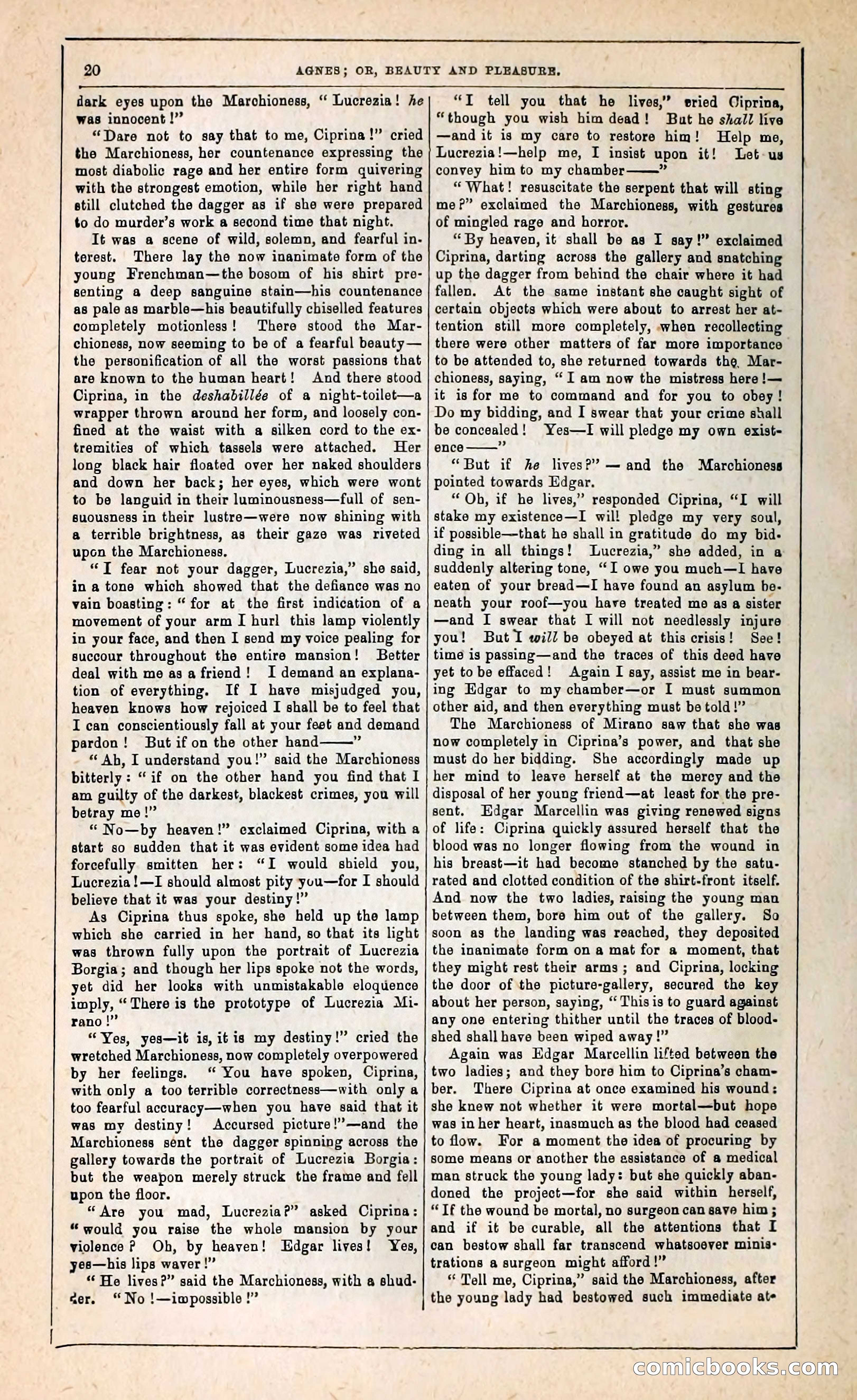
A restored page from Penny Dreadfuls, 1857. Page through the whole issue in the reader above.
📄 Transcribed text from this page (OCR, searchable)
Machine-transcribed from the original scan — historical spelling and the odd misread are preserved.
Renn nen nN NN Tee SSS 20 dark eyes upon the Marchioness, “ Lucrezia! he was innocent !” “Dare not to say that to me, Ciprina!” cried the Marchioness, her countenance expressing the most diabolic rage and her entire form quivering with the strongest emotion, while her right hand still clutched the dagger as if she were prepared to do murder’s work a second time that night. It was a scene of wild, solemn, and fearful in- terest. There lay the now inanimate form of the young Frenchman—the bosom of his shirt pre- senting a deep sanguine stain—his countenance as pale as marble—his beautifully chiselled features completely motionless! There stood the Mar- chioness, now seeming to be of a fearful beauty — the personification of all the worst passions that are known to the human heart! And there stood Ciprina, in the deshabillée of a night-toilet—a wrapper thrown around her form, and loosely con- fined at the waist with a silken cord to the ex- tremities of which tassels were attached. Her long black hair floated over her naked shoulders and down her back; her eyes, which were wont to be languid in their luminousness—full of sen- guousness in their lustre—were now shining with a terrible brightness, as their gaze was riveted upon the Marchioness. “T fear not your dagger, Lucrezia,” she said, in a tone which showed that the defiance was no vain boasting: “ for at the first indication of a movement of your arm I hurl this lamp violently in your face, and then I send my voice pealing for succour throughout the entire mansion! Better deal with me as afriend! I demand an explana- tion of everything. If I have misjudged you, heaven knows how rejoiced I shall be to feel that I can conscientiously fall at your feet and demand pardon! But if on the other hand ws “Ab, I understand you!” said the Marchioness bitterly : “if on the other hand you find that I am guilty of the darkest, blackest crimes, you will betray me!” “ No—by heaven!” exclaimed Ciprina, with a start so sudden that it was evident some idea had forcefully smitten her: “I would shield you, Lucrezia!—I should almost pity you—for I should believe that it was your destiny!” As Ciprina thus spoke, she held up the lamp which she carried in her hand, so that its light was thrown fully upon the portrait of Lucrezia Borgia; and though her lips spoke not the words, yet did her looks with unmistakable eloquence imply, “There is the prototype of Lucrezia Mi- rano !” “Yes, yes—it is, itis my destiny!” cried the wretched Marchioness, now completely overpowered by her feelings. ‘“ You have spoken, Ciprina, with only a too terrible correctness—with only a too fearful accuracy—when you have said that it was my destiny! Accursed picture!”—and the Marchioness sent the dagger spinning across the gallery towards the portrait of Lucrezia Borgia: but the weapon merely struck the frame and fell upon the floor. “Are you mad, Lucrezia?” asked Ciprina: “would you raise the whole mansion by your violence P Oh, by heaven! Edgar lives! Yes, yes—his lips waver !” ‘““ He lives?” said the Marchioness, with a shud- ger. “No !—impossible !” AGNES; OR, BEAUTY AND PLEASURE. “T tell you that he lives,” eried Giprina, “though you wish him dead! But he shall live —and it is my caro to restore him! Help me, Lucrezia!—help me, I insist upon it! Let-us convey him to my chamber 3 “What! resuscitate the serpent that will sting me?” exclaimed the Marchioness, with gestures of mingled rage and horror. “By heaven, it shall be as I say!” exclaimed Ciprina, darting across the gallery and snatching up the dagger from behind the chair where it had fallen. At the same instant she caught sight of certain objects which were about to arrest her at- tention still more completely, when recollecting there were other matters of far more importance to be attended to, she returned towards the, Mar- chioness, saying, “ I am now the mistress here !— it is for me to command and for you to obey! Do my bidding, and I swear that your crime shall be concealed! Yes—lI will pledge my own exist- ence 4 “But if he lives?’ — and the pointed towards Edgar. “Oh, if he lives,” responded Ciprina, “I will stake my existence—I wil! pledge my very soul, if possible—that he shall in gratitude do my bid- ding in all things! Lucrezia,” she added, in a suddenly altering tone, ‘I owe you much—lI have eaten of your bread—lI have found an asylum be- neath your roof—you have treated me as a sister —and I swear that I will not needlessly injure you! But I «will be obeyed at this crisis! See! time is passing—and the traces of this deed have yet to be effaced! Again I say, assist me in bear- ing Edgar to my chamber—or I must summon other aid, and then everything must be told!” The Marchioness of Mirano saw that she was now completely in Ciprina’s power, and that she must do her bidding. She accordingly made up her mind to leave herself at the mercy and the disposal of her young friend—at least for the pre- sent. Edgar Marcellin was giving renewed signs of life: Ciprina quickly assured herself that the blood was no longer flowing from the wound in his breast—it had become stanched by the satu- rated and clotted condition of the shirt-front itself. And now the two ladies, raising the young man between them, bore him out of the gallery. So soon as the landing was reached, they deposited the inanimate form on a mat for a moment, that they might rest their arms; and Ciprina, locking the door of the picture-gallery, secured the key about her person, saying, “ Thisis to guard against any one entering thither until the traces of blood- shed shall have been wiped away!” Again was Edgar Marcellin lifted between the two ladies; and they bore him to Ciprina’s cham- ber. There Ciprina at once examined his wound: she knew not whether it were mortal—but hope was inher heart, inasmuch as the blood had ceased to flow. For a moment the idea of procuring by some means or another the assistance of a medical man struck the young lady: but she quickly aban- doned the project—for she said within herself, “Tf the wound be mortal, no surgeon can gave him ; and if it be curable, all the attentions that I can bestow shall far transcend whatsoever minis- trations a surgeon might afford!” * Tell me, Ciprina,” said the Marchioness, after the young lady had bestowed such immediate ate Marchioness echook (€@) 5