
Penny Dreadfuls, 1857 · page 213 of 394
Agnes, or, Beauty and Pleasure — page 213: what you’re looking at
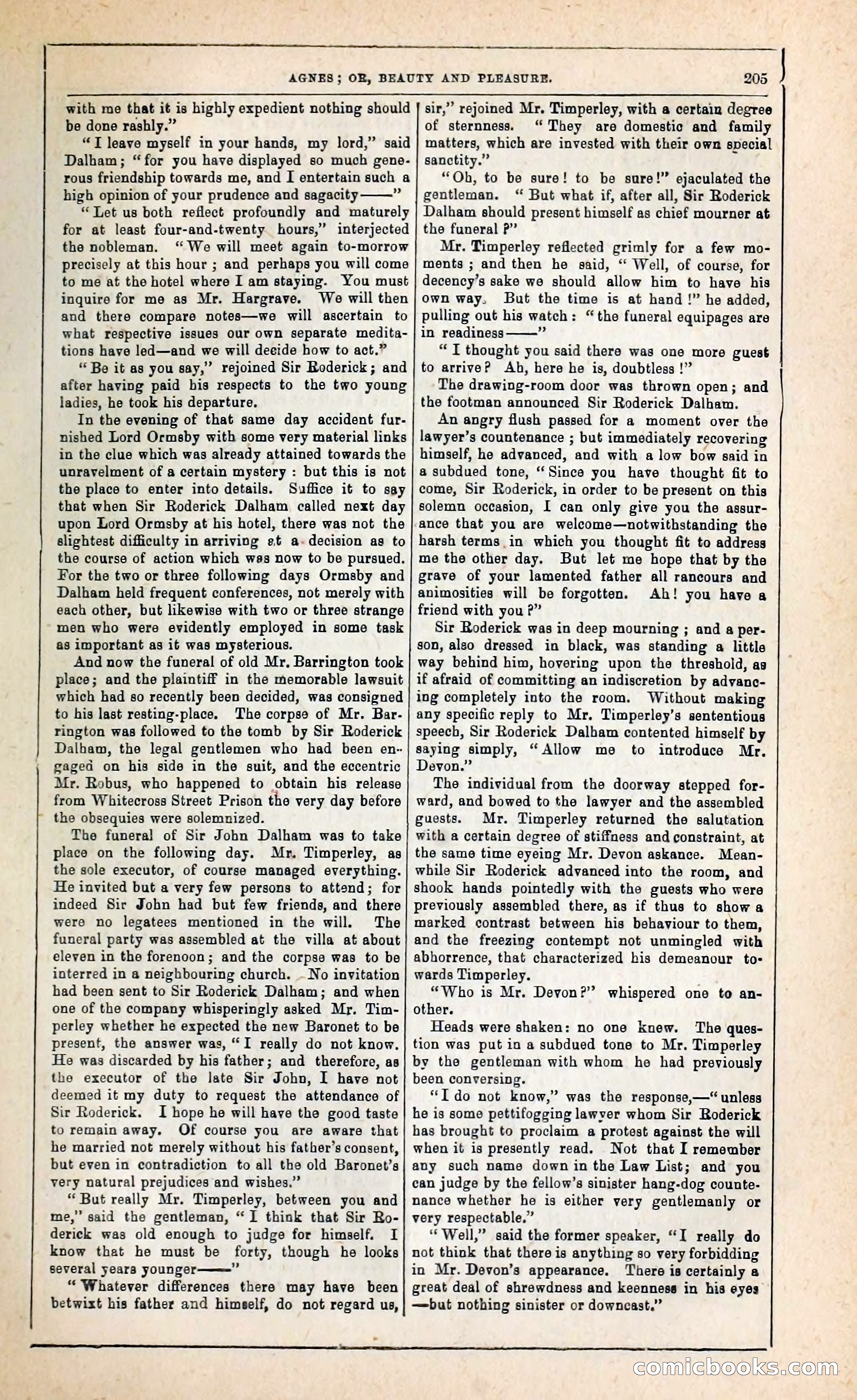
A restored page from Penny Dreadfuls, 1857. Page through the whole issue in the reader above.
📄 Transcribed text from this page (OCR, searchable)
Machine-transcribed from the original scan — historical spelling and the odd misread are preserved.
i AGNES; OB, BEAUTY AND PLEASURE, 205 with me that it is highly expedient nothing should be done rashly.” “T leave myself in your hands, my lord,” said Dalham; “for you have displayed so much gene- rous friendship towards me, and I entertain such a high opinion of your prudence and sagacity ee “Let us both reflect profoundly and maturely for at least four-and-twenty hours,” interjected the nobleman. ‘“ We will meet again to-morrow precisely at this hour ; and perhaps you will come to me at the hotel where I am staying. You must inquire for me as Mr. Hargrave. We will then and there compare notes—we will ascertain to what respective issues our own separate medita- tions have led—and we will deeide how to act.” Be it as you say,’ rejoined Sir Roderick; and after having paid his respects to the two young ladies, he took his departure. In the evening of that same day accident fur- nished Lord Ormsby with some very material links in the clue which was already attained towards the unravelment of a certain mystery : but this is not the place to enter into details. Suffice it to say that when Sir Roderick Dalham called next day upon Lord Ormsby at his hotel, there was not the slightest difficulty in arriving et a-decision as to the course of action which was now to be pursued. For the two or three following days Ormsby and Dalham held frequent conferences, not merely with each other, but likewise with two or three strange men who were evidently employed in some task as important as it was mysterious. And now the funeral of old Mr, Barrington took place; and the plaintiff in the memorable lawsuit which had so recently been decided, was consigned to his last resting-place. The corpse of Mr. Bar- rington was followed to the tomb by Sir Roderick Dalham, the legal gentlemen who had been en-. gaged on his side in the suit, and the eccentric Mr. Robus, who happened to obtain his release from Whitecross Street Prison the very day before the obsequies were solemnized. The funeral of Sir John Dalham was to take place on the following day. Mr. Timperley, as the sole executor, of course managed everything. He invited but a very few persons to attend; for indeed Sir John had but few friends, and there were no legatees mentioned in the will. The funeral party was assembled at the villa at about eleyen in the forenoon; and the corpse was to be interred in a neighbouring church. - No invitation had been sent to Sir Roderick Dalham; and when one of the company whisperingly asked Mr. Tim- perley whether he expected the new Baronet to be present, the answer was, “I really do not know. He was discarded by his father; and therefore, as the executor of the late Sir John, I have not deemed it my duty to request the attendance of Sir Roderick. I hope he will have the good taste to remain away. Of course you are aware that he married not merely without his father’s consent, but even in contradiction to all the old Baronet’s very natural prejudices and wishes.” “ But really Mr. Timperley, between you and me,’’ said the gentleman, “I think that Sir Ro- derick was old enough to judge for himself. I know that he must be forty, though he looks several years younger “ Whatever differences there may have been betwixt his father and himeelf, do not regard us, sir,” rejoined Mr. Timperley, with a certain degree of sternness. “They are domestic and family matters, which are invested with their own special sanctity.” “Oh, to be sure! to be sure!” ejaculated the gentleman. ‘“ But what if, after all, Sir Roderick Dalham should present himself as chief mourner at the funeral P” Mr. Timperley reflected grimly for a few mo- ments ; and then he said, “ Well, of course, for decency’s sake we should allow him to have his own way. But the time is at hand !” he added, pulling out his watch: “the funeral equipages are in readiness " “I thought you said there was one more guest to arrive? Ab, here he is, doubtless !” The drawing-room door was thrown open; and the footman announced Sir Roderick Dalham. An angry flush passed for a moment over the lawyer’s countenance ; but immediately recovering himself, he advanced, and with a low bow said in a subdued tone, “Since you have thought fit to come, Sir Roderick, in order to be present on this solemn occasion, I can only give you the assur- ance that you are welcome—notwithstanding the harsh terms in which you thought fit to address me the other day. But let me hope that by the grave of your lamented father all rancours and animosities will be forgotten. Ah! you have a friend with you P” Sir Roderick was in deep mourning ; and a per- son, also dressed in black, was standing a little way behind him, hovering upon the threshold, as if afraid of committing an indiscretion by advanc- ing completely into the room. Without making any specific reply to Mr. Timperley’s sententious speech, Sir Roderick Dalham contented himself by saying simply, “Allow me to introduce Mr. Devon.” The individual from the doorway stepped for- ward, and bowed to the lawyer and the assembled guests. Mr. Timperley returned the salutation with a certain degree of stiffness and constraint, at the same time eyeing Mr. Devon askance. Mean- while Sir Roderick advanced into the room, and shook hands pointedly with the guests who were previously assembled there, as if thus to showa marked contrast between his behaviour to them, and the freezing contempt not unmingled with abhorrence, that characterized his demeanour to- wards Timperley. “Who is Mr. Devon?” whispered one to an- other. Heads were shaken: no one knew. The ques- tion was put in a subdued tone to Mr. Timperley by the gentleman with whom he had previously been conversing. “T do not know,” was the response,—“ unless he is some pettifogging lawver whom Sir Roderick has brought to proclaim a protest against the will when it is presently read. Not that I remember any such name down in the Law List; and you can judge by the fellow’s sinister hang-dog counte- nance whether he is either very gentlemanly or very respectable.” “Well,” said the former speaker, “I really do not think that there is anything so very forbidding in Mr. Devon’s appearance. There is certainly a great deal of shrewdness and keennese in his eyes —but nothing sinister or downcast.” co lNOOLK (©) 5}