
Penny Dreadfuls, 1857 · page 155 of 394
Agnes, or, Beauty and Pleasure — page 155: what you’re looking at
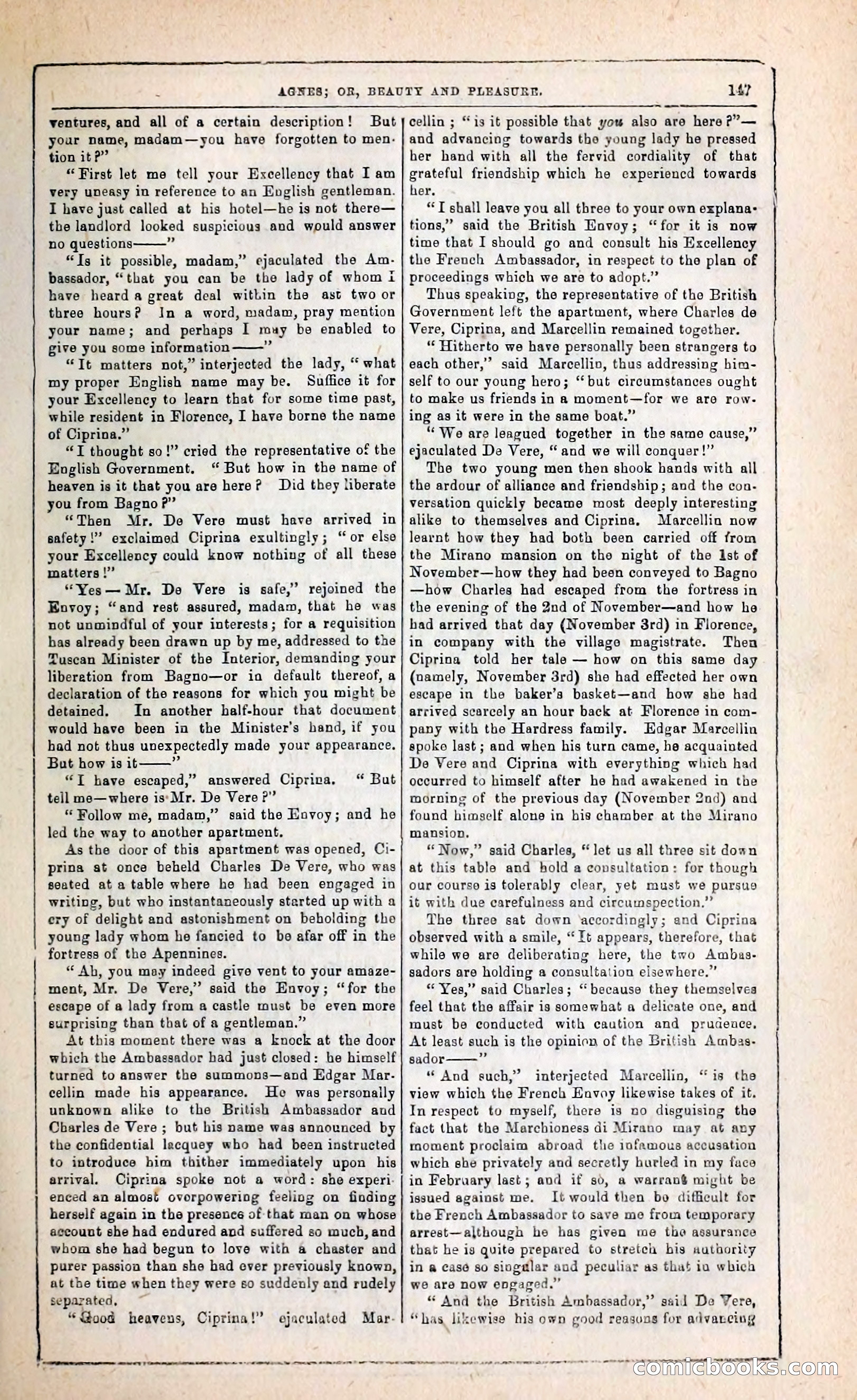
A restored page from Penny Dreadfuls, 1857. Page through the whole issue in the reader above.
📄 Transcribed text from this page (OCR, searchable)
Machine-transcribed from the original scan — historical spelling and the odd misread are preserved.
: ~ ventures, and all of a certain description! But your name, madam—you have forgotten to men. tion it?” “First let me tell your Excellency that I am very uneasy in reference to an English gentleman. I have just called at his hotel—he is not there— the landlord looked suspicious and would answer no questions ” “Ts it possible, madam,” ejaculated the Am- bassador, “that you can be the lady of whom i have heard a great deal within the ast two or three hours? In a word, madam, pray mention your name; and perhaps I muy be enabled to give you some information a “Tt matters not,” interjected the lady, “ what my proper English name may be. Suffice it for your Excellency to learn that for some time past, while resident in Florence, I have borne the name of Ciprina.”’ “T thought so!” cried the representative of the English Government. “ But how in the name of heaven is it that you are here? Did they liberate you from Bagno P” “Then Mr. De Vere must have arrived in safety!” exclaimed Ciprina exultingly; “or else your Excellency could know nothing of all these matters |” “VYes— Mr. De Vere is safe,’ rejoined the Envoy; “and rest assured, madam, that he was not unmindful of your interests; for a requisition has already been drawn up by me, addressed to the Tuscan Minister of the Interior, demanding your liberation from Bagno—or ino default thereof, a declaration of the reasons for which you might be detained. In another half-hour that document would have been in the Minister’s hand, if you had not thus unexpectedly made your appearance. But how is it : “T have escaped,” answered Cipriva, tell me—where is'Mr. De Vere ?” * Follow me, madam,” said the Envoy; and he led the way to another apartment. As the door of this apartment was opened, Ci- prina at once beheld Charles De Vere, who was seated at a table where he had been engaged in writing, but who instantaneously started up with a ery of delight and astonishment on beholding tho young lady whom he fancied to be afar off in the fortress of the Apennines. * Ah, you may indeed give vent to your amaze- ment, Mr. De Vere,” said the Envoy; “for the escape of a lady from a castle must be even more surprising than that of a gentleman.” At this moment there was a knock at the door which the Ambassador had just closed: be himself turned to answer the summons—and Edgar Mar- cellin made his appearance. He was personaily unknown alike to the British Ambassador and Charles de Vere ; but his name was announced by the confidential lacquey who had been instructed to introduce him thither immediately upon his arrival. Ciprina spoke not a word: she experi. enced an almost ovorpoweriog feeling on finding herself again in the presence of that man on whose account she had endured and suffered so much, and whom she had begun to love with a chaster and purer passion than she had ever previously known, at the time when they were so suddenly and rudely separated, “Good heavens, Ciprina!”’ ejaculated Mar- “ But —~ertr AGNES; OR, BEAUTY AND PLEASURE, TT Oe OT Ee re OO 14? cellin ; “is it possible that yow also are here ?”?— and advancing towards the young lady he pressed her hand with all the fervid cordiality of that grateful friendship which he experiencd towards her. *‘T shall leave you all three to your own explana: tions,” said the British Envoy; “for it is now time that I should go and consult his Excellency the French Ambassador, in respect to the plan of proceedings which we are to adopt.” Thus speaking, the representative of the British Government left the apartment, where Charles de Vere, Ciprina, and Marcellin remained together. ‘Hitherto we have personally been strangers to each other,” said Marcellin, thus addressing him- self to our young hero; ‘‘ but circumstances ought to make us friends in a moment—for we are row- ing as it were in the same boat.” “We are leagued together in the same cause,” ejaculated De Vere, “and we will conquer!” The two young men then shook hands with all the ardour of alliance and friendship; and the con- versation quickly became most deeply interesting alike to themselves and Ciprina, Marcellin now learnt how they had both been carried off from the Mirano mansion on the night of the Ist of November—how they had been conveyed to Bagno —how Charles had escaped from the fortress in the evening of the 2nd of November—and how he had arrived that day (November 3rd) in Florence, in company with the village magistrate. Then Ciprina told her tale — how on this same day (namely, November 3rd) she had effected her own escape in the baker’s basket—and how she had arrived scarcely an hour back at Florence in com- pany with the Hardress family. Edgar Marcellin spoke last; and when his turn came, he acquainted De Vere and Ciprina with everything which had occurred to himself after he had awakened in the morning of the previous day (November 2nd) and found himself alone in his chamber at the Mirano mansion. “Now,” said Charles, “let us all three sit down at this table and hold a consultation: for though our courso is tolerably clear, yet must we pursua it with due carefulness and circumspection,”’ The three sat down ‘accordingly; and Ciprina observed with a smile, “It appears, therefore, that while we are deliberating here, the two Ambas- sadors are holding a consultation elsewhere.” “Yes,” said Charles; “because they themselves feel that the affair is somewhat a delicate one, and must be conducted with caution and prudence, At least such is the opinion of the British Ambas- sador vs “And such,” interjected Marcellin, “is the view which the French Envoy likewise takes of it. In respect to myself, there is no disguising the fact that the Marchioness di Mirano may at any moment proclaim abroad tlie infamous accusation which she privately and secretly hurled in my face in February last; and if so, a warran$ might be issued against me. It would then bo difficult for the French Ambassador to save me from temporary arrest—although he has given me the assurance that he is quite prepared to stretch his authority in @ casé so singtlar and peculiar as that io which we are now engaged.” “ And the British Ambassador,” sail De Vere, “has likewise his own good reasuns for advancing a OMI NOSES co 5}