
Penny Dreadfuls, 1857 · page 133 of 394
Agnes, or, Beauty and Pleasure — page 133: what you’re looking at
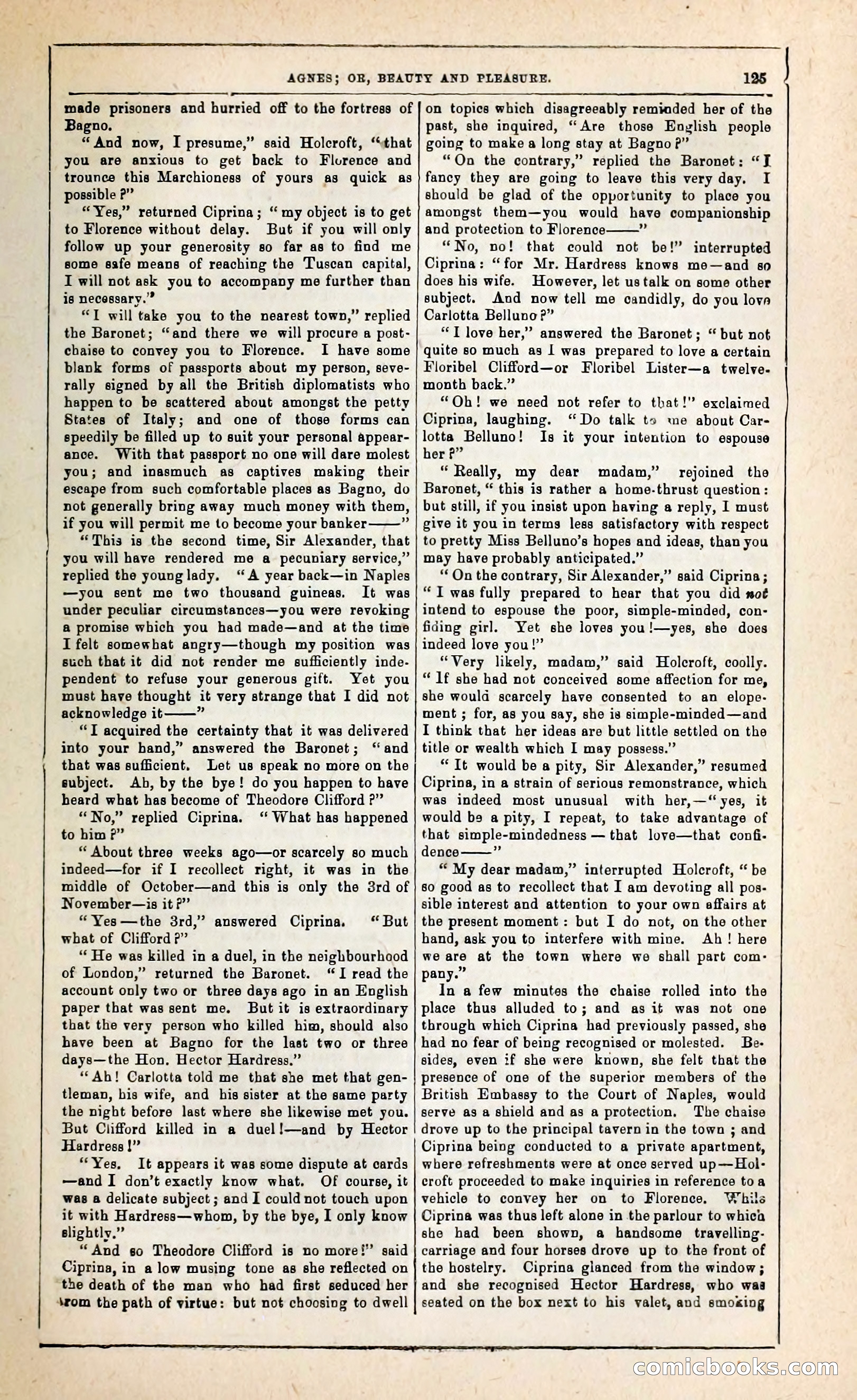
A restored page from Penny Dreadfuls, 1857. Page through the whole issue in the reader above.
📄 Transcribed text from this page (OCR, searchable)
Machine-transcribed from the original scan — historical spelling and the odd misread are preserved.
AGNES; OR, BEAUTY AND PLEASURE. made prisoners and hurried off to the fortress of Bagno. “And now, I presume,” said Holcroft, “that you are anxious to get back to Florence and trounce this Marchioness of yours as quick as possible P” “Yes,” returned Ciprina; ‘“ my object is to get to Florence without delay. But if you will only follow up your generosity so far as to find me some safe means of reaching the Tuscan capital, I will not ask you to accompany me further than is necessary.” “TI will take you to the nearest town,” replied the Baronet; “and there we will procure a post- chaise to convey you to Florence. I have some blank forms of passports about my person, seve- rally signed by all the British diplomatists who happen to be scattered about amongst the petty States of Italy; and one of those forms can speedily be filled up to suit your personal appear- ance. With that passport no one will dare molest you; and inasmuch as captives making their escape from such comfortable places as Bagno, do not generally bring away much money with them, if you will permit me to become your banker " “This is the second time, Sir Alexander, that you will have rendered me a pecuniary service,” replied the younglady. ‘A year back—in Naples —you sent me two thousand guineas. It was under peculiar circumstances—you were revoking @ promise which you had made—and at the time I felt somewhat angry—though my position was such that it did not render me sufficiently inde- pendent to refuse your generous gift. Yet you must have thought it very strange that I did not acknowledge it 7 “T acquired the certainty that it was delivered into your hand,” answered the Baronet; “ and that was sufficient. Let us speak no more on the subject. Ab, by the bye! do you happen to have heard what has become of Theodore Clifford ?” “No,” replied Ciprina. ‘“ What has happened to him P” “ About three weeks ago—or scarcely so much indeed—for if I recollect right, it was in the middle of October—and this is only the 8rd of November—is it ?” “Yes—the 3rd,” answered Ciprina. what of Clifford P” “He was killed in a duel, in the neighbourhood of London,” returned the Baronet. “I read the account only two or three days ago in an English paper that was sent me. But it is extraordinary that the very person who killed him, should also have been at Bagno for the last two or three days—the Hon. Hector Hardress,” ““Ah! Carlotta told me that she met that gen- tleman, his wife, and his sister at the same party the night before last where she likewise met you. But Clifford killed in a duel!—and by Hector Hardress |” “Yes, It appears it was some dispute at cards —and I don’t exactly know what. Of course, it was 4 delicate subject ; and I could not touch upon it with Hardress—whom, by the bye, I only know elightly.” “And so Theodore Clifford is no more?” said Ciprina, in a low musing tone as she reflected on the death of the man who had first seduced her ‘rom the path of virtue: but not choosing to dwell * But on topics which disagreeably remimded her of the past, she inquired, “Are those English people going to make a long stay at Bagno P” “On the contrary,” replied the Baronet: “J fancy they are going to leave this very day. I should be glad of the opportunity to place you amongst them—you would have companionship and protection to Florence “No, no! that could not be!” interrupted Ciprina: “for Mr. Hardress knows me—and so does his wife. However, let us talk on some other subject. And now tell me candidly, do you lova Carlotta Belluno ?” ‘I love her,” answered the Baronet; “ but not quite so much as | was prepared to love a certain Floribel Clifford—or Floribel Lister—a twelve- month back.” “Oh! we need not refer to that!” exclaimed Ciprina, laughing. “Do talk to me about Car- lotta Belluno! Is it your intention to espouse her ?” “ Really, my dear madam,” rejoined the Baronet, “ this is rather a home-thrust question: but still, if you insist upon having a reply, I must give it you in terms less satisfactory with respect to pretty Miss Belluno’s hopes and ideas, than you may have probably anticipated.” “On the contrary, Sir Alexander,” said Ciprina; “I was fully prepared to hear that you did sot intend to espouse the poor, simple-minded, con- fiding girl. Yet she loves you!—yes, she does indeed love you!” “Very likely, madam,” said Holeroft, coolly. “ If she had not conceived some affection for me, she would scarcely have consented to an elope- ment ; for, as you say, she is simple-minded—and I think that her ideas are but little settled on the title or wealth which I may possess.” “It would be a pity, Sir Alexander,” resumed Ciprina, in a strain of serious remonstrance, which was indeed most unusual with her,—‘“ yes, it would bs a pity, I repeat, to take advantage of that simple-mindedness — that love—that confi- dence as “* My dear madam,” interrupted Holcroft, “ be so good as to recollect that I am devoting all pos- sible interest and attention to your own affairs at the present moment: but I do not, on the other hand, ask you to interfere with mine. Ah! here we are at the town where we shall part com- pany.” In a few minutes the chaise rolled into the place thus alluded to; and as it was not one through which Ciprina had previously passed, she had no fear of being recognised or molested. Be- sides, even if she were known, she felt that the presence of one of the superior members of the British Embassy to the Court of Naples, would serve as a shield and as a protection. The chaise drove up to the principal tavern in the town ; and Ciprina being conducted to a private apartment, where refreshments were at once served up—Hol- croft proceeded to make inquiries in reference toa vehicle to convey her on to Florence. While Ciprina was thus left alone in the parlour to whica she had been shown, a handsome travelling- carriage and four horses drove up to the front of the hostelry. Ciprina glanced from the window; and she recognised Hector Hardress, who waa seated on the box next to his valet, and smo«ing > COMMicloookKxs nn} os | co 5}