
Penny Dreadfuls, 1857 · page 122 of 394
Agnes, or, Beauty and Pleasure — page 122: what you’re looking at
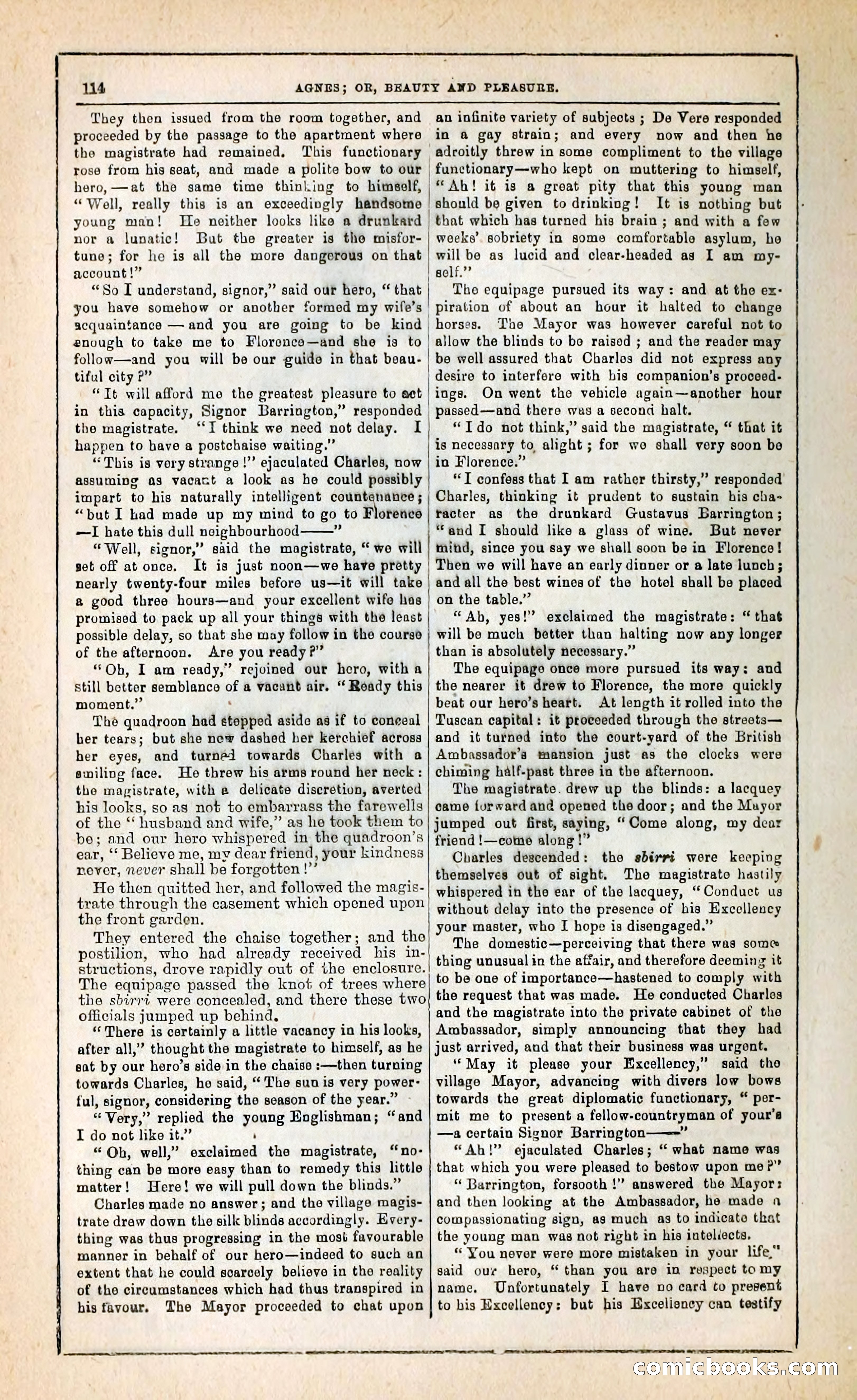
A restored page from Penny Dreadfuls, 1857. Page through the whole issue in the reader above.
📄 Transcribed text from this page (OCR, searchable)
Machine-transcribed from the original scan — historical spelling and the odd misread are preserved.
114 AGNES; OR, BEAUTY AND PLEASURE. They then issued from the room together, and proceeded by the passage to the apartment where the magistrate had remained. This functionary rose from his seat, and made a polite bow to our hero, —at the same time thinking to himself, young man! He neither looks like a drunkard nor a lunatic! But the greater is the misfor- tune; for he is all the more dangerous on that account!” “So I understand, signor,” said our hero, “ that an infinite variety of subjects ; De Vere responded in @ gay strain; and every now and then he adroitly threw in some compliment to the village 'functionary—who kept on muttering to himself, you have somehow or another formed my wife’s acquaintance —and you are going to be kind enough to take me to Floronce—and she is to follow—and you will be our guide in that beau- tiful city P” “Tt will afford me the greatest pleasure to act in this capacity, Signor Barrington,” responded the magistrate. ‘‘I think we need not delay. I happen to have a postchaise waiting.” “This is very strange !” ejaculated Charles, now assuming as vacarct a look as he could possibly impart to his naturally intelligent countenance ; “but I had made up my mind to go to Florence —TI hate this dull neighbourhood fe “Well, signor,” said the magistrate, “ we will set off at once. It is just noon—we have pretty nearly twenty-four miles before us—it will take # good three hours—and your excellent wife has promised to pack up all your things with the least possible delay, so that she may follow in the course of the afternoon. Are you ready P” “Oh, I am ready,” rejoined our hero, with a still better semblance of a vacant air. “ Ready this moment.”’ . The quadroon had etepped aside as if to conceal her tears; but she new dashed her kerchief across her eyes, and turned towards Charles with a smiling face. He threw his arms round her neck : the mapistrate, with a delicate discretion, averted his looks, so as not to embarrass the farewells of the “ husband and wife,” as he took them to bo; and our hero whispered in the quadroon’s ear, ‘‘ Believe me, mv dear friend, your kindness never, never shall be forgotten !’’ He then quitted her, and followed the magis- trate through the casement which opened upon the front garden. They entered the chaise together; and tho postilion, who had already received his in- structions, drove rapidly out of the enclosure. The equipage passed the knot of trees where the shim were concealed, and there these two officials jumped up behind. ‘There is certainly a little vacancy in his looks, after all,’ thought the magistrate to himself, as he sat by our hero’s side in the chaise :—then turning towards Charles, he said, “ The sun is very power- ful, signor, considering the season of the year.” “Very,” replied the young Englishman; “and I do not like it.” ‘ “ Oh, well,’ exclaimed the magistrate, “no- thing can be more easy than to remedy this little matter! Here! we will pull down the blinds.” Charles made no answer; and the village magis- trate draw down the silk blinds accordingly. Every- thing was thus progressing in the most favourable manner in behalf of our hero—indeed to such an extent that he could scarcely believe in the reality of the circumstances which had thus transpired in his favour. The Mayor proceeded to chat upon _————— “Ah! it is a great pity that this young man “Well, really this is an exceedingly handsome — should be given to drinking! It is nothing but that which has turned his brain ; and with a few weeks’ sobriety in some comfortable asylum, he will be as lucid and clear-headed as I am my- self.” Tho equipage pursued its way: and at tho ex- piration of about an hour it halted to change horses. Too Mayor was however careful not to allow the blinds to bo raised ; and the reader may be well assured that Charlos did not express any desire to interfere with bis companion’s proceed- ings. On went the vehicle again—another hour passed—and there was a second halt. *Tdo not think,” said the magistrate, “ that it is necessary to alight; for wo shall very soon be in Florence.” “T confess that I am rather thirsty,” responded Charles, thinking it prudent to sustain his cha- racter as the drunkard Gustavus Barrington ; “and I should like a glass of wine. But never mind, since you say we shall soon be in Florence! Then we will have an early dinner or a late lunch; and all the best wines of the hotel shall be placed on the table.” “Ab, yes!” exclaimed the magistrate: “ that will be much better than halting now any longer than is absolutely necessary.” The equipage once more pursued its way: and the nearer it drew to Florence, the more quickly beat our hero’s heart. At length it rolled into the Tuscan capital: it proceeded through the streets— and it turned into the court-yard of the British Ambassador’s mansion just as the clocks were chiming half-past three in the afternoon. The magistrate. drew up the blinds: a lacquey came iurward and opened the door; and the Muyor jumped out first, saying, “ Come along, my dear friend !—come along!” Charles descended: tho sbirré wore keeping themselves out of sight. The magistrate hastily whispered in the ear of the lacquey, “Conduct us without delay into the presence of his Excellency your master, who I hope is disengaged.” The domestic—perceiving that there was some thing unusual in the affair, and therefore deeming it to be one of importance—hastened to comply with the request that was made. He conducted Charles and the magistrate into the private cabinet of the Ambassador, simply announcing that they had just arrived, and that their business was urgent. ‘May it please your Excellency,” said tho villaze Mayor, advancing with divers low bows towards the great diplomatic functionary, “ per- mit me to present a fellow-countryman of your's —a certain Signor Barrington “Ah!” ejaculated Charles; “ what name was that which you were pleased to bestow upon me P” “ Barrington, forsooth !” answered the Mayor: and then looking at the Ambassador, he made a compassionating sign, as much as to indicate that the young man was not right in his inteliects, ‘ You never were more mistaken in your life“ said our hero, “ than you are in respect tomy name. Unfortunately I have no card to present to bis Excellency: but his Excelioncy can testify let elie (Ee) boo nn S (C@) S|