
Penny Dreadfuls, 1857 · page 118 of 394
Agnes, or, Beauty and Pleasure — page 118: what you’re looking at
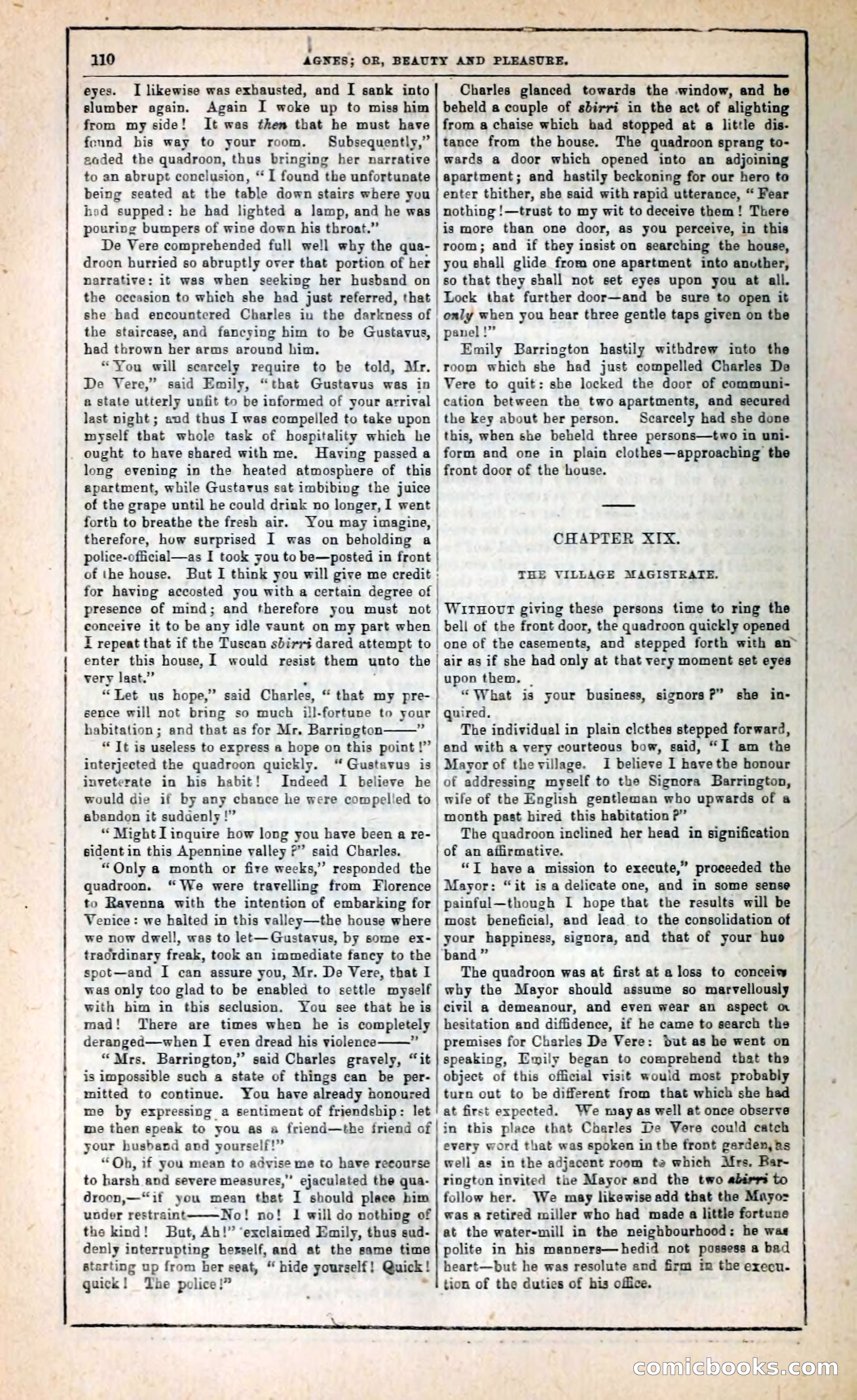
A restored page from Penny Dreadfuls, 1857. Page through the whole issue in the reader above.
📄 Transcribed text from this page (OCR, searchable)
Machine-transcribed from the original scan — historical spelling and the odd misread are preserved.
’ AGNES; OR, BEAUTY AND PLEASURE, 110 I likewise was exhausted, and I sank into slumber again. Again I woke up to miss him from myside! It was them that he must have fennd bis way to your room. Subsequently,” 2aded the quadroon, thus bringing her narrative to an abrupt conclusion, “ I found the unfortunate being seated at the table down stairs where you hod supped: be had lighted a lamp, and he was pouring bumpers of wine down his throat.” De Vere comprehended full well why the qua- droon hurried so abruptly over that portion of her narrative: it was when seeking her husband on the occasion to which she had just referred, that she had encountered Charles in the darkness of | ~ Charles glanced towards the window, and he beheld a couple of sbirri in the act of alighting from a chaise which bad stopped at a little dis- tance from the house. The quadroon sprang to- wards a door which opened into an adjoining apartment; and hastily beckoning for our hero to enter thither, she said with rapid utterance, “ Fear nothing !—trust to my wit to deceive them! There is more than one door, as you perceive, in this room; and if they insist on searching the house, you shall glide from one apartment into anvther, so that they shall not set eyes upon you at all. Lock that further door—and be sure to open it only when you hear three gentle taps given on the the staircase, and fancying him to be Gustavus, | panel!” had thrown her arms around him. “You will scarcely require to be told, Mr. | Emily Barrington hastily withdrew into the room which she had just compelled Charles De De Vere,” said Emily, “that Gustavus was in| Vere to quit: she locked the door of communi- a state utterly unfit to be informed of your arrival | cation between the two apartments, and secured last night; aud thus I was compelled to take upon | the key about her person. Scarcely had she done myself that whole task of hospitality which he | this, when she beheld three persons—two in uni- ought to have shared with me. Having passed a | form and one in plain clothes—approaching the long evening in the heated atmosphere of this apartment, while Gustarus sat imbibing the juice of the grape until he could drink no longer, I went forth to breathe the fresh air. You may imagine, therefore, how surprised I was on beholding a/| police-official—as I took you to be—posted in front | But I think you will give me credit ; for having accosted you with a certain degree of of the house. presence of mind; and therefore you must not oper’ it to be any idle vaunt on my part when | front door of the house. CHAPTER XIX. THE VILLAGE MAGISTRATE. WirTHovT giving these persons time to ring the bell of the front door, the quadroon quickly opened | I repeat that if the Tuscan sbirrs dared attempt to | one of the casements, and stepped forth with an> enter this house, I would resist them unto the | air as if she had only at that very moment set eyes very last.” A “Let us hope,” said Charles, “ that my pre- sence will not bring so much ill-fortune to your habitation; and that as for Mr. Barrington “ It is useless to express a hope on this point!” interjected the quadroon quickly. “ Gustavus is inveterate in his habit! upon them. | “What is your business, signors?” she in- quired. The individuel in plain clcthes stepped forward, and with a very courteous bow, said, “I am the Mayor of thevillage. I believe I have the honour Indeed I believe he| of addressing myself to the Signora Barrington, would die if by any chance he were compelled to| wife of the English gentleman who upwards of a abandon it suddenly !” “Might inquire how long you have been a re- sidentin this Apennine valley ?” said Charles. “Only a month or fire weeks,” responded the quadroon. “ We were travelling from Florence to Ravenna with the intention of embarking for Venice: we halted in this valley—the house where we now dwell, was to let-— Gustavus, by some ex- tradrdinary freak, took an immediate fancy to the spot—and I can assure you, Mr. De Vere, that I was only too glad to be enabled to settle myself with him in this seclusion. You see that he is mad! There are times when he is completely deranged—when I even dread his violence : “Mrs. Barrington,” said Charles gravely, “it is impossible such a state of things can be per- mitted to continue. You have already honoured me by expressing a sentiment of friendship: let | premises for Charles De Vere: | month past hired this habitation ?” The quadroon inclined her head in signification of an affirmative. “JT havea mission to execute,” proceeded the Mayor: “it is a delicate one, and in some sense painful—though I hope that the results will be most beneficial, and lead to the consolidation of your happiness, signora, and that of your hue band” The quadroon was at first at a loss to conceit why the Mayor should assume so marvellously civil a demeanour, and even wear an aspect m hesitation and diffidence, if he came to search the but as he went on speaking, Emily began to comprehend that tho object of this official visit would most probably turn out to be different from that which she had at first expected. We may as well at once observe me then epeak to you as a friend—the friend of|in this place that Charles De Vere could catch your husband and yourself!” “Oh, if you mean to advise me to have recourse to harsh and severe measures,” ejaculated the qua- droon,—“if you mean that I should place bim under restraint No! no! 1 will do nothing of the kind! But, Ah!” ‘exclaimed Emily, thus sud- denly interrupting herself, and at the same time starting up from her seat, “ hide yourself! Quick! guick! The police!” every word that was spoken in the front garden, Rs well as in the adjacent room ta which Mrs. Bar- rington invited the Mayor and the two abirrs to follow her. We may likewise add that the Mayo> was a retired miller who had made a little fortune at the water-mill in the neighbourhood: he was polite in his manners—bhedid not possess a bad heart—but he was resolute and firm in the execu. tion of the duties of his office. COMMIClLOOkKsS 5}