
Penny Dreadfuls, 1857 · page 108 of 394
Agnes, or, Beauty and Pleasure — page 108: what you’re looking at
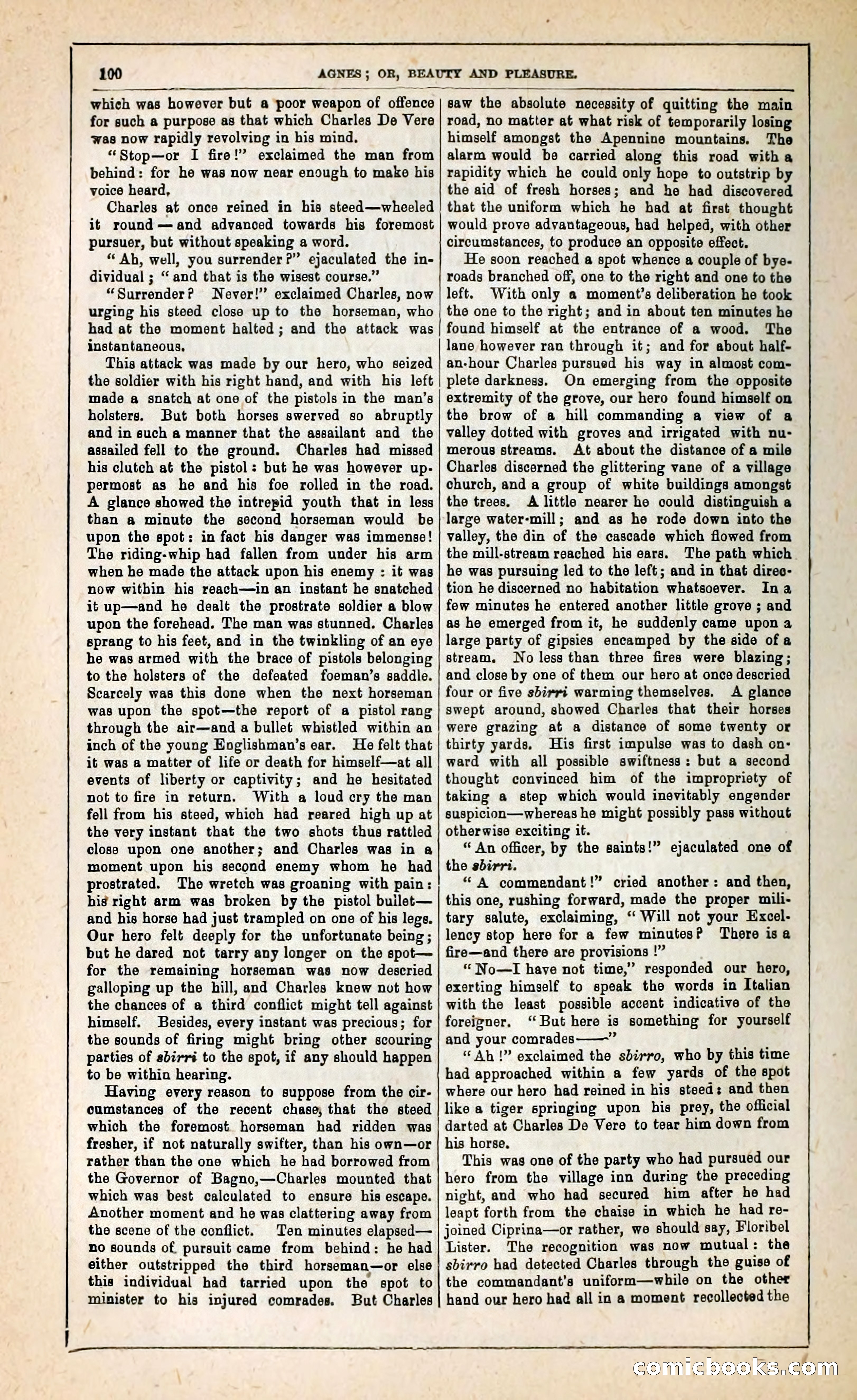
A restored page from Penny Dreadfuls, 1857. Page through the whole issue in the reader above.
📄 Transcribed text from this page (OCR, searchable)
Machine-transcribed from the original scan — historical spelling and the odd misread are preserved.
100 which was however but a poor weapon of offence for such a purpose as that which Charles De Vere was now rapidly revolving in his mind, “Stop—or I fire!” exclaimed the man from behind: for he was now near enough to make his voice heard, Charles at once reined in his steed—wheeled it round=—and advanced towards his foremost pursuer, but without speaking a word. “‘ Ah, well, you surrender?” ejaculated the in- dividual ; “ and that is the wisest course.” “Surrender? Never!” exclaimed Charles, now urging his steed close up to the horseman, who had at the moment halted; and the attack was instantaneous. This attack was made by our hero, who seized the soldier with his right hand, and with his left made a snatch at one of the pistols in the man’s holsters. But both horses swerved so abruptly and in such a manner that the assailant and the assailed fell to the ground. Charles had missed his clutch at the pistol: but he was however up- permost as he and his foe rolled in the road. A glance showed the intrepid youth that in less than a minute the second horseman would be upon the spot: in fact his danger was immense! The riding-whip had fallen from under his arm when he made the attack upon his enemy : it was now within his reach—in an instant he snatched it up—and he dealt the prostrate soldier a blow upon the forehead. The man was stunned. Charles sprang to his feet, and in the twinkling of an eye he was armed with the brace of pistols belonging to the holsters of the defeated foeman’s saddle. Scarcely was this done when the next horseman was upon the spot—the report of a pistol rang through the air—and a bullet whistled within an inch of the young Englishman’s ear. He felt that it was a matter of life or death for himself—at all events of liberty or captivity; and he hesitated not to fire in return. With a loud cry the man fell from his steed, which had reared high up at the very instant that the two shots thus rattled close upon one another; and Charles was in a moment upon his second enemy whom he had prostrated. The wretch was groaning with pain: his right arm was broken by the pistol builet— and his horse had just trampled on one of his legs. Our hero felt deeply for the unfortunate being ; but he dared not tarry any longer on the spot— for the remaining horseman was now descried galloping up the hill, and Charles knew not how the chances of a third conflict might tell against himself. Besides, every instant was precious; for the sounds of firing might bring other scouring parties of sbirré to the spot, if any should happen to be within hearing. Having every reason to suppose from the cir- cumstances of the recent chase, that the steed which the foremost horseman had ridden was fresher, if not naturally swifter, than his own—or rather than the one which he had borrowed from the Governor of Bagno,—Charles mounted that which was best calculated to ensure his escape. Another moment and he was clattering away from the scene of the conflict. Ten minutes elapsed— no sounds of pursuit came from behind: he had either outstripped the third horseman—or else this individual had tarried upon the spot to minister to his injured comrades. But Charles J a eee sss AGNES; OR, BEAUTY AND PLEASURE. saw the absolute necessity of quitting the main road, no matter at what risk of temporarily losing himself amongst the Apennine mountains. The alarm would be carried along this road witha rapidity which he could only hope to outstrip by the aid of fresh horses; and he had discovered that the uniform which he had at first thought would prove advantageous, had helped, with other circumstances, to produce an opposite effect. He soon reached a spot whence a couple of bye- roads branched off, one to the right and one to the left. With only a moment’s deliberation he took the one to the right; and in about ten minutes he found himself at the entrance of a wood. The lane however ran through it; and for about half- an-hour Charles pursued his way in almost com- plete darkness. On emerging from the opposite extremity of the grove, our hero found himself on the brow of a hill commanding a view of a valley dotted with groves and irrigated with nu- merous streams. At about the distance of a mile Charles discerned the glittering vane of a village church, and a group of white buildings amongst the trees. A little nearer he could distinguish a large water-mill; and as he rode down into the valley, the din of the cascade which flowed from the mill-stream reached his ears. The path which he was pursuing led to the left; and in that direo- tion he discerned no habitation whatsoever. Ina few minutes he entered another little grove ; and as he emerged from it, he suddenly came upon a large party of gipsies encamped by the side ofa stream. No less than three fires were blazing; and close by one of them our hero at once descried four or five sbirri warming themselves. A glance swept around, showed Charles that their horses were grazing at a distance of some twenty or thirty yards. His first impulse was to dash on- ward with all possible swiftness: but a second thought convinced him of the impropriety of taking a step which would inevitably engender suspicion—whereas he might possibly pass without otherwise exciting it. “ An officer, by the saints!” ejaculated one of the sbirri. “ A commendant!” cried another: and then, this one, rushing forward, made the proper mili- tary salute, exclaiming, “ Will not your Excel- lency stop here for a few minutes? There isa fire—and there are provisions !” “ No—lI have not time,” responded our hero, exerting himself to speak the words in Italian with the least possible accent indicative of the foreigner. ‘But here is something for yourself and your comrades——” “Ah!” exclaimed the sbirro, who by this time had approached within a few yards of the spot where our hero had reined in his steed: and then like a tiger springing upon his prey, the official darted at Charles De Vere to tear him down from his horse. This was one of the party who had pursued our hero from the village inn during the preceding night, and who had secured him after he had leapt forth from the chaise in which he had re- joined Ciprina—or rather, we should say, Floribel Lister. The recognition was now mutual: the sbirro had detected Charles through the guise of the commandant’s uniform—while on the other hand our hero had all in a moment recollected the chook (eo) S|